STOCKPILE VOLUME AND INVENTORY GUIDE · UPDATED NOVEMBER 2026
Drone stockpile volumes and inventory in France: quarries, landfill cells, recycling yards and year-end accounts
New
For €39 VAT included (€32.50 excl. VAT): a guide to have a volume measured by drone on a French industrial site, and defend it afterwards.
After payment
- The page after payment shows the link to your guide: you start reading right away.
- An email from C-DRONE (no-reply@tech-bharat.com) sends you this link again with your order details (amount, VAT, order number).
- Find my purchases gives you your links back at any time.
- No phone calls: nobody will ring you.
Guarantee: content as described, or your money back
For €110 more, the complete library: all 48 guides, this one included →
VAT included (€32.50 excl. VAT) · secure Stripe payment (card, Apple Pay, Google Pay) · terms of sale (in French)
What you get
- The online guide: 11 chapters, about 34 A4 pages, printable to PDF
- 5 ready-to-copy templates: specification for a volume survey campaign · volume survey report · variance table against the book stock · deliverable check sheet · annual report outline · and 1 more
- For: Quarry, aggregate transfer and crushing plant operators in France · Operators of non-hazardous waste landfills (ISDND) · Finance teams, controllers and auditors of French subsidiaries
- Delivery: instant online access right after payment; Stripe invoice by email
- Preview: the whole first chapter, free, further down this page
11chapters
34printable A4 pages
5templates to copy
18checklist items
Checked at the source
Reviewed by industry professionals. Every rule links to its text.
322links to official texts across our guides
76automated checks before every release
November 2026latest revision of this guide
- Primary sources: Légifrance, EUR-Lex.
- Every figure linked to its source, dated in the last chapter.
- Dated updates: you always read the latest version.
Who it is for
- Quarry, aggregate transfer and crushing plant operators in France who must keep their annual plan and product stocks up to date
- Operators of non-hazardous waste landfills (ISDND) who assess the remaining capacity of their cells every year
- Managers of recycling, sorting and waste transfer yards (metals, wood, plastics, non-hazardous waste) who must prove their storage areas, volumes and heights
- Finance teams, controllers and auditors of French subsidiaries who must support a bulk stock figure at year end
- Survey firms and drone operators, French or foreign, who deliver these volumes on French sites and want a report that holds
In pictures
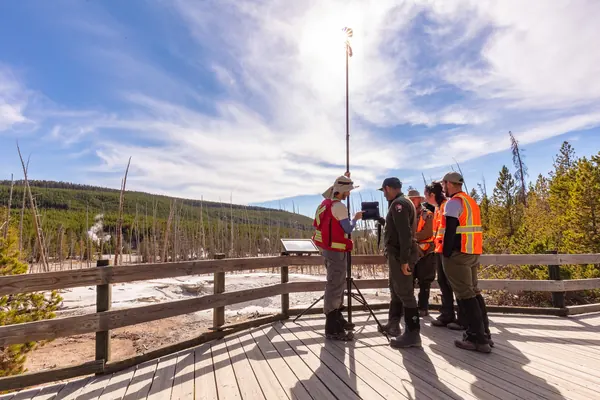
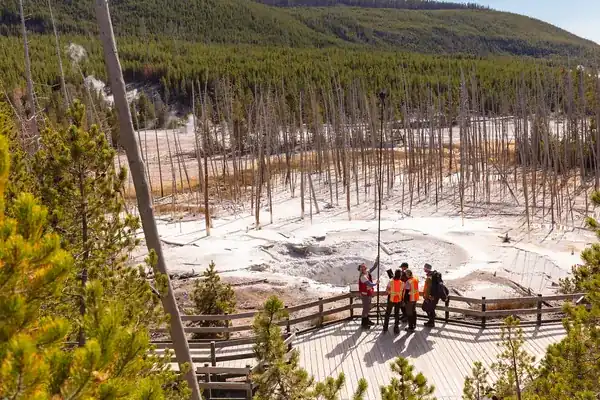
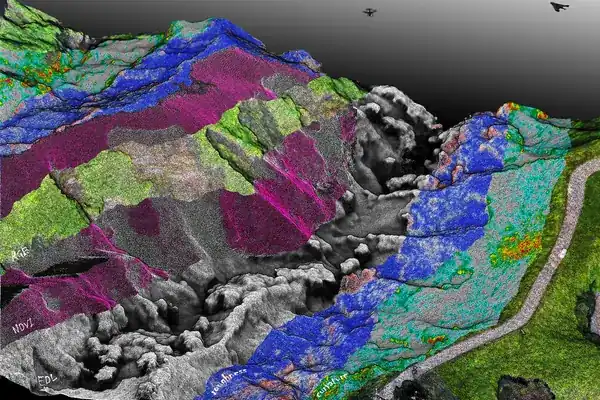
Illustrative photos, published by their authors under free licences.
Contents of the complete guide
- Volume, capacity, inventory: three questions, three readers (free extract below)
- The volume method: point clouds, surfaces and the reference plane
- Accuracy, tolerance and uncertainty in %: calculate it before promising it
- French ICPE categories: what each regime requires you to measure
- Landfill cell (ISDND): remaining capacity and remaining life
- Quarry: annual plan, extracted volumes and product stocks
- Recycling yards and transfer stations: areas, volumes and heights
- Year-end inventory: from volume to book stock, with the statutory auditor
- Comparing two surveys over time without comparing two methods
- Ordering, accepting and archiving the deliverable
- Five templates to copy
- Sources and consultation dates
Included: 18 checklist items and 13 decision or reference tables.
Introduction
A volume measured by drone is rarely challenged on the day it is delivered. It is challenged six months later: when the inspector asks why the remaining capacity of a landfill cell fell twice as fast as the tonnage received, when the statutory auditor wants to know what base the sand stockpile was calculated against, when this year's survey can no longer be compared with last year's because the contractor changed software, or when a yard discovers that a stockpile is higher than its permit allows. In each case it is not the drone that is missing. It is the written method: which reference surface, which boundary, which uncertainty, which density, which comparison rule.
This guide gives that method to those who order the measurement and those who deliver it, on sites in France. It starts from what French texts actually require of a quarry, of a non-hazardous waste landfill and of a transfer or sorting yard, then from what the French Commercial Code and the French auditing standard require for a stock at year end. It explains how a volume is calculated, how to put a percentage on its uncertainty before promising it, how to assess the remaining capacity of a landfill cell, how to move from volume to tonnage and then to the book inventory, and how to compare two surveys without comparing two methods. It ends with five templates: specification, volume survey report, variance table against the book stock, deliverable check sheet and annual report outline.
Two French terms recur. ICPE (installation classée pour la protection de l'environnement) is the French system of classified installations: each activity falls under a numbered category of a national nomenclature, with a regime of authorisation (A), registration (E), declaration (D) or declaration with periodic inspection (DC). ISDND (installation de stockage de déchets non dangereux) is a non-hazardous waste landfill.
The guide is up to date as of 6 November 2026. The ministerial orders cited were read that day in their consolidated version, on Ineris's AIDA database, which reproduces the versions published on Légifrance, and the nomenclature in its February 2026 version. The worked examples are recalculated in the text so you can rerun them with your own figures. Read it in order the first time; after that, chapter 3 (uncertainty), the chapter for your type of site and the templates are enough for each campaign.
Volume, capacity, inventory: three questions, three readers
Three figures that answer different questions
On the same site, the same drone flight can serve three purposes that have neither the same reader, nor the same unit, nor the same tolerance.
The volume survey answers "how much material, or empty space, lies between two surfaces?". It is expressed in cubic metres. This is the technical object: a digital model of the site surface, a reference surface, a boundary, a difference.
Capacity answers "how much can I still receive, extract or store, given what I am permitted?". It is expressed in the unit of the administrative act: mass of waste for a landfill cell, tonnes per year for a quarry, area or "volume likely to be present" for a transfer yard. Its reader is the operator first, the environmental inspectorate second.
Inventory answers "what quantity of stock exists at the closing date, and what is it worth?". It is expressed in tonnes, then in euros. Its reader is the finance team and, through it, the statutory auditor (commissaire aux comptes).
| Question | Unit | Main reader | Text behind the requirement | What counts alongside the drone |
|---|---|---|---|---|
| How much material or void between two surfaces? | m³ | Operator, engineering firm | None as such: it is a measurement | Check points surveyed on the ground |
| How much more can this landfill cell take? | t (permit), m³ (annual declaration) | Operator, inspectorate | Order of 15 February 2016, articles 4 and 25 | Weighbridge records at the site entrance |
| Is my quarry plan up to date? | Dimensioned plan, areas | Operator, inspectorate | Order of 22 September 1994, article 15 | Boundary and levelling markers |
| Do my stockpiles respect permitted area, volume and height? | m², m³, m | Operator, inspectorate | ICPE nomenclature, general requirement orders | Stock accounts from weighings |
| What is my stock at year end? | t, then € | Finance team, statutory auditor | Commercial Code, articles L123-12 and R123-177; NEP 501 | Weighings, material accounts, measured density |
The practical consequence is simple: a volume report that does not say which question it answers will be misread. The same 12,000 m³ can be correct as a volume, insufficient as a capacity (if it forgets the thickness of the final cap on a landfill cell) and wrong as an inventory (if it is converted with a textbook density).
What a drone measures, and what it does not
A drone measures a surface: photogrammetry rebuilds a point cloud and a digital surface model (DSM) from highly overlapping photos; a LiDAR sensor does the same with laser pulses. Everything else is calculated.
- It does not measure the underside of a pile: the base of a stockpile on natural ground is an assumption, unless the pad was surveyed empty.
- It does not measure mass: going from cubic metres to tonnes needs a density, which varies with moisture, compaction and grading.
- It does not see under a canopy, inside a silo or inside a closed building.
- It does not measure value: product quality, grading and write-downs remain the operator's decisions.
What published measurements say
Three studies give honest orders of magnitude. A team from Perm National Research Polytechnic University and BOKU Vienna (Filkin, Sliusar, Huber-Humer, Ritzkowski and Korotaev, Waste Management, 2022) compared a consumer drone and a survey-grade drone on dumps and landfills: the difference from ground surveys was about 1% even with a minimal number of ground control points, rising to about 5% with no control points and cloud processing (doi:10.1016/j.wasman.2021.12.029). On stockpiles carried by barges, He, Chen, Zeng and Huang (Sensors, 2019) found a deviation of about ±2% from traditional manual measurement, without ground control points (doi:10.3390/s19163534). Finally, Raeva, Filipova and Filipov (ISPRS Archives, 2016), comparing GNSS and drone on an open-pit quarry stockpile, note that mining regulations in many countries require ±3% accuracy on the total volume (doi:10.5194/isprs-archives-xli-b1-999-2016).
These figures concern the geometric volume under study conditions. They say nothing about the reference surface under a pile on sloping ground, or about density. Chapter 3 shows how to calculate your own uncertainty, site by site.
Five minutes to classify your need
- Who will read the figure first: operations, the inspectorate, finance, a customer or a third party in a dispute?
- In what unit does that reader expect it: m³, tonnes, m², height in metres, euros?
- On what date must the figure be true: closing date, plan anniversary, calendar year end for the annual declaration?
- Is there a comparable earlier survey (same boundary, same reference, raw data archived)?
- What will the figure be reconciled with: incoming and outgoing weighings, declared tonnages, book stock?
With these five answers, template 1 (specification) is straightforward to fill in and the contractor knows what to deliver.
How it works
- You pay on StripeBy card, Apple Pay or Google Pay, in one go, on the checkout page hosted by Stripe: your card details never go through our servers.
- You read it right awayRight after payment, you land on the complete guide's page. Bookmark it or print it to PDF; the link and the invoice are emailed to you, and everything stays findable with “Find my purchases”, at the bottom of every page.
- Guaranteed contentAs described, or your money back: email devis@c-drone.fr and we restore access or refund you (terms of sale, in French).
Frequently asked questions
What does “Drone stockpile volumes and inventory in France: quarries, landfill cells, recycling yards and year-end accounts” contain and how much is it?
For €39 VAT included (€32.50 excl. VAT), you get drone stockpile volumes and inventory in France: quarries, landfill cells, recycling yards and year-end accounts: 11 chapters online, about 34 printable A4 pages and 5 ready-to-copy templates, to have a volume measured by drone on a French industrial site, and defend it afterwards: choose the reference surface and the boundary, work out the uncertainty in % before promising it, assess the remaining capacity of a landfill cell, know what each French classified-installation category (quarry, non-hazardous landfill, waste transfer and sorting) requires you to measure, move from volume to the year-end book inventory with the statutory auditor, and compare two surveys over time without comparing two methods.
How do I receive the guide?
Right after payment you are redirected to the complete guide's page. Bookmark it, or print it to PDF (Ctrl+P or Cmd+P, “Save as PDF”). Stripe also emails you the receipt.
Do I get an invoice?
Yes: Stripe generates the invoice and emails it. You can enter your company name and VAT number at checkout. Seller: Lacangel Group (VAT FR21995268018); prices VAT included.
Is the guide kept up to date?
Yes. The guide's page is updated when the rules change; your access stays valid and you always read the latest version.
Which texts is the guide based on?
On the official texts in force (EU regulations, French decrees and codes), cited and dated with their links: you can check every rule at its source, which is authoritative. C-DRONE is an independent publisher.
Which device can I read it on?
Computer, tablet or phone: it is a web page, with no app or account to create. Print it to PDF to archive it or share it within your team.
What guarantee do I get?
The content matches its description, or you get your money back: email devis@c-drone.fr and we restore access or refund you (terms of sale, in French). This also applies to business purchases.
Other guides
New Drone light show guide
Organising a drone light show in France: budget, permits, contract
Town, company or wedding: check whether your project works, file the prefecture application on time, compare quotes, sign a contract that deals with the weather and run the night itself
€29 incl. VAT · €24.17 excl. VAT · 11 chapters · instant access
New CATS exam prep
Passing the French CATS drone exam: course and 104 practice questions
The eight subjects of the official DGAC syllabus summarised, 64 answered and explained questions, a 40-question mock exam and a four-week revision plan, with the French terms you will meet
€24 incl. VAT · €20.00 excl. VAT · 11 chapters · instant access
New Thermography guide
Drone thermography in France: commission, check and use the report
Roofs, facades, flat roofs, solar PV: choose the right measurement window, write the specification, check the flight conditions, read the report in fifteen minutes and turn it into repair decisions
€29 incl. VAT · €24.17 excl. VAT · 11 chapters · instant access
Free articles on the topic
- Landfill cell volume survey by drone: ISDND monitoring, remaining capacity, price
- Measuring a Bulk Stockpile by Drone for the Annual Inventory: Year-End Accounts, Auditors, Price
- Drone and Scrap Metal Recycling Yard: ICPE Heading 2713, Stockpile Volume and Prices
- Quarry 3D modelling by drone for the annual production declaration: method, accuracy, price
- Quarry face inspection by drone: stability, photogrammetry, price
- Drone and crushing-screening plant: ICPE heading 2515, mobile units, conical stockpiles and dust
Instant access to your guide after payment · terms of sale (in French). Questions before buying: devis@c-drone.fr.