WIND TURBINE BLADE INSPECTION GUIDE · UPDATED NOVEMBER 2026
Wind turbine blade inspection by drone in France: commissioning, comparing methods and reading the report
New
For €39 VAT included (€32.50 excl. VAT): a guide to commission, compare and use a wind turbine blade inspection in France.
After payment
- The page after payment shows the link to your guide: you start reading right away.
- An email from C-DRONE (no-reply@tech-bharat.com) sends you this link again with your order details (amount, VAT, order number).
- Find my purchases gives you your links back at any time.
- No phone calls: nobody will ring you.
Guarantee: content as described, or your money back
For €110 more, the complete library: all 48 guides, this one included →
VAT included (€32.50 excl. VAT) · secure Stripe payment (card, Apple Pay, Google Pay) · terms of sale (in French)
What you get
- The online guide: 9 chapters, about 29 A4 pages, printable to PDF
- 5 ready-to-copy templates: blade inspection specification · defect grading grid · wind farm mission checklist · blade inspection report outline · three-quote comparison grid · and 1 more
- For: Wind farm operators and maintenance managers · Maintenance contractors and engineering firms · Asset managers, buyers, insurers and loss adjusters
- Delivery: instant online access right after payment; Stripe invoice by email
- Preview: the whole first chapter, free, further down this page
9chapters
29printable A4 pages
5templates to copy
25checklist items
Checked at the source
Reviewed by industry professionals. Every rule links to its text.
322links to official texts across our guides
76automated checks before every release
November 2026latest revision of this guide
- Primary sources: Légifrance, EUR-Lex, Géoportail.
- Every figure linked to its source, dated in the last chapter.
- Dated updates: you always read the latest version.
Who it is for
- Wind farm operators and maintenance managers who commission inspections of their turbines in France, including project companies and community wind farms
- Maintenance contractors and engineering firms that include blade inspection in their contracts
- Asset managers, buyers, insurers and loss adjusters who must read an inspection report and make a decision from it
- Drone pilots and inspection companies, French or foreign, who want to deliver a report that stands up to the operator and loads into its CMMS
In pictures
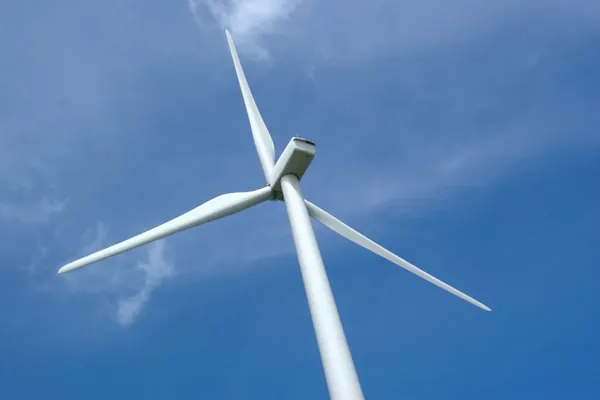
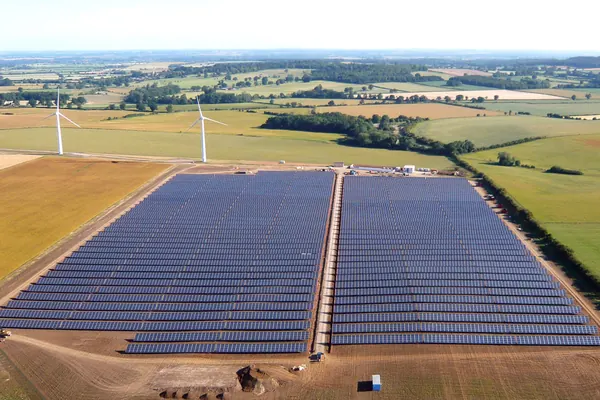
Illustrative photos, published by their authors under free licences.
Contents of the complete guide
- Drone, ground camera, platform or rope access: choosing the method for the question asked (free extract below)
- Inspecting without stopping the turbine: what is possible, what is not
- Blade defects: where they start, what they look like
- Defect list and severity: grading defects to decide
- Inspection frequency: what the 2011 order says and what maintenance adds
- Preparing the mission on a wind farm: height, airspace, classified site and locked-out turbine
- Commissioning the inspection: specification, resolution and data
- Reading the report and loading it into your CMMS
- Five templates to copy
- Sources and consultation dates
Included: 25 checklist items and 11 decision or reference tables.
Introduction
A good blade inspection is not judged by the number of photos delivered. It is judged by one simple question, asked three months later by the maintenance manager: "which blade, where exactly, what defect, how severe, and what do I do now?". Too many reports cannot answer it. Hundreds of images, a list of defects graded on the contractor's own scale, approximate positions, no comparison with the previous campaign, and a file that loads into no maintenance tool. The money is spent, the turbine has been stopped, and the decision is no easier to make.
This guide gives those who commission these inspections in France, and those who carry them out, the method that is usually missing. It compares the ways of looking at a blade (drone, ground camera, platform, rope access, internal inspection) for each question, works out what an inspection without stopping the turbine can and cannot see, describes blade defects and their false positives, proposes a shared defect list and severity scale, sets the frequency against the French order of 26 August 2011, prepares the mission on a wind farm (height, airspace, prevention plan, turbine lock-out), and details what a report must contain to load into a CMMS. It ends with five templates: specification, defect grading grid, mission checklist, report outline and three-quote comparison grid.
The guide is up to date as of 7 November 2026. The articles of the order of 26 August 2011 cited here were re-read that day on Légifrance, in their consolidated version in force. French legal terms are given in brackets where you will meet them in documents. The calculations (tip speed, motion blur, resolution, flight height, lost production) are worked out in the text with their assumptions written down: redo them with your own turbine data. Read it in order the first time; after that, chapter 4 (grading), chapter 7 (commissioning), chapter 8 (acceptance) and the templates are enough for each campaign.
Drone, ground camera, platform or rope access: choosing the method for the question asked
Five ways to look at a blade
A recent onshore wind turbine blade is commonly more than sixty metres long. It can be looked at in five ways, which do not answer the same questions.
The drone flying close. A high-resolution camera follows each blade a few metres away, along its faces and edges, with the rotor stopped. It is the most widespread method for detailed visual inspection: it covers the whole outer surface, at a resolution of the order of a millimetre, with nobody working at height.
The drone with a thermal camera. It looks for what the surface does not show: a delamination, water ingress or a failing bond sometimes creates a thermal contrast. The measurement depends heavily on conditions (prior sunshine, time of day, wind) and is always read alongside the visible images.
The ground camera. A camera with a very long lens, on a tripod, photographs the blades from the foot of the turbine or from a distance. Some systems trigger as each blade passes, with the turbine rotating. Nobody flies, nobody climbs; on the other hand, the faces are seen at an angle, the atmosphere degrades the image over distance, and areas hidden by the viewing angle stay hidden.
Rope access, platform or lift. A technician in contact with the blade, on ropes, on a platform hung from the nacelle, or in the basket of a mobile elevating platform where the height allows. It is the only way to touch, tap-test, measure a thickness, and repair. French labour law restricts rope work: article R4323-64 of the Labour Code prohibits using rope access to create a workstation, except where collective protection is technically impossible or would expose workers to a greater risk, and article R4323-89 sets the conditions (at least one working rope and one safety rope). The text of R4323-64 is on the French government's labour code site.
Internal inspection. A camera or a small crawler enters the blade through the root, with the turbine stopped, to examine the shear webs, bond lines and the lightning down-conductor. No external method sees these areas.
What each method sees, and what it does not
| Method | Turbine | What it sees | What it does not see | Typical use |
|---|---|---|---|---|
| Visible drone, rotor stopped | Stopped and locked | The whole outer surface, surface defects at millimetre scale | The interior, thickness, whether a bond holds | Detailed periodic inspection, acceptance, end of warranty |
| Thermal drone | Stopped, sometimes rotating depending on protocol | Thermal anomalies consistent with an internal defect | The nature of the defect without confirmation; anything the weather masks | Targeted complement, after a visible finding or a doubt |
| Ground camera | Stopped or rotating | Surface defects visible at the resolution achieved | Faces seen at too steep an angle, fine defects at the tip | Fast screening of a farm, follow-up between detailed inspections |
| Rope access, platform | Stopped and locked out | Everything touch and measurement reveal | Nothing on the surface escapes it, but slowly | Expert assessment of a defect, repair |
| Internal inspection | Stopped and locked out | Shear webs, bond lines, lightning down-conductor | The outer surface | After a lightning strike, a suspected structural defect |
No method replaces the others. Good practice is to look wide and fast with the drone or the ground camera, then send the rope team or the platform where the report has pointed, with a photo, a position and a severity.
Resolution: the number that decides what you will see
The size of one pixel on the blade (resolution, or sampling distance) is worked out from the size of one sensor pixel, the distance to the blade and the lens focal length:
resolution on the blade = pixel size × distance ÷ focal length
Three examples worked out here:
- Full-frame 45-megapixel sensor (35.9 mm for 8,192 pixels, i.e. 4.38 µm per pixel), 50 mm lens, 10 m from the blade: 4.38 µm × 10 m ÷ 50 mm = 0.88 mm per pixel.
- One-inch 20-megapixel sensor (13.2 mm for 5,472 pixels, i.e. 2.41 µm), true focal length 8.8 mm, at 10 m: 2.41 µm × 10 m ÷ 8.8 mm = 2.74 mm per pixel; at 5 m, 1.37 mm.
- Ground camera, same full-frame sensor, 600 mm lens, placed 100 m from the foot of a turbine with a 100 m hub height: the distance to the hub is the square root of 100² + 100², i.e. 141 m; theoretical resolution 4.38 µm × 141 m ÷ 600 mm = 1.03 mm per pixel. In practice, air turbulence over 141 m, the oblique view and focusing degrade this figure: it is not assumed, it is checked on the images.
For a defect to be seen unambiguously, it must cover several pixels. The prudent rule used in this guide: ask for a resolution at least three times finer than the smallest defect you want to see. To spot a crack 3 mm wide, you need one millimetre per pixel or better. That is why the specification in template 1 requires a resolution per blade zone, not a drone model.
What research says about image analysis
A drone inspection produces hundreds of images per turbine. Reading them is the real cost, and it is increasingly assisted by software. A study by ASM Shihavuddin and seven co-authors at the Technical University of Denmark, published in 2019 in the journal Energies, trained a deep learning system to suggest the location and type of surface defects on drone images of blades; the authors report almost human-level precision for the suggested locations and types, and show that data augmentation markedly improves results when the training set is small (doi:10.3390/en12040676). The key word is "suggest": the software pre-selects, an inspector grades. A report must state who graded each defect, and against which scale; chapter 4 provides one.
Five minutes to classify your need
| Your question | Method first | Possible complement |
|---|---|---|
| "Meet the visual blade check obligation, turbine by turbine" | Visible drone, or ground camera if the resolution achieved is enough | Visible drone on turbines where a defect is flagged |
| "Know the real condition of my blades before the warranty ends" | Visible drone, rotor stopped, all faces | Thermography and internal inspection on doubtful defects |
| "A turbine has been struck by lightning" | Visible drone on that turbine | Internal inspection, lightning protection continuity measurement |
| "Track leading edge erosion from one campaign to the next" | Visible drone, same positions and same resolution every campaign | None, if the comparison is kept up |
| "Buy or sell a wind farm" | Visible drone on the whole farm | A sample of internal inspections |
| "Repair" | Rope access or platform, guided by the drone report | Drone check after repair |
Our free guide to wind turbine drone inspection gives the overview; this guide goes into commissioning, grading and reading the report.
How it works
- You pay on StripeBy card, Apple Pay or Google Pay, in one go, on the checkout page hosted by Stripe: your card details never go through our servers.
- You read it right awayRight after payment, you land on the complete guide's page. Bookmark it or print it to PDF; the link and the invoice are emailed to you, and everything stays findable with “Find my purchases”, at the bottom of every page.
- Guaranteed contentAs described, or your money back: email devis@c-drone.fr and we restore access or refund you (terms of sale, in French).
Frequently asked questions
What does “Wind turbine blade inspection by drone in France: commissioning, comparing methods and reading the report” contain and how much is it?
For €39 VAT included (€32.50 excl. VAT), you get wind turbine blade inspection by drone in France: commissioning, comparing methods and reading the report: 9 chapters online, about 29 printable A4 pages and 5 ready-to-copy templates, to commission, compare and use a wind turbine blade inspection in France: choose the right method (drone, ground camera, platform or rope access) for the question asked, know what an inspection without stopping the turbine can and cannot see, recognise and grade blade defects on a shared severity scale, set the frequency against articles 9, 17, 18 and 19 of the French order of 26 August 2011, prepare the mission on a wind farm (height, airspace, prevention plan, turbine lock-out), then accept a report whose data goes straight into your CMMS.
How do I receive the guide?
Right after payment you are redirected to the complete guide's page. Bookmark it, or print it to PDF (Ctrl+P or Cmd+P, “Save as PDF”). Stripe also emails you the receipt.
Do I get an invoice?
Yes: Stripe generates the invoice and emails it. You can enter your company name and VAT number at checkout. Seller: Lacangel Group (VAT FR21995268018); prices VAT included.
Is the guide kept up to date?
Yes. The guide's page is updated when the rules change; your access stays valid and you always read the latest version.
Which texts is the guide based on?
On the official texts in force (EU regulations, French decrees and codes), cited and dated with their links: you can check every rule at its source, which is authoritative. C-DRONE is an independent publisher.
Which device can I read it on?
Computer, tablet or phone: it is a web page, with no app or account to create. Print it to PDF to archive it or share it within your team.
What guarantee do I get?
The content matches its description, or you get your money back: email devis@c-drone.fr and we restore access or refund you (terms of sale, in French). This also applies to business purchases.
Other guides
New Drone light show guide
Organising a drone light show in France: budget, permits, contract
Town, company or wedding: check whether your project works, file the prefecture application on time, compare quotes, sign a contract that deals with the weather and run the night itself
€29 incl. VAT · €24.17 excl. VAT · 11 chapters · instant access
New CATS exam prep
Passing the French CATS drone exam: course and 104 practice questions
The eight subjects of the official DGAC syllabus summarised, 64 answered and explained questions, a 40-question mock exam and a four-week revision plan, with the French terms you will meet
€24 incl. VAT · €20.00 excl. VAT · 11 chapters · instant access
New Thermography guide
Drone thermography in France: commission, check and use the report
Roofs, facades, flat roofs, solar PV: choose the right measurement window, write the specification, check the flight conditions, read the report in fifteen minutes and turn it into repair decisions
€29 incl. VAT · €24.17 excl. VAT · 11 chapters · instant access
Free articles on the topic
- Wind turbine inspection by drone: method and cost
- Wind turbine drone inspection: blades, tower, regulatory duty and price
- Offshore wind turbine drone inspection: method, maritime regulations, price
Instant access to your guide after payment · terms of sale (in French). Questions before buying: devis@c-drone.fr.