A professional drone pilot for this mission Request a free quote
C-DRONE GUIDE · 3 MARCH 2026
Drones and co-owned buildings: inspecting roofs and façades without scaffolding
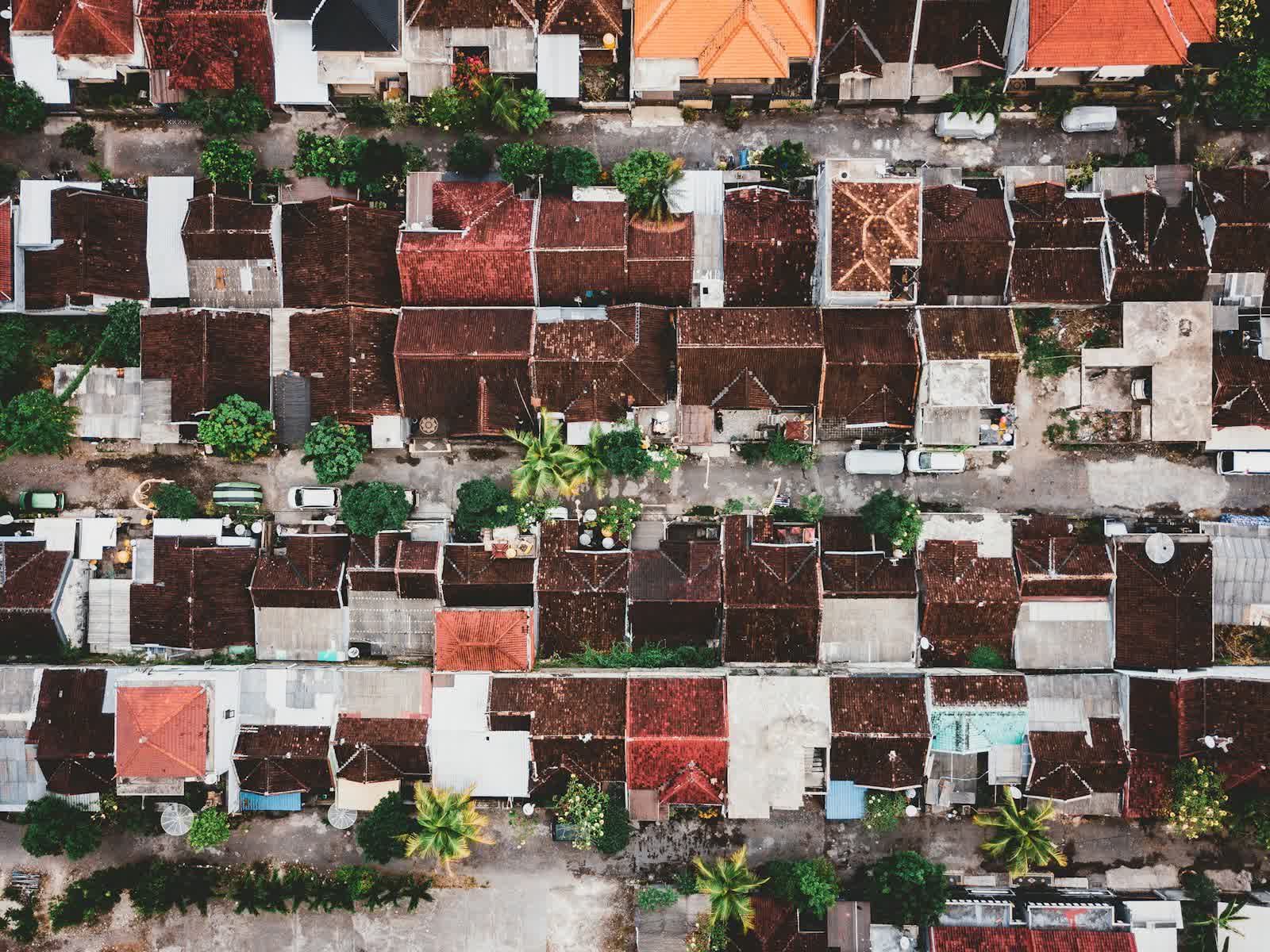
Checking the condition of an apartment building's roof used to cost the price of scaffolding or a cherry picker; today it costs an hour of flight. For property managers and co-ownership boards, drones have become the diagnostic tool of choice — provided you know the process, its limits and the rules specific to co-owned buildings.
Published on 3 March 2026, updated on 22 September 2026 — regulations in force as of September 2026.
The economics: drone versus scaffolding
Let's lay out 2026 market figures. A drone inspection of a medium-sized building (roof, chimney stacks, flashing, four façades) costs between €500 and €1,500 depending on complexity, analysis report included. The traditional alternative: full scaffolding runs to tens of thousands of euros for an entire building (often €15,000 to €60,000 including hire and assembly), a cherry picker €500 to €1,000 a day where the road allows, a rope-access technician €600 to €1,200 a day. Not counting the delays: public-domain occupation permits for scaffolding, parking suspensions for the picker.
The comparison must stay honest: a drone sees, it does not touch. It will not sound a crack with a hammer, lift a tile or scrape render. Its place in the maintenance strategy is therefore diagnostic: detect, locate, document and prioritise defects, so that heavy access equipment is deployed only where needed, against a precise specification. That is exactly where the real saving lies: not in replacing scaffolding, but in avoiding erecting it for nothing — or erecting it everywhere when only one roof edge is at fault.
What the drone actually detects
Fitted with a high-resolution sensor and optical zoom — common inspection machines offer hybrid zooms up to 56× — the drone documents without contact: displaced, broken or porous tiles and slates, loose ridge lines, tired flashing and valleys, vegetated or pierced gutters, façade cracks and their paths, spalling balconies with exposed rebar, degraded expansion joints, flat-roof waterproofing issues (blistering, standing water). As a complement, a thermal camera reveals insulation defects, recent water ingress (moisture changes the thermal signature) and thermal bridges — a flight at daybreak after a cool night gives the best contrast.
Every shot is geotagged and time-stamped, which turns the inspection into citable evidence: the report places each defect on a roof plan, ranks it by severity (urgent, to monitor, routine maintenance) and, on subsequent visits, compares it with the previous state. This longitudinal dimension is what wins over co-ownership boards: a crack photographed identically twelve months apart puts an end to general-meeting debates based on impressions.
The co-ownership process: who decides, who authorises
Good news for lead times: a simple inspection counts as routine maintenance of the common areas. The syndic (managing agent) can therefore order it from the operating budget without a general-meeting vote, exactly as they would call out a roofer — consulting the co-ownership board according to custom and amount. A general-meeting vote only becomes necessary for the works the inspection reveals. In practice, the request often comes from the board itself, worried by a damp patch or a slate found in the courtyard; the drone report then grounds the debate in facts before works quotes are sought.
As for aerial permissions, a building in town almost always means the specific category and the prefectoral declaration (ten working days minimum — see our dedicated guide). The operator handles that procedure; the syndic smooths the ground game: notifying occupants by notice 48 hours ahead — advisable both out of courtesy and under GDPR, since the drone passes close to windows —, access to the inner courtyard for take-off, and coordination with the caretaker. One point of vigilance: private windows and balconies. The inspection targets the common areas; the pilot frames tightly on the structure and blurs any inadvertently visible interior in the report.
The inspection report: demand the right deliverable
The value of the service is in the report, not the flight. A professional deliverable includes: an annotated overview of the roof (plan or orthophoto), detail photos of each defect with precise location, a severity rating on three or four levels, prioritised action recommendations, and mission metadata (date, conditions, equipment). Allow 5 to 10 working days. Best practice adds a comparison with the previous inspection and an online viewer where the board can browse the high-definition images.
Three red flags when choosing the provider. A "report" that is just a folder of raw photos with no analysis: you are paying for a flight, not a diagnosis. A provider that is also a roofing firm prescribing itself the works: the mix is not illegal, but an independent diagnosis protects the co-ownership from unnecessary works. And no trace of flight authorisations: if an incident occurs above the neighbouring school yard, the commissioning party — the co-owners' association — could be held partly liable. The price of a complete, independent report, €500 to €1,500, should be judged against what it steers: works decisions counted in tens or hundreds of thousands of euros.
When to schedule the inspection, and how often
The optimal calendar follows the building's life. Routine inspection is best scheduled in spring, after the winter storms and before the summer thunderstorms, so conclusions feed into the next general meeting's budget. Event-driven inspection follows a notable episode: a named storm, hail, a prolonged heatwave (expansion), or elements found fallen. Pre-works inspection feeds the specification before contractors are consulted — and handover inspection, too rare, verifies the quality of delivered works before reserves are lifted, at the moment when having a defect redone still costs nothing.
How often? The consensus among managers: every two to three years for a recent building in a temperate zone, yearly for an old building, an end-of-life roof, a seafront or a storm-prone area. Many syndics negotiate a monitoring contract: one flight per year on a fixed date, same trajectories, same framing, comparative report — €400 to €800 a year for an average building, often under €10 per unit per year. Set against the cost of water damage whose leak would have been visible two years earlier on an aerial photo, the trade-off speaks for itself.
Put it into practice
- Drone roof inspection: rates and cities covered from €200
- Roof inspection in Nice Provence-Alpes-Côte d'Azur
- Roof inspection in Toulon Provence-Alpes-Côte d'Azur
- Roof inspection in Angers Pays de la Loire