A professional drone pilot for this mission Request a free quote
C-DRONE GUIDE · 4 MAY 2026
Drones in real estate: what actually sells
Property portals have observed it for years: listings illustrated with aerial views attract significantly more clicks and viewing requests than the rest. But not all properties benefit equally, and not all aerial images are equal. This guide details what actually works — property types, shots, altitudes — the regulatory framework in town, and the return-on-investment maths for an agency or a seller.
Published on 4 May 2026, updated on 22 September 2026 — regulations in force as of September 2026.
Why aerial sells: context, not stunts
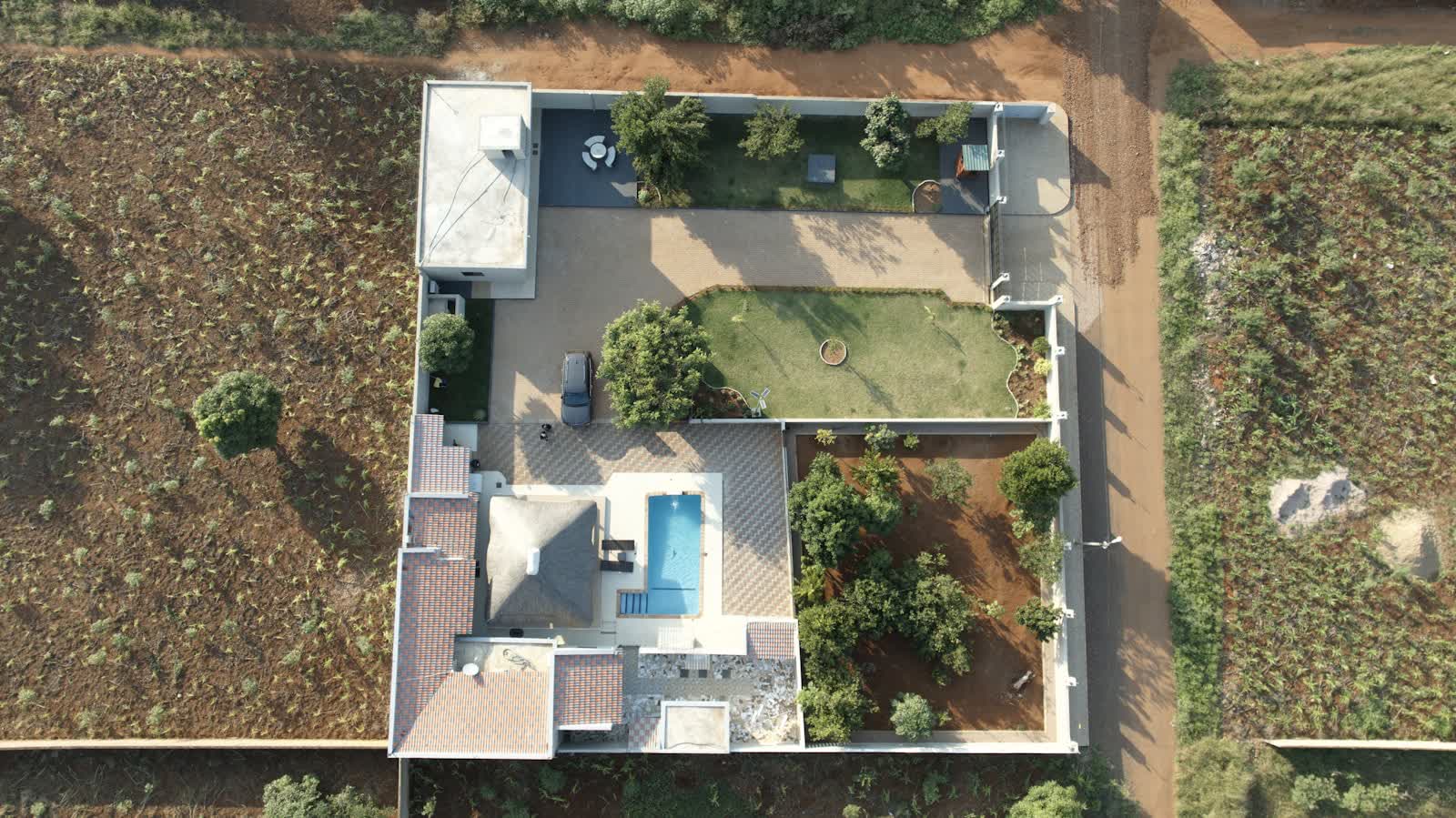
An aerial photo does not sell because it is spectacular, but because it answers the three questions buyers ask before even reading the listing: where exactly is the property, what surrounds it, and how big is the plot really? A view from 40 m up shows at a glance the plot's orientation, the distance to neighbours, the swimming pool next door or the ring road you can hear from the garden. This visual honesty filters out pointless viewings: buyers who make the trip already know what they will find, and the share of viewings converted into offers rises.
Industry professionals report "drone" listings generating two to three times more engagement on portals, and above all easier mandates: offering an aerial shoot within an exclusive mandate has become a standard prospecting argument for agencies and architectural photographers. Conversely, merciless aerial views hurt properties with unattractive surroundings — you must know when to skip them, or choose low angles that flatter without deceiving. The limit is legal as much as ethical: retouching out a high-voltage line engages the seller's liability for misrepresentation.
Which properties benefit most
Return on investment peaks for properties whose value lies in what cannot be seen from the street: houses with large grounds, rural properties, farmhouses, homes with a view (sea, mountains, vineyards), character estates whose roof and park carry the prestige, and building plots — where an aerial view with cadastral boundaries overlaid has become near-indispensable. For luxury real estate, an aerial film with smooth golden-hour shots is now a market standard, on a par with the virtual tour.
At the other end, an upper-floor flat in an ordinary building gains little from a flyover — with exceptions: showing the actual view from the 6th-floor balcony (the drone hovers at the exact floor height, an image impossible to get otherwise), or situating the residence relative to the metro and schools. In between, commercial and industrial premises use aerial images to show truck access, parking and roof areas — an increasingly common argument to highlight the photovoltaic potential of a 2,000 m² roof.
The images that convert: altitudes, angles, timing
The brief for an effective real-estate shoot fits in six shots. An establishing view at 60-80 m placing the property in its neighbourhood; a 30-40 m view at 45 degrees showing the whole plot — usually the listing's lead photo; two façades taken from 10-15 m — the altitude that replaces the photographer's ladder and straightens perspectives; one shot oriented towards the key asset (view, garden, pool); and a top-down vertical of the plot, on which the agency can trace property lines. For video, a slow orbit around the property and an approach shot up the driveway are enough: past 60 seconds, nobody keeps watching.
Timing makes half the image: late morning for east-facing façades, mid-afternoon for west, and golden hour for premium properties. Avoid the summer midday sun that flattens relief and hardens shadows. Two details that betray amateurs: cars in the courtyard (have them moved before the flight) and a tilted horizon. Finally, require delivery in high resolution AND in a portal-optimised version (under 500 KB): a magnificent aerial photo that the portal compresses into mush converts nothing at all.
Flying in town: what the rules actually allow
This is the point agencies underestimate: most properties for sale are in built-up areas, and built-up areas change everything. In the open category, flying over public space in a populated area is tightly constrained: a sub-250 g C0 drone can fly in A1 (never over assemblies of people), a C2 requires the A2 certificate and 30 m horizontal distance from uninvolved people. In practice, photographing a house from within its own plot, with the owner's consent and without overflying the street, is often feasible in the open category; overflying the street requires either — since 1 January 2026 — a professional open-category flight over public space (no overflight of people, daytime only), or the specific category with an STS-01 declaration, plus a prefecture notification ten working days ahead.
Add the local restrictions visible on the official Géoportail drone map: airport CTRs that cap or ban flights across entire municipalities, prohibited zones over historic centres, sensitive sites. A serious pilot checks the address before quoting and builds the lead time into the marketing schedule. Last aspect: image rights and privacy. Never publish a photo where the neighbour can be recognised in their garden, blur licence plates and people, and inform the immediate neighbours as a courtesy — half of drone reports to the police come from neighbours unaware of a perfectly legal flight.
Prices, packages and return on investment
The 2026 French market has standardised around three packages. The simple photo package — 8 to 15 edited aerial photos, one hour on site — costs €150 to €300 in unrestricted areas, €250 to €450 when regulatory paperwork is needed. The photo + video pack (photos plus an edited, graded 45-60 second film) runs €400 to €800. The premium shoot for exceptional properties — aerial, interior, virtual tour, long film — goes for €800 to €2,000. Agencies contracting a monthly volume get 20 to 30% off and, above all, guaranteed response times.
Set against the stakes, the maths is quick: on a €400,000 house, the photo package represents less than 0.1% of the sale price, to be weighed against the cost of a listing that drags — every price cut is measured in thousands of euros. That is why aerial shoots are migrating from "luxury option" to standard exclusive-mandate tool, alongside interior HDR photography. For a private seller the reasoning holds too: commissioning a shoot before listing costs €200 to stand out from every smartphone-photographed ad.
Put it into practice
- Drone real estate drone services: rates and cities covered from €250
- Real estate drone services in Aurillac Auvergne-Rhône-Alpes
- Real estate drone services in Nice Provence-Alpes-Côte d'Azur
- Real estate drone services in Toulon Provence-Alpes-Côte d'Azur