A professional drone pilot for this mission Request a free quote
C-DRONE GUIDE · 18 MAY 2026
Roof inspection: drone or cherry picker? The complete comparison
Inspecting a roof long meant climbing onto it — with the risks, access costs and broken tiles that entails. The drone has upended the equation: fifteen minutes of flight document what half a day on a cherry picker barely covered. But aerial work platforms are not finished, because seeing is not touching. A comparison with figures and use cases, to pick the right method at the right time.
Published on 18 May 2026, updated on 22 September 2026 — regulations in force as of September 2026.
The head-to-head in figures
On a two-storey house, the gap is massive. A drone inspection costs €200 to €500 including the report, occupies one person for half a day, and never touches the covering. A cherry picker requires renting the machine (€200 to €400 a day for a towable lift, €600 to €1,200 with driver for a truck-mounted platform), an operator with the French CACES licence, often a highway permit if the machine parks on the pavement (allow one to three weeks in town), and only sees what is reachable from its position. Scaffolding runs into thousands of euros and days of assembly — it only makes sense when works follow.
| Criterion | Drone | Cherry picker | Scaffolding |
|---|---|---|---|
| Cost (single house) | €200 – €500 | €600 – €1,500 | €2,000 – €6,000 |
| Lead time | 2 to 5 days | 1 to 3 weeks (permits) | 2 to 4 weeks |
| Time on site | 1 to 2 h | half-day to full day | several days |
| Human risk | none (nobody at height) | moderate | moderate |
| Visual coverage | 100% of the roof | reachable faces | scaffolded areas |
| Physical contact | no | yes | yes |
What the drone sees — and the lift never will
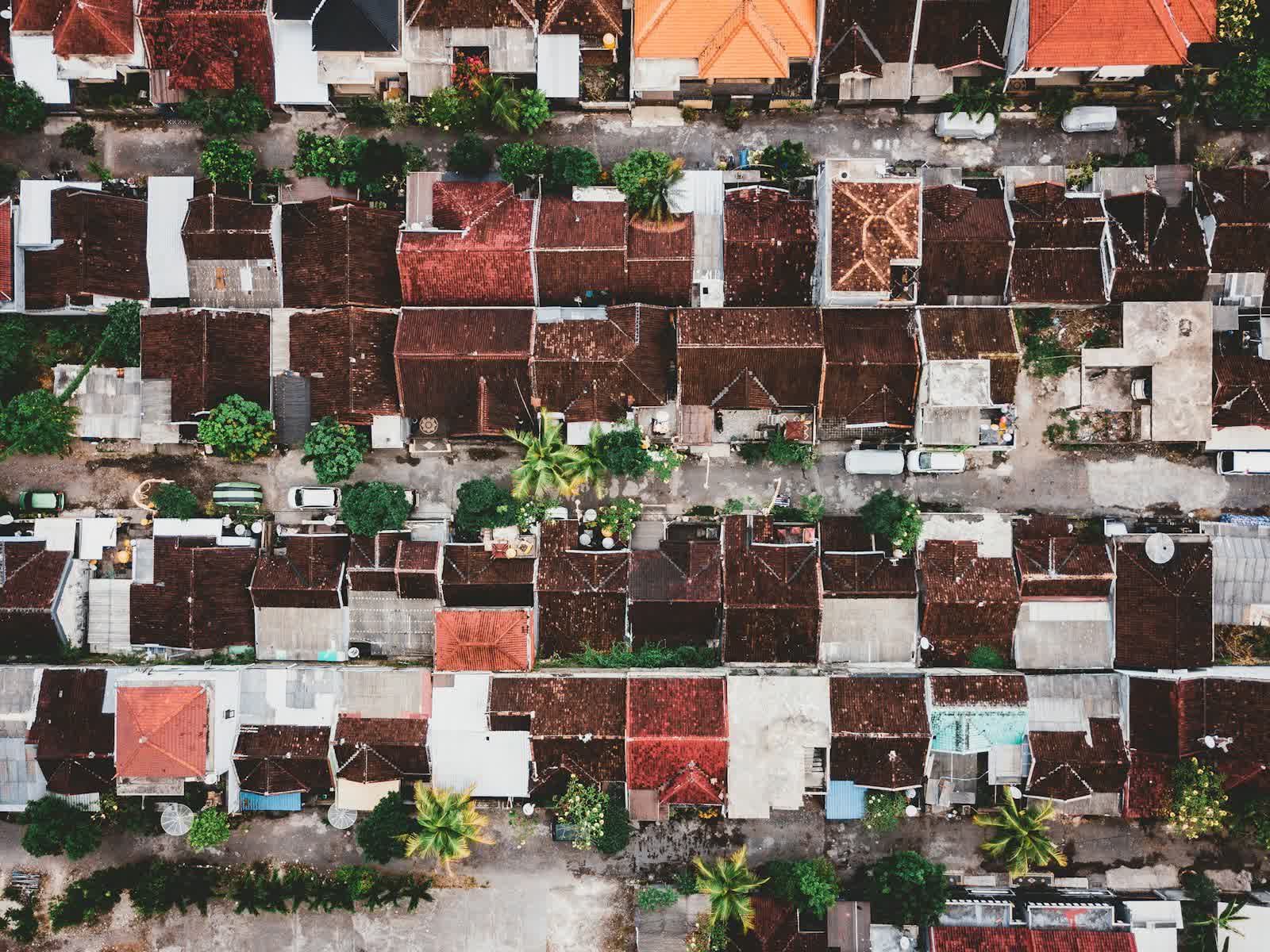
The drone's decisive advantage is not just price: it is exhaustiveness. A methodical flight photographs 100% of the roof planes, including deep valleys, the backs of chimneys, annex roofs and areas no machine can approach — above a veranda, an enclosed garden or an inner courtyard. With a modern optical zoom, the pilot reads the condition of a single tile from 20 m away: cracks, lifting moss, loose ridge tiles, tired flashings, pierced zincwork, overgrown gutters. Every photo is time-stamped and geolocated, producing dated evidence that is invaluable in expert assessments or disputes (hail, storm, defective workmanship).
Two add-ons multiply the flight's value. Thermography reveals the invisible: a radiometric camera spots moisture zones under the covering and insulation defects from above, undetectable by eye. Photogrammetry turns the photos into a measured 3D model: exact areas per roof plane, ridge and gutter lengths — enough to produce an accurate roofing quote without ever climbing up. Roofers have caught on: many now subcontract a drone flight before quoting, and insurance assessors increasingly require one after hail events.
When the cherry picker remains indispensable
The drone observes; it does not touch. Yet some diagnoses require contact: probing the real condition of a batten under a tile, lifting an element to check the underlay membrane, taking an asbestos-cement sample for analysis, testing the adhesion of a façade render. Likewise, any intervention — replacing the broken tiles the drone spotted, refixing a flashing, unblocking a downpipe — requires a physical presence at height. The efficient sequence is therefore often hybrid: drone for the exhaustive diagnosis, then a targeted lift only on the points needing work, with a quote refined by the imagery.
The lift also keeps the advantage in contexts where flying is impossible or administratively heavy: the immediate surroundings of an airport in a red zone of the drone map, sensitive sites (prisons, military installations, certain classified industrial sites), indoor halls where GPS drops out — although caged indoor drones are progressing fast — or persistently bad weather, since most common drones fly neither in sustained rain nor above 50 km/h winds. Finally, in co-owned buildings, the property manager's approval sometimes comes faster for a lift than for a flyover, especially when residents worry about privacy: professional pilots defuse this with prior written information.
Safety and insurance: the argument that settles it
Falls from height remain one of the leading causes of serious and fatal accidents in French construction, and roofs are the deadliest terrain. Every avoided climb is a risk removed — the drone's central argument, even before the savings. For a company it translates directly: less risk exposure for teams, lighter safety obligations during the diagnostic phase, and an image of modernity with clients. Many roofing firms now reserve work at height for actual interventions, never for diagnosis.
On insurance, two distinct regimes apply. The pilot covers the operation with mandatory aviation liability insurance; check the certificate as for any service. For the client, a drone inspection avoids shouldering the liabilities of improvised work at height — an owner who lets a tradesman climb without collective protection is exposed in the event of an accident. Note finally that drone reports are now accepted by insurance assessors to document claims (hail, storm), provided they are dated, geolocated and produced by a registered operator: one more point to check when choosing a provider.
A typical inspection and the deliverables to require
A professional inspection follows a consistent protocol. Beforehand: checking airspace restrictions at the address, prefecture notification if a built-up-area flight falls under the specific category, informing the neighbours. On site: a safety perimeter, an overview flight at 30-40 m to map the roof, then detailed passes plane by plane at 10-15 m, zooms on every defect, and where relevant a thermal pass at the end of the day when contrasts are best. Total duration: one to two hours for a house, half a day for a residential block or industrial building.
The deliverable is what separates a flight from an inspection. Require: a report structured plane by plane with photos located on a roof plan, a severity rating per defect (monitor / repair / urgent), the high-resolution photos delivered alongside, and an operational conclusion prioritising the works. The best providers add a roof orthophoto with measured areas, directly usable by the roofer for quoting. Allow 48 to 72 h for delivery. A "report" that amounts to a folder of loose photos is not worth its price: images without analysis look nice but move nothing forward.
Put it into practice
- Drone roof inspection: rates and cities covered from €200
- Roof inspection in Roubaix Hauts-de-France
- Roof inspection in Asnières-sur-Seine Île-de-France
- Roof inspection in Cherbourg-en-Cotentin Normandie