FLEET COMPLIANCE GUIDE · UPDATED NOVEMBER 2026
Drone fleet compliance in France: classes C0 to C6, legacy drones, privately built drones and 2027
New
For €39 VAT included (€32.50 excl. VAT): a guide to bring a professional drone fleet into line.
After payment
- The page after payment shows the link to your guide: you start reading right away.
- An email from C-DRONE (no-reply@tech-bharat.com) sends you this link again with your order details (amount, VAT, order number).
- Find my purchases gives you your links back at any time.
- No phone calls: nobody will ring you.
Guarantee: content as described, or your money back
For €110 more, the complete library: all 48 guides, this one included →
VAT included (€32.50 excl. VAT) · secure Stripe payment (card, Apple Pay, Google Pay) · terms of sale (in French)
What you get
- The online guide: 11 chapters, about 31 A4 pages, printable to PDF
- 7 ready-to-copy templates: fleet inventory · per-aircraft compliance sheet · privately built aircraft file · aircraft maintenance log · battery log · update log · fleet renewal plan · and 3 more
- For: FPV pilots and builders of custom airframes · Foreign operators
- Delivery: instant online access right after payment; Stripe invoice by email
- Preview: the whole first chapter, free, further down this page
11chapters
31printable A4 pages
7templates to copy
17checklist items
Checked at the source
Reviewed by industry professionals. Every rule links to its text.
322links to official texts across our guides
76automated checks before every release
November 2026latest revision of this guide
- Primary sources: Légifrance, EUR-Lex, Géoportail, DGAC, EASA.
- Every figure linked to its source, dated in the last chapter.
- Dated updates: you always read the latest version.
Built on the frameworks of the European Union (regulations 2019/945 and 2019/947), EASA, the DGAC and the DSAC.
Who it is for
- Professional operators and remote pilots with several drones, some bought before 2024 or assembled in-house, who need to know what each one still allows
- Fleet managers in a company, engineering firm or local authority preparing a purchase, a renewal or a public tender response
- FPV pilots and builders of custom airframes who work with aircraft they assembled themselves or from kits
- Foreign operators who bring their fleet to France and clients who want to check that the drone planned for their mission is the right one before signing
In pictures
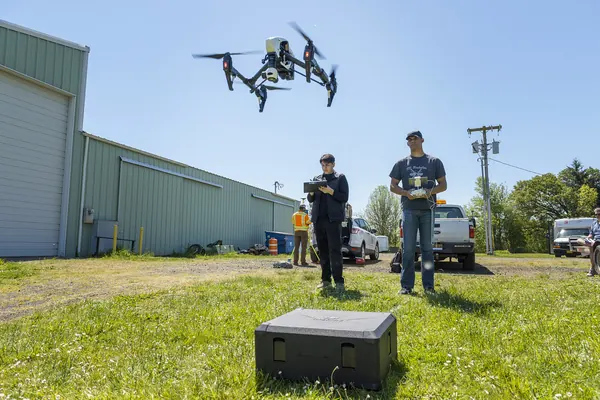
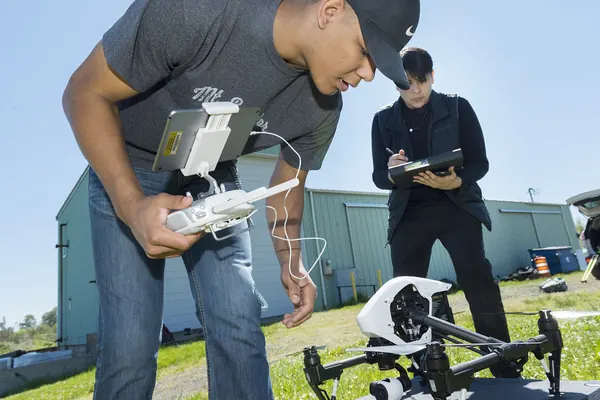

Illustrative photos, published by their authors under free licences.
Contents of the complete guide
- The three statuses that open the open category: sorting your fleet (free extract below)
- Classes C0 to C6: what the label guarantees, aircraft by aircraft
- Legacy drones without a class: what they allow and what they no longer do
- Privately built aircraft and kits: the boundary, the limits and the file to keep
- Marking, registration, remote identification: the aircraft compliant on the ground
- Updates, geo-awareness and manufacturer data: managing them instead of suffering them
- Maintenance and records: what the regulation requires and how to keep them
- The decision table: which mission, which aircraft
- The 2027 question: what the texts say, what EASA proposes
- The renewal plan: keep, equip, replace or subcontract
- Seven templates to copy
- Sources and consultation dates
Included: 17 checklist items and 15 decision or reference tables.
Introduction
A professional drone fleet ages faster than its motors. An aircraft bought in 2022 still flies perfectly well, but it has no class; an FPV frame built in the workshop does not have the same status as a retail kit assembled on the same bench; a class C2 drone whose firmware is out of date no longer meets the conditions of A2. What decides how an aircraft may be used is not how well it flies but its regulatory status, and that status is read on a label, a declaration of conformity, a market-placement date and a logbook.
This guide is for taking stock aircraft by aircraft, then deciding. It explains the three statuses that open the open category (class C0 to C6, legacy drone under Article 20, privately built), what each class guarantees and allows, the special case of kits, marking, registration, direct remote identification and French electronic signalling, how to manage the manufacturer's updates and data, and the maintenance and records the regulation requires in the specific category. It ends with a decision table by type of mission, a clarification of the 2027 date going around (no text in force carries it, but EASA Opinion 06/2026 of 18 September 2026 proposes real changes), a fleet renewal method and seven templates: fleet inventory, per-aircraft compliance sheet, privately built aircraft file, maintenance log, battery log, update log and renewal plan.
The rules are EU-wide, so most of the guide applies in any EU Member State; where France adds its own layer (aircraft registration and electronic signalling from 800 g, AlphaTango), the guide says so. It is up to date as of 4 November 2026. The EU regulations were re-read that day in their versions consolidated at 1 May 2025 published on EUR-Lex, Opinion 06/2026 on the EASA website and the DGAC page on the open category on ecologie.gouv.fr. Read it in order the first time; after that, the inventory (template 1), the per-aircraft sheet (template 2) and the table in chapter 8 are enough for each purchase or new mission.
The three statuses that open the open category: sorting your fleet
The starting rule: Article 4
Article 4 of Implementing Regulation (EU) 2019/947 sets the conditions of the open category. The first concerns the aircraft itself: the UAS "belongs to one of the classes set out in Delegated Regulation (EU) 2019/945, or is privately built, or meets the conditions defined in Article 20". There are only three entry points, and every drone in your fleet goes through exactly one:
- a class: the aircraft bears a C0, C1, C2, C3 or C4 label (and, for standard scenarios in the specific category, C5 or C6) and comes with the EU declaration of conformity that mentions it;
- Article 20: the aircraft was manufactured industrially, has no class, and was placed on the market before 1 January 2024. The trade calls it a "legacy" drone;
- privately built: the aircraft was "assembled or manufactured for the builder's own use", excluding those "assembled from sets of parts placed on the market as a single ready-to-assemble kit" (Article 2 of Regulation 2019/947).
An aircraft that goes through none of these three doors cannot fly in the open category. That is the case, for example, of a drone without a class sold new after 1 January 2024, or of a retail kit without a class bought in 2025: it only flies in the specific category, under an authorisation or a scenario that does not require a class.
The other conditions of Article 4 apply to everyone: maximum take-off mass below 25 kg, no flight over assemblies of people, visual line of sight (except follow-me mode and observers where provided for), below 120 m from the surface, no dangerous goods and no dropping of any material. The last point closes the open category to any spraying, seeding or dropping, whatever the aircraft's status.
What each status allows, in one table
| Status | A1 (flight over isolated people possible depending on the aircraft) | A2 (close to people) | A3 (far from built-up areas) | STS-01 / STS-02 |
|---|---|---|---|---|
| Class C0 | Yes | No | No (A1 is enough) | No |
| Class C1 | Yes, with active and up-to-date direct remote ID and geo-awareness | No | No (A1 is enough) | No |
| Class C2 | No | Yes, with the A2 certificate and active, up-to-date remote ID and geo-awareness | Yes | No |
| Class C3 | No | No | Yes, with active, up-to-date remote ID and geo-awareness | No (unless an accessory kit makes it C5) |
| Class C4 | No | No | Yes | No |
| Class C5 | No | No | No | STS-01 |
| Class C6 | No | No | No | STS-02 |
| Legacy drone (Article 20) | Yes below 250 g | No | Yes below 25 kg | No |
| Privately built | Yes below 250 g and below 19 m/s | No | Yes below 25 kg | Not under the texts in force (see chapter 9) |
The "No" entries in the A3 column for C0 and C1 are not bans: an aircraft allowed in A1 may of course fly far from people. They only recall that the subcategory to use is the most favourable one.
The ten-minute sort
For each aircraft, answer four questions and record the answers in the inventory (template 1).
- Is there a class label on the aircraft, and an EU declaration of conformity that mentions it? Both are needed: the label alone is not enough, the sales sheet even less. Yes: "class" status. No: question 2.
- Was the aircraft bought finished (or as a single retail kit)? Yes: question 3. No, it was built from parts bought separately: "privately built" status, to be documented (template 3).
- Was it placed on the market before 1 January 2024? The original purchase invoice, the model's release date or a seller's statement proves it. Yes: "legacy, Article 20" status. No: specific category only.
- What is its maximum take-off mass, payload included, in the configuration you use? That is what puts a legacy or privately built aircraft in A1 (below 250 g) or A3 (below 25 kg). Weigh the aircraft with its heaviest battery and its actual payload.
Three recurring traps
- The "C1-ready" drone on a product page. Only the EU declaration of conformity that comes with the aircraft and the label fixed on it count. Some manufacturers obtained a class for models already sold and deliver it through a procedure (update, label to apply): the aircraft only has the class once that procedure has been applied and documented.
- The kit assembled in-house presented as privately built. The definition expressly excludes it. A single ready-to-assemble kit is a retail product: it has a class, or falls under Article 20 if placed on the market before 2024, or only flies in the specific category.
- The "dry" mass. The 250 g and 25 kg thresholds include the payload. An aircraft listed at 245 g can exceed 250 g with a high-capacity battery, propeller guards or a filter: it then leaves A1.
How it works
- You pay on StripeBy card, Apple Pay or Google Pay, in one go, on the checkout page hosted by Stripe: your card details never go through our servers.
- You read it right awayRight after payment, you land on the complete guide's page. Bookmark it or print it to PDF; the link and the invoice are emailed to you, and everything stays findable with “Find my purchases”, at the bottom of every page.
- Guaranteed contentAs described, or your money back: email devis@c-drone.fr and we restore access or refund you (terms of sale, in French).
Frequently asked questions
What does “Drone fleet compliance in France: classes C0 to C6, legacy drones, privately built drones and 2027” contain and how much is it?
For €39 VAT included (€32.50 excl. VAT), you get drone fleet compliance in France: classes C0 to C6, legacy drones, privately built drones and 2027: 11 chapters online, about 31 printable A4 pages and 7 ready-to-copy templates, to bring a professional drone fleet into line: classify each aircraft (class C0 to C6, legacy drone under Article 20, privately built or kit), know which missions it allows, keep its marking, registration, direct remote identification and French electronic signalling in order, manage the manufacturer's updates and data, keep the maintenance log, and decide whether to keep, equip or replace each aircraft in the light of what the texts and EASA Opinion 06/2026 say about 2027.
How do I receive the guide?
Right after payment you are redirected to the complete guide's page. Bookmark it, or print it to PDF (Ctrl+P or Cmd+P, “Save as PDF”). Stripe also emails you the receipt.
Do I get an invoice?
Yes: Stripe generates the invoice and emails it. You can enter your company name and VAT number at checkout. Seller: Lacangel Group (VAT FR21995268018); prices VAT included.
Is the guide kept up to date?
Yes. The guide's page is updated when the rules change; your access stays valid and you always read the latest version.
Which texts is the guide based on?
On the official texts in force (EU regulations, French decrees and codes), cited and dated with their links: you can check every rule at its source, which is authoritative. C-DRONE is an independent publisher.
Which device can I read it on?
Computer, tablet or phone: it is a web page, with no app or account to create. Print it to PDF to archive it or share it within your team.
What guarantee do I get?
The content matches its description, or you get your money back: email devis@c-drone.fr and we restore access or refund you (terms of sale, in French). This also applies to business purchases.
Other guides
New Drone light show guide
Organising a drone light show in France: budget, permits, contract
Town, company or wedding: check whether your project works, file the prefecture application on time, compare quotes, sign a contract that deals with the weather and run the night itself
€29 incl. VAT · €24.17 excl. VAT · 11 chapters · instant access
New CATS exam prep
Passing the French CATS drone exam: course and 104 practice questions
The eight subjects of the official DGAC syllabus summarised, 64 answered and explained questions, a 40-question mock exam and a four-week revision plan, with the French terms you will meet
€24 incl. VAT · €20.00 excl. VAT · 11 chapters · instant access
New Thermography guide
Drone thermography in France: commission, check and use the report
Roofs, facades, flat roofs, solar PV: choose the right measurement window, write the specification, check the flight conditions, read the report in fifteen minutes and turn it into repair decisions
€29 incl. VAT · €24.17 excl. VAT · 11 chapters · instant access
Free articles on the topic
- Privately built drones in professional use: FPV, kits and the 2027 question
- Professional drone without a C class (legacy) in 2026: what it can still do, and when to upgrade your fleet
- Drone Parachutes and Ground-Risk Mitigation: Class C5, SORA M2, When It's Required, Price
Instant access to your guide after payment · terms of sale (in French). Questions before buying: devis@c-drone.fr.