BUILT-UP AREA FLIGHTS GUIDE · UPDATED NOVEMBER 2026
Professional drone flights in French towns and cities: prior declaration and populated areas
New
For €39 VAT included (€32.50 excl. VAT): a guide to prepare a professional drone mission in a French town or city.
After payment
- The page after payment shows the link to your guide: you start reading right away.
- An email from C-DRONE (no-reply@tech-bharat.com) sends you this link again with your order details (amount, VAT, order number).
- Find my purchases gives you your links back at any time.
- No phone calls: nobody will ring you.
Guarantee: content as described, or your money back
For €110 more, the complete library: all 48 guides, this one included →
VAT included (€32.50 excl. VAT) · secure Stripe payment (card, Apple Pay, Google Pay) · terms of sale (in French)
What you get
- The online guide: 11 chapters, about 30 A4 pages, printable to PDF
- 8 ready-to-copy templates: site pre-assessment sheet · cover email for the declaration to the prefecture · statement of the professional purpose of the operation · owner · request for temporary occupation of public land · notice to residents and shops · agreement between the operator and an event organiser · controlled ground area sheet · and 4 more
- Delivery: instant online access right after payment; Stripe invoice by email
- Preview: the whole first chapter, free, further down this page
11chapters
30printable A4 pages
8templates to copy
34checklist items
Checked at the source
Reviewed by industry professionals. Every rule links to its text.
322links to official texts across our guides
76automated checks before every release
November 2026latest revision of this guide
- Primary sources: Légifrance, EUR-Lex, Géoportail, DGAC, service-public.fr.
- Every figure linked to its source, dated in the last chapter.
- Dated updates: you always read the latest version.
Who it is for
- Drone operators and remote pilots, French or foreign, flying in French towns: facades, roofs, urban construction sites, real estate, filming, events
- Production companies and agencies organising aerial shots in Paris, the Île-de-France region or a large French city
- Clients (property managers, landlords, construction firms, event organisers) who need a realistic schedule and want to check their provider is compliant
- Local authority departments commissioning flights or receiving requests to occupy public space for a drone
In pictures
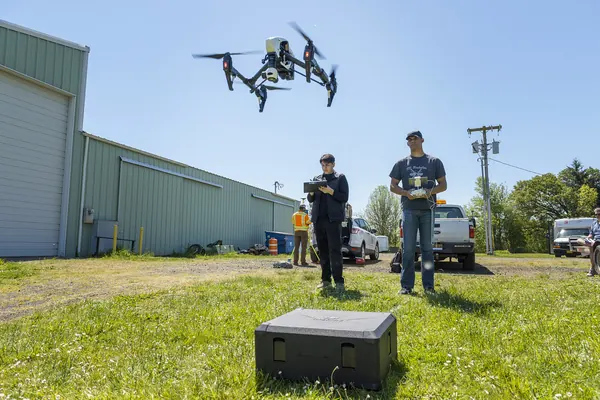
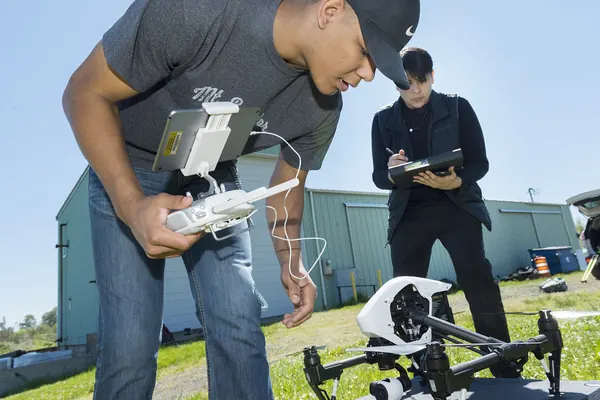
Illustrative photos, published by their authors under free licences.
Contents of the complete guide
- Built-up area, populated area, public space: what your mission triggers (free extract below)
- Choosing the framework in town: professional open category, STS-01 or authorisation
- The prior declaration step by step: AlphaTango or form 15476*04
- The 10 working-day notice: getting the count right, and the back-schedule
- The file: documents to gather before declaring
- Public space on the ground: town hall, controlled ground area and residents
- Events and gatherings: what can be done, what cannot
- Paris and the Île-de-France region: P23, police prefecture and départements
- The decision tree: which procedure, which lead time
- Flight day: checks, changes and after the flight
- Eight templates to copy
- Sources and dates consulted
Included: 34 checklist items and 13 decision or reference tables.
Introduction
In a French city, a drone mission is rarely decided in the air. It is decided ten to fifteen days earlier, when you need to know whether the address is in a populated area, whether the prior declaration is due, which operating framework to use, which documents to attach and which prefecture to send them to, and whether the pavement where your safety perimeter will stand belongs to the municipality. A gap at that stage is paid for on the day: flight postponed, a police check that goes badly, a client who finds out the footage was shot outside any legal framework.
This guide sets out the full procedure for the operator flying in built-up areas and for the client commissioning the mission. It starts from what the texts say since 1 January 2026: the order of 23 December 2025 amended the order of 3 December 2020 (the "Espace" or airspace order), opened the open category to professional flights above public space in built-up areas and raised the prior declaration notice to 10 working days. It then explains each step in the order it is done, and ends with a decision tree and eight ready-to-fill templates: site pre-assessment sheet, cover email to the prefecture, statement of the professional purpose, owner or site manager consent, request to occupy public land, notice to residents, agreement with an event organiser, and controlled ground area sheet.
The guide is up to date as of 3 November 2026. The texts cited were re-read that day on Légifrance, form 15476*04 and its notice on service-public.fr, and the DSAC guides on ecologie.gouv.fr. French texts are only authoritative in French, and the forms are in French: the French names you will need are given in brackets. Read it in order the first time; afterwards, chapter 9 (the decision tree) and the templates are enough for each new mission.
Built-up area, populated area, public space: what your mission triggers
Three notions decide everything, and they do not overlap. Mixing them up is the most common mistake, in both directions: some operators declare flights that did not need it, others fly undeclared where a declaration was due.
The built-up area (agglomération)
This is the notion that closes public space to recreational flying. To draw its limits, the DSAC guides refer to article R110-2 of the French Highway code: the "area where closely spaced buildings are grouped and whose entry and exit are marked by signs" along the road. The notice of form 15476*04 adds that the limits follow the land parcels served by road sections classified as "in built-up area" by municipal order. A village of a few houses between two town signs is a built-up area, whatever its size.
The outline of built-up areas on the Géoportail restrictions map is indicative only, as the DSAC itself states. When in doubt, the municipal order or the road signs on site decide.
The populated area (zone peuplée)
This is the notion that triggers the prior declaration. Article 2 of the airspace order, as amended on 23 December 2025, says a drone is in a populated area when it flies:
- within, or less than 50 m (horizontal distance) from, a built-up area shown on the current aeronautical charts of the SIA, the French aeronautical information service (1:500,000, or failing that 1:250,000 or 1:100,000);
- or less than 150 m (horizontal distance) from a gathering of people.
Two clarifications in the official texts change practice. Only places the chart legend classes as "agglomération" count, not those shown as mere navigation landmarks or small settlements: a hamlet that is not on the aeronautical chart is not a populated area on that criterion alone. And a gathering, according to the DSAC, is a group so dense that people cannot move away: the audience of a show or sports event, parks, beaches or tourist sites at busy times, a parade. The form's notice speaks of "a crowd of several dozen people".
Public space (espace public)
This is the notion that separates the professional flight now possible in the open category from the flight that was never prohibited. The DSAC defines it as public roads and places open to the public, that is, freely accessible (beaches, public gardens, promenades) or accessible on a condition anyone can meet, such as an entry ticket. A stadium on match day, an amusement park or a shopping centre car park are public space in this sense. A closed courtyard, a private garden or the fenced interior of an industrial site are not.
What articles 5 and 6 say, on one page
- Article 5, 1° (open category): the drone does not fly above public space in a built-up area, except "in the course of the professional activity of its operator", or in places where the prefect authorises the open category. In a populated area, these professional flights are subject to the article 6 declaration.
- Article 6, 1° (specific category: STS-01, authorisations): every flight in a populated area is subject to a prior declaration to the territorially competent prefect, with ten working days' notice, on AlphaTango or with form 15476. The prefect may prohibit or restrict the flight.
The direct consequence of this wording: in the open category, it is flying above public space in a populated area that must be declared; in the specific category, it is every flight in a populated area, even above private land. That is what the form's box "flights exclusively outside public space" is for.
Common situations
| Situation | Populated area? | What the mission triggers |
|---|---|---|
| Street facade in a city centre, C1 drone, open category | Yes | Prior declaration; municipal permission if the perimeter occupies the pavement |
| Warehouse roof in a business park outside any built-up area on the chart, more than 50 m from it, no public | No | No prefecture declaration; restrictions map, CTRs and sensitive sites still apply |
| House photographed from the client's garden, drone never leaves the plot, open category | Yes | No declaration required by article 5 while the flight and safety area stay off public space; as soon as the street is overflown, it is due |
| Same house, STS-01 mission | Yes | Prior declaration (article 6), box "exclusively outside public space" ticked |
| Square of a village not shown on the aeronautical chart, no gathering within 150 m, professional open category | No | Flight above public space possible without a prefecture declaration; informing the town hall is recommended |
| Market or fair 100 m from a farm plot, outside built-up areas, STS-01 mission | Yes (gathering) | Prior declaration; the gathering is never overflown |
| Concert, match, parade: drone above the public | Yes | Impossible in the open category and in STS-01; see chapter 7 |
| Central Paris, outside the two woods | Prohibited area P23 | Waiver from the Paris police prefecture (chapter 8) |
| Bois de Boulogne or Bois de Vincennes | Yes | Prior declaration to the Paris police prefecture |
Five minutes to classify an address
- Open the ICAO 1:500,000 aeronautical chart on Géoportail and check whether the address is in a built-up area shown on the chart, or within 50 m of one.
- Overlay the drone restrictions map: it shows indicative built-up area outlines, prohibited areas and maximum heights.
- Identify, on site or on a satellite view, what around the site will be open to the public on the day: street, pavement, square, shop car park.
- Ask the client what happens within 150 m that day: market, school run, ceremony, match, works with public access.
- Record the answers in the pre-assessment sheet (template 1). It is used to fill in the declaration and, in a check, to show the question was asked.
How it works
- You pay on StripeBy card, Apple Pay or Google Pay, in one go, on the checkout page hosted by Stripe: your card details never go through our servers.
- You read it right awayRight after payment, you land on the complete guide's page. Bookmark it or print it to PDF; the link and the invoice are emailed to you, and everything stays findable with “Find my purchases”, at the bottom of every page.
- Guaranteed contentAs described, or your money back: email devis@c-drone.fr and we restore access or refund you (terms of sale, in French).
Frequently asked questions
What does “Professional drone flights in French towns and cities: prior declaration and populated areas” contain and how much is it?
For €39 VAT included (€32.50 excl. VAT), you get professional drone flights in French towns and cities: prior declaration and populated areas: 11 chapters online, about 30 printable A4 pages and 8 ready-to-copy templates, to prepare a professional drone mission in a French town or city: know whether the flight is in a populated area and must be declared, choose between the professional open category, STS-01 and an authorisation, file the prior declaration (AlphaTango or form 15476*04) with its documents, count the 10 working-day notice, get permission to occupy public space, film an event without flying over the public, and fly in Paris and the Île-de-France region.
How do I receive the guide?
Right after payment you are redirected to the complete guide's page. Bookmark it, or print it to PDF (Ctrl+P or Cmd+P, “Save as PDF”). Stripe also emails you the receipt.
Do I get an invoice?
Yes: Stripe generates the invoice and emails it. You can enter your company name and VAT number at checkout. Seller: Lacangel Group (VAT FR21995268018); prices VAT included.
Is the guide kept up to date?
Yes. The guide's page is updated when the rules change; your access stays valid and you always read the latest version.
Which texts is the guide based on?
On the official texts in force (EU regulations, French decrees and codes), cited and dated with their links: you can check every rule at its source, which is authoritative. C-DRONE is an independent publisher.
Which device can I read it on?
Computer, tablet or phone: it is a web page, with no app or account to create. Print it to PDF to archive it or share it within your team.
What guarantee do I get?
The content matches its description, or you get your money back: email devis@c-drone.fr and we restore access or refund you (terms of sale, in French). This also applies to business purchases.
Other guides
New Drone light show guide
Organising a drone light show in France: budget, permits, contract
Town, company or wedding: check whether your project works, file the prefecture application on time, compare quotes, sign a contract that deals with the weather and run the night itself
€29 incl. VAT · €24.17 excl. VAT · 11 chapters · instant access
New CATS exam prep
Passing the French CATS drone exam: course and 104 practice questions
The eight subjects of the official DGAC syllabus summarised, 64 answered and explained questions, a 40-question mock exam and a four-week revision plan, with the French terms you will meet
€24 incl. VAT · €20.00 excl. VAT · 11 chapters · instant access
New Thermography guide
Drone thermography in France: commission, check and use the report
Roofs, facades, flat roofs, solar PV: choose the right measurement window, write the specification, check the flight conditions, read the report in fifteen minutes and turn it into repair decisions
€29 incl. VAT · €24.17 excl. VAT · 11 chapters · instant access
Free articles on the topic
- Prior notification for flights over populated areas: the procedure step by step
- Getting authorised to fly a drone over a built-up area in France
- Drones Over Cities: What the 23 December 2025 Order Changes for Flying Above Public Space
- Professional Drone Flights Over Public Space in Built-Up Areas: What the 23 December 2025 Order Changes
- Drone filming on public land: the city hall permit and the flight authorisation are two separate steps
Instant access to your guide after payment · terms of sale (in French). Questions before buying: devis@c-drone.fr.