A professional drone pilot for this mission Request a free quote
C-DRONE GUIDE · 24 JULY 2026
Construction crane inspection by drone: what it sees, VGP compliance, price
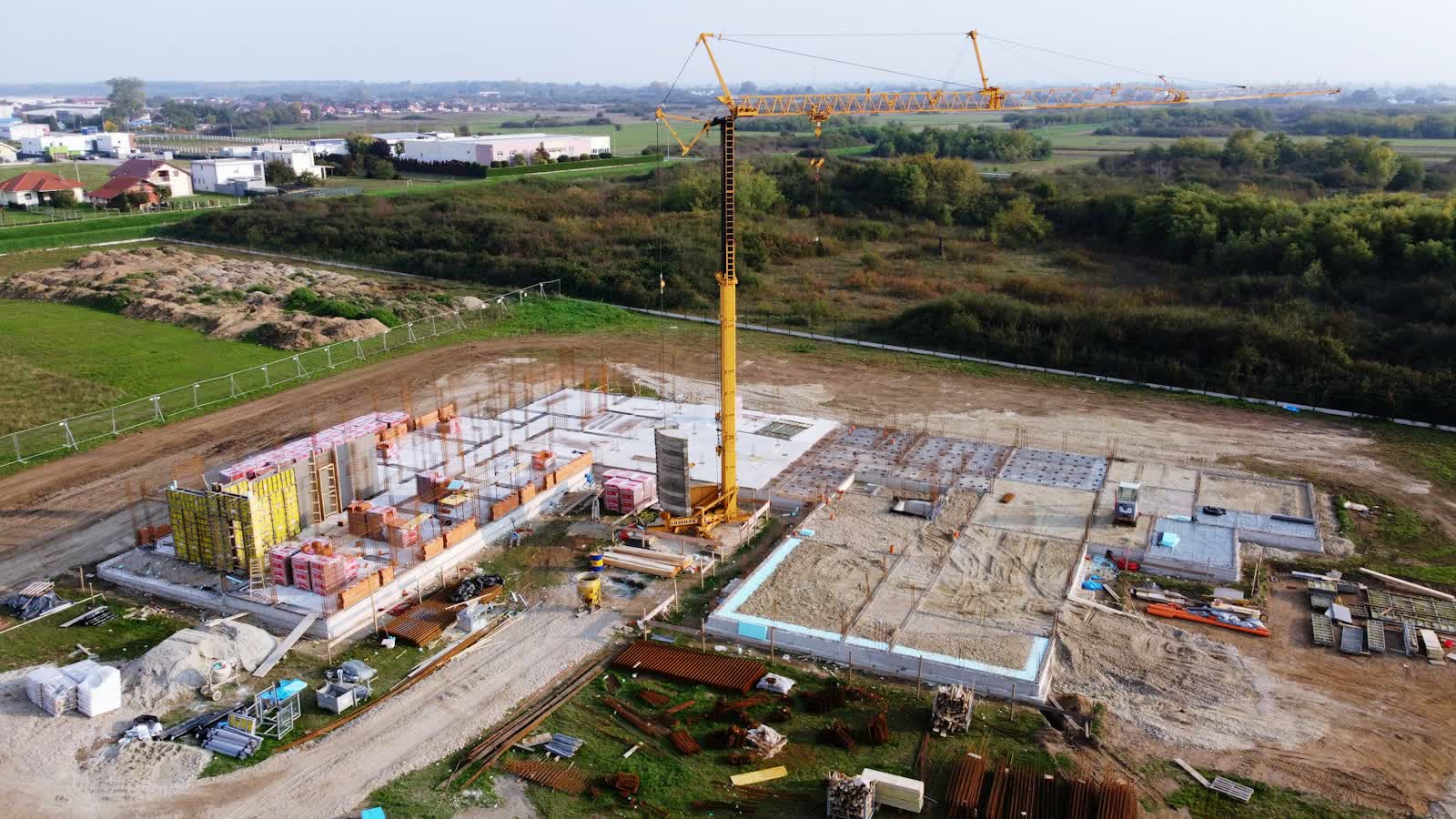
A site manager who wants to check the state of a jib before a sensitive lift, a crane rental company preparing for a periodic inspection, or a controlling body documenting an incident without waiting for a rope-access technician: in all three cases, visually inspecting a tower or mobile crane by default means sending a technician up 30, 50 or 80 m, cable by cable, along the jib or the mast. A drone covers the same structure in a few minutes, with no one hanging at height. Here is what a drone can inspect on a construction crane, why it does not replace the mandatory periodic inspection, and what it costs in 2026.
Published on 24 July 2026, updated on 22 September 2026 — regulations in force as of September 2026.
Why the drone changes construction crane inspection
Visually inspecting a tower crane traditionally means climbing the mast via the internal ladder, then moving along the jib or counter-jib on a lifeline to visually check the welds, bolts, load-bearing cables and pulleys — an operation that takes several hours, takes the crane out of service, and exposes the technician to one of the most accident-prone forms of work at height in the building and civil-engineering sector. On a mobile or self-propelled crane, the telescopic boom poses the same difficulty: some points are only visible once it is partly extended, which takes the machine out of service outside of any lifting operation.
A drone fitted with a high-resolution camera, flown a few metres from the structure, photographs every joint, every cable and every patch of rust or corrosion without a technician having to hang from it. The benefit goes beyond safety: the crane stays available for most of the flight, the inspection can be repeated cheaply between two mandatory periodic inspections, and it documents a precise state whenever there is doubt after an impact, a violent gust of wind or an incident reported by the crane operator.
What a drone can inspect on a crane — and what it does not replace
Three areas cover most of the demand. The jib and counter-jib: the visual condition of the lattice, of visible welds, of the paint (early corrosion), and how the pulleys are fixed. The load-bearing cables: visible strands, localised rust spots, wear points at the pulleys — a first-pass check that does not remove the need for a physical inspection if an anomaly is found. The crane head and cabin: the condition of the wind vane, the mandatory aviation warning lights at height, and the counterweight fixings.
A 2024 study published in the journal Buildings by Jiao, Wu, Zhang, Fan, Cai, Wang and Zhou describes a drone-based tower crane inspection system combined with onboard image processing, able to identify most major and significant hazards in flight within about thirty minutes, against several hours for a classic manual inspection (see the study). The authors highlight the same limit that applies to any drone inspection: it efficiently spots surface-visible anomalies, but measures neither a cable's mechanical strength nor a weld's internal condition — two parameters that remain a job for classic non-destructive testing whenever doubt persists.
The VGP: what the drone does not replace
In France, any lifting equipment used on a construction site — tower crane, mobile crane, truck-mounted auxiliary crane — is subject to a mandatory periodic inspection (VGP, vérification générale périodique), an obligation set out in articles R.4323-23 to R.4323-27 of the French Labour Code and, for tower cranes, in the order of 1 March 2004. It is carried out by a qualified person (an accredited body or an in-house competent technician, depending on the case), at a frequency that depends on the type of equipment: every 6 months for a mobile or auxiliary crane, annually for a tower crane — and it includes an examination of the state of conservation, static and dynamic load tests, and functional tests that a drone cannot perform.
The drone is therefore not a substitute for the VGP: it is a complementary tool, used ahead of time to prepare for the inspector's visit by flagging points that deserve particular attention, or between two VGPs to monitor how an already-identified anomaly (corrosion, impact, deformation) evolves without mobilising a rope-access technician for every check. The flight's photographic report feeds into the equipment's follow-up file, alongside the statutory inspection report, which remains the only document with legal standing in the event of an inspection or an accident.
Flight category and coordination with the site
On a site closed to the public, with no bystanders nearby, a crane inspection most often falls under the open category: sub-category A2, with a safety distance from anyone present on the ground during the flight. As soon as the site borders a public road or an occupied building that the flight passes over, the mission can shift to the specific category — see our guide to the open versus specific category — with, where applicable, a prior declaration in a populated area under the relevant European standard scenario.
Beyond aviation rules, the main constraint remains operational: a crane in service is a moving obstacle, and the inspection must be coordinated with the crane operator — jib locked in a known position, the machine taken out of service for the duration of the flight, and everyone on site informed before take-off. As with any professional mission, the operator must be registered on AlphaTango, must check regulated zones on the Géoportail map — some urban construction cranes sit close to an aerodrome or a low-altitude military zone — and must hold professional third-party liability insurance.
The price of a drone crane inspection in 2026
The price mainly depends on the crane's height, the number of points to document and whether coordination with the crane operator during the flight is needed. Orders of magnitude observed in France in 2026:
| Service | Observed price (excl. VAT) |
|---|---|
| Visual inspection of a tower crane (jib, counter-jib, crane head) | €350 to €700 |
| Targeted inspection of a mobile or auxiliary crane (telescopic boom) | €250 to €500 |
| Post-incident record (impact, gust of wind) with a dated photo report | €300 to €600 |
| Periodic monitoring across several cranes (rental company or contractor framework agreement) | volume-based discount per crane, negotiated |
That price stays well below the cost of a lifeline inspection — including the machine's downtime — billed by the hour of a qualified rope-access technician. The drone does not remove the need for the statutory VGP, but it reduces its indirect cost: fewer last-minute surprises on inspection day, and a usable photographic record in case of a dispute with a rental company or insurer.
Frequently asked questions about drone crane inspection
Does the drone replace the VGP? No: the mandatory periodic inspection includes load and functional tests that a drone cannot perform. It complements it ahead of time or between two deadlines.
Does the crane need to stop during the inspection? Yes, in practice: the jib must be locked in a known position and the machine taken out of service for the duration of the flight, both for the pilot's safety and for image quality.
Can the inside of the mast or the cabin be inspected? No: a drone documents what is visible from the outside. The inside of the mast, the internal mechanical components and the electrical panel remain a job for a classic inspection.
Who can fly a drone on a construction site? A remote pilot registered as an operator on AlphaTango, covered by professional third-party liability insurance, and coordinated with the site manager before any intervention.
Put it into practice
- Drone construction site monitoring: rates and cities covered from €250
- Construction site monitoring in Bayonne Nouvelle-Aquitaine
- Construction site monitoring in Beauvais Hauts-de-France
- Construction site monitoring in Chalon-sur-Saône Bourgogne-Franche-Comté