A professional drone pilot for this mission Request a free quote
C-DRONE GUIDE · 13 OCTOBER 2026
Drones on building sites: SPS coordination and safety plans
On a building site, the drone often slips in through the side door: ordered by the client for communication, by the main contractor for volume surveys or by an insurer for a damage report, it lands one morning without the health and safety (SPS) coordinator having been told. Yet under the French Labour Code, the drone contractor is an intervening company like any other. This guide explains what that means in practice — general coordination plan, specific safety plan (PPSPS), joint inspection, cranes — and how to plan for it without weighing the job down.
Published on 13 October 2026 — regulations in force as of September 2026.
The drone contractor is an intervening company
Article L. 4532-2 of the French Labour Code requires health and safety coordination on any building or civil engineering site where several self-employed workers or companies work, subcontractors included, to prevent the risks of their simultaneous or successive activities. The text makes no distinction by trade: a pilot taking off inside the site perimeter, even for two hours, is working there. Whoever ordered the job — client, project manager, main contractor, insurance expert — coordination applies.
How demanding it is then depends on the category of the operation. Article R. 4532-1 defines three. A site requires prior declaration when it is expected to exceed 20 workers at any time and last more than 30 working days, or when its volume exceeds 500 man-days (article R. 4532-2). As soon as several companies work on such a site, or on a site involving specified high-risk works, the client has the coordinator draw up a general coordination plan (PGC), under article L. 4532-8. That document triggers the obligation for each company to produce a specific safety plan (PPSPS).
In practice, almost every site on which regular aerial monitoring is ordered — apartment blocks, office buildings, bridges, logistics platforms — exceeds these thresholds. The drone therefore enters an already structured framework, which is better understood in advance than discovered at the gate.
PPSPS, joint inspection, coordination log: what is due
On a site covered by a general coordination plan, article L. 4532-9 requires each company, subcontractors included, to draw up a specific health and safety plan (PPSPS) before starting work and pass it to the coordinator. The standard lead time is 30 days from receipt of the signed contract (article R. 4532-56); it drops to 8 days for certain subcontractors working without particular risks (article R. 4532-62). For a drone, the PPSPS need not be thick: it must describe what is specific to the flight and unknown to the general plan.
- Take-off and landing points, their marking and the ground exclusion area.
- Flight paths and heights, avoiding direct overflight of occupied workstations.
- Coordination with lifting equipment: time slot, radio channel, no-go sectors.
- Lost-link and emergency landing procedures, and what to do after a crash.
- Lithium battery handling: transport, charging, storage away from combustible material stores.
- The aviation framework: category, scenario, prior notification for populated areas if the site is in town.
Before the first visit, the coordinator carries out a joint inspection with the company (article R. 4532-13), whose signed report is entered in the coordination log (article R. 4532-38), together with the company's name and dates on site. For monthly monitoring over two years, one PPSPS and one joint inspection cover the campaign, updated at each change of phase — structural works to weather-tight envelope, a second crane going up. On a small third-category site without a general plan, the PPSPS is not required, but coordination still applies: the coordinator may set instructions, and a written exchange remains everyone's best protection.
The risks a drone adds to the site
Construction safety research long saw the drone mainly as a prevention tool. The national survey of safety managers by Masoud Gheisari and Behzad Esmaeili, published in 2019 in Safety Science, ranks monitoring lifting equipment near overhead power lines, monitoring activities around cranes and spotting unprotected edges as the top uses; the main barriers cited are liability and legal issues (see the study). Mostafa Namian, Mohammad Khalid, George Wang and Yelda Turkan then showed, in the Transportation Research Record in 2021, the other side: drones expose workers to new risks that companies have yet to identify properly (see the study).
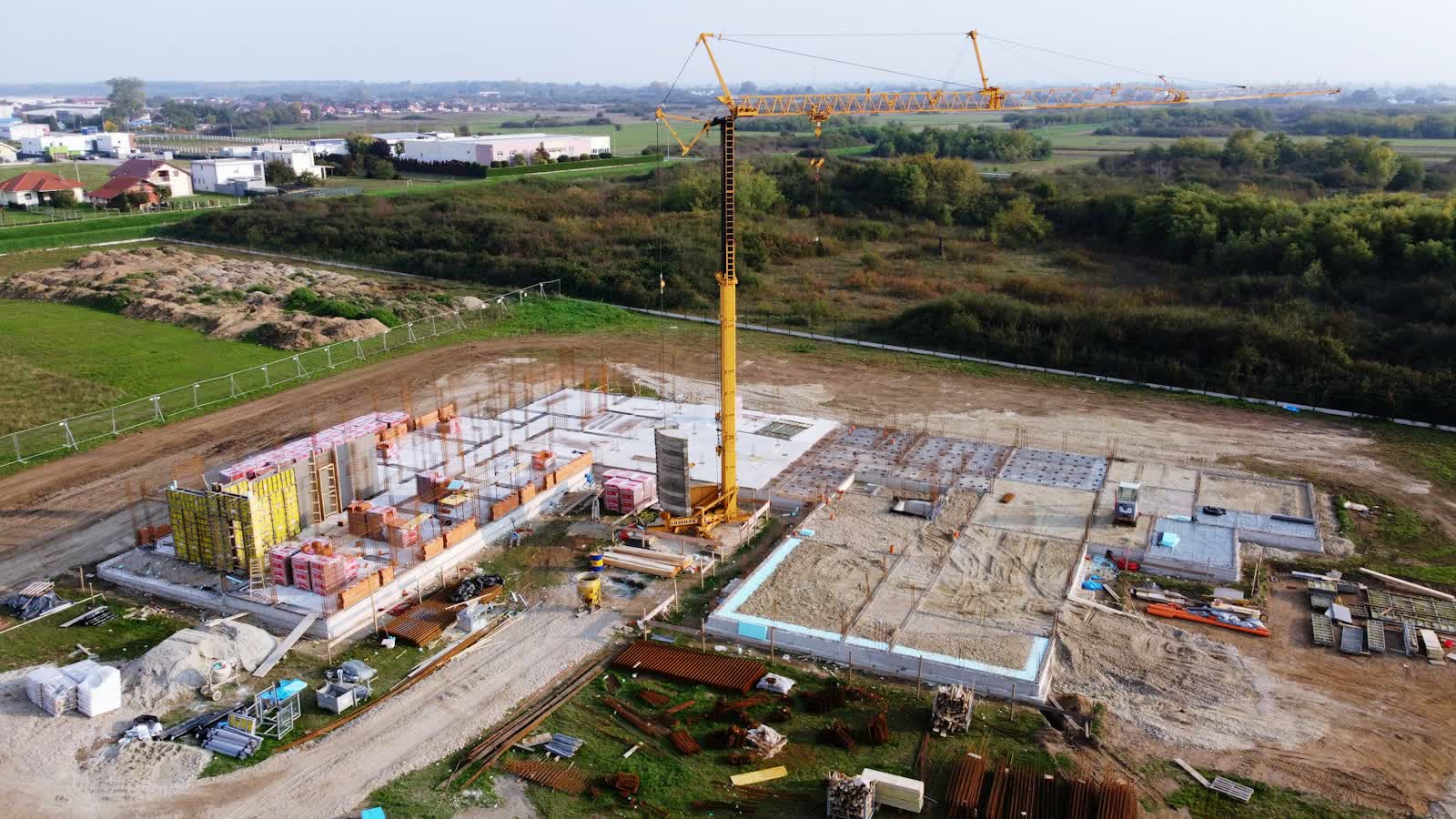
These risks fall into three groups. A fall of an aircraft weighing several kilos onto a workstation, scaffold or roof being laid. Distraction: a crane operator, plant driver or worker at height who looks up at an unexpected drone loses a few seconds of attention at the wrong moment. Co-activity with lifting equipment, the most serious: a tower crane's jib, ropes and load are moving obstacles, and the anti-collision systems that manage interference between cranes do not detect a drone.
One technical point often surprises clients: out of service, a tower crane is left weathervaning, its jib rotating freely with the wind to reduce wind load. A "stopped" crane is therefore not stationary. The flight plan must stay outside the circle swept by the jib and counter-jib, or fit into a slot agreed with the crane operator. Our guide to drone inspection of construction cranes covers the opposite case, where the crane is the subject of the job and must be locked out.
Organising the job: who prepares what, and when
The difficulty rarely lies in the substance, almost always in the chain of communication. When the client orders the drone for communication or reporting, the main contractor and the coordinator sometimes hear about it the day before. The right sequence has four steps:
- At order: the client gives the contractor the SPS coordinator's name and contact details, the general coordination plan or its useful extracts (access, lifting zones, hours), and names the site contact.
- In the following days: the contractor writes its focused PPSPS and checks the site's aviation framework (zone map, any CTR, prior notification if the site is in a built-up area, with its 10-working-day lead time).
- Before the first visit: joint inspection with the coordinator, on site or documented remotely for a simple site; choice of take-off points; coordination rule with the crane operator(s).
- At each flight: report to the site manager on arrival, radio briefing with the crane operator, immediate stop if a crane moves in the sector or workers step under the flight path.
For monthly monitoring, this process is not replayed at every visit: it is updated at each change of phase. That is also what makes aerial monitoring compatible with the rhythm described in our guide to drone monitoring of construction progress, where flights are timed to billing milestones.
Who pays, and 2026 prices
SPS coordination itself is paid for by the client, who pays the coordinator. The PPSPS and the time spent on the joint inspection, however, fall to the intervening company: a serious drone contractor puts them in its quote as a separate line rather than discovering them afterwards. Ranges observed in France in 2026, excluding VAT:
| Item | Range (excl. VAT) |
| Drone-focused PPSPS, first draft | €150 to €400 |
| On-site joint inspection (travel included, half day) | €200 to €450 |
| PPSPS update at a change of phase | €80 to €200 |
| Monthly monitoring flight with deliverables (excl. preparation) | €350 to €900 per visit |
Over a campaign of twelve to twenty-four visits, SPS preparation accounts for less than 5% of the total budget; on a one-off job it can be a third of the price, hence the value of bundling needs (monitoring, volume surveys, communication) into one contract. The paid guide Drones in construction: structure, roof, facade and site inspection includes a template drone PPSPS and a joint-inspection outline to adapt. For a specific site, request a quote with the SPS coordinator's contact details, the number of cranes and the phase schedule.
Frequently asked questions
Does a one-hour flight really need a PPSPS?
If the site is covered by a general coordination plan, yes: article L. 4532-9 covers every company called to work there, whatever the duration. The document can be short and focused on flight risks. On a small site without a general plan it is not required, but coordination still applies and the coordinator may set instructions.
Is a stopped crane no longer a risk for the drone?
It still is. Out of service, a tower crane is left weathervaning: its jib rotates freely with the wind. The drone must stay outside the circle swept by the jib and counter-jib, even with the crane stopped, or fly in a slot agreed with the crane operator and site manager.
Put it into practice
- Drone construction site monitoring: rates and cities covered from €250
- Construction site monitoring in Argenteuil Île-de-France
- Construction site monitoring in Vitry-sur-Seine Île-de-France
- Construction site monitoring in Colombes Île-de-France