Drones in construction: structure, roof, facade and site inspection
Buy — €15 Contents and free extract
VAT included · secure Stripe payment · instant access: by paying you request immediate access to the digital content and acknowledge you lose your right to cancel.
C-DRONE GUIDE · 13 OCTOBER 2026
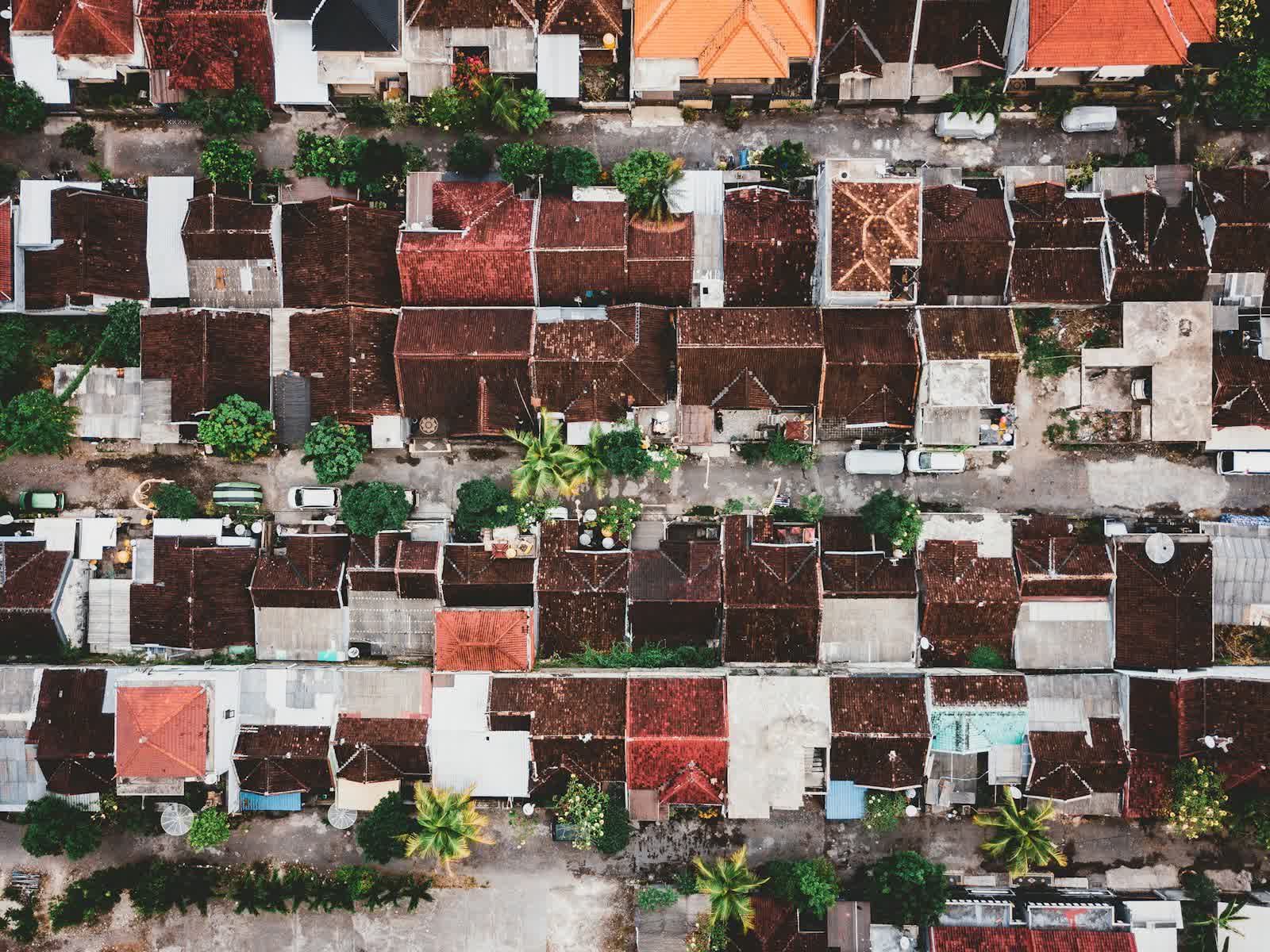
Roof-spraying drones in France: what to have in place before buying one
A spraying drone cannot be flown in the open category: EU rules forbid dropping any material there, and spraying a moss treatment means dropping it. Before buying the machine you therefore need to know which specific-category framework you will fly under, whether the chosen drone fits it (mass, class), which product you are allowed to apply and how to keep drift away from neighbours. C-DRONE does not sell drones: this page is meant to help you choose without getting the framework wrong. The professional operator guide then covers the declaration, authorisation, operations manual and insurance.
Published on 13 October 2026 — regulations in force as of September 2026.
Why the open category is ruled out from the start
Implementing Regulation (EU) 2019/947 only classes a flight in the open category if all the conditions of its Article 4 are met, two of which are enough to rule out spraying: a take-off mass below 25 kg (point b) and no material dropped (point f). The second settles the matter whatever the drone's size: as soon as it sprays, the flight falls under the specific category.
Mass then weighs on the choice of framework. A litre of water-based solution weighs about one kilogram: a full 20 to 30 litre tank alone therefore weighs 20 to 30 kg, before the drone and its batteries. Large-tank machines exceed 25 kg at take-off, and that threshold separates the simplified frameworks from case-by-case authorisations.
The flight framework decides the drone, not the other way round
In the specific category there are four doors, each with its own machine requirements:
| Framework | Formality | Drone |
|---|---|---|
| Standard scenario STS-01 (in sight, controlled ground area, populated areas included) | Declaration on AlphaTango | Class C5, under 25 kg |
| Standard scenario STS-02 (beyond sight, sparsely populated area) | Declaration on AlphaTango | Class C6, under 25 kg |
| PDRA-S01 (STS-01 operations without class marking) | Authorisation request to the DSAC on METEOR | Under 3 m and 25 kg, no class requirement |
| SORA (full risk assessment) | Authorisation request to the DSAC on METEOR | Depending on the assessment, including above 25 kg |
A standard scenario is only open to a drone bearing the C5 or C6 class marking: check it on the target model's data sheet and EU declaration of conformity, because a spraying drone without it, or above 25 kg with a full tank, can only fly under a DSAC authorisation — through PDRA-S01 under 25 kg, through a SORA above. Have the DSAC confirm the framework with the target drone's data sheet before buying it: it will tell you whether the operation you describe can be authorised with that machine. In built-up areas, each job also requires a préfecture declaration at least 10 working days before the flight.
The product: the label matters as much as the drone
A roof moss treatment is not an unregulated product. Check two things on the label before the first job: that use on "roofs" or "outdoor surfaces" is authorised, and under which regime the product is placed on the market. If it is a plant protection product, aerial spraying of it is banned by article L253-8 of the French Rural Code, and the exemption in Law No. 2025-365 of 23 April 2025 only covers crops (steep slopes, rootstock mother vines, overseas banana plantations): it does not cover a roof. If it is a biocide, its conditions of use apply: dose, protection of the user and the environment, distances from water.
Keep the product's safety data sheet and technical sheet in your mission file: these are the documents well-informed clients ask for, and the drone roof cleaning guide advises them to do exactly that.
Drift: the risk behind neighbour disputes
In a housing estate, a droplet landing next door costs more than the roof treated. Two published trials measure what drives it. In a wind tunnel, Qi Liu, Shengde Chen, Guobin Wang and Yubin Lan tested a quadrotor drone rig at four pressures (2 to 5 bar) and three wind speeds (2, 4 and 6 m/s): pressure and wind speed both had a significant effect on drift, higher pressure producing more fine droplets under 100 µm, and rotor downwash limited the share of droplets travelling far (Applied Sciences, 2021, see the study). In the field, Shengde Chen and co-authors compared four nozzles over rice: the cumulative drift rate fell from 73.9% with the finest droplets (95 µm median diameter) to 23.1% with the coarsest (185 µm) under their test conditions (Agronomy, 2020, see the study).
These trials concern crops, not roofs, but their lesson applies to choosing the machine: a drone whose pressure and droplet size can be adjusted, and a procedure that sets a wind threshold above which you do not spray, directly reduce the risk of marks on a neighbour's car, conservatory or vegetable patch. That threshold, sheeting and distances from water belong in the operations manual the DSAC will review.
The checklist before ordering the machine
- The target framework (PDRA-S01 or SORA) and the DSAC's view on the operation described with this drone.
- Take-off mass with a full tank, any class marking (C5, C6) and the manufacturer's declaration of conformity.
- The remote pilot qualifications that framework requires, and the associated practical training.
- The operator registered on AlphaTango, with an operations manual describing spraying.
- Insurance that names the spraying activity and damage to neighbouring property.
- A product whose label authorises use on roofs, with its data sheets.
- The price clients pay for the service, to check the machine pays for itself: published ranges are collected in the drone roof cleaning guide, and facade ranges in the drone facade cleaning guide.
For farming work (steep vineyards, spreading), the framework is different: see agricultural drone spraying and spreading.
Frequently asked questions
Can a roof be de-mossed with a drone in the open category?
No. Article 4(1)(f) of Regulation (EU) 2019/947 limits the open category to flights carrying no dangerous goods and dropping no material. Spraying, even water, falls under the specific category, with a registered operator, a pilot trained for the chosen framework, an operations manual and insurance.
Does the 2025 law on spraying drones apply to roofs?
No. French Law No. 2025-365 of 23 April 2025 opens an exemption, limited to drones, to the ban on aerial spraying of plant protection products (Rural Code, article L253-8) for specific crops: slopes of at least 20%, rootstock mother vines, banana plantations in the overseas departments, with biocontrol, organic-approved or low-risk products. Roof treatment is not a crop: it requires a product whose label authorises that use.
Put it into practice
- Drone roof inspection: rates and cities covered from €200
- Roof inspection in Rouen Normandie
- Roof inspection in Tourcoing Hauts-de-France
- Roof inspection in Poitiers Nouvelle-Aquitaine