C-DRONE GUIDE · 23 JULY 2026
Drone thermal inspection of industrial switchboards and busbar systems: preventive maintenance, method, price
A maintenance manager at an industrial or logistics site where busbar trunking runs high above the racking, an operator of an outdoor medium-voltage substation, or a solar farm operator whose conversion stations are spread across several hectares: in all three cases, infrared thermography remains the reference tool for spotting a hot spot before it turns into a failure or an electrical fire, but the classic round with a handheld camera, cabinet by cabinet, quickly hits its limits once the installation stretches upward or across a large area. A drone fitted with a radiometric thermal camera covers in a few flights what a technician would need hours on foot or on a platform to walk. Here is how this method works, what the applicable electrical and aviation regulations say, and what it costs in 2026.
Get up to 3 quotes from professional drone pilots in your area
Describe the mission in two steps. With your consent, it is passed on to partner professional pilots (3 at most), who contact you directly with their proposal.
Published on 23 July 2026, updated on 22 September 2026 — regulations in force as of September 2026.
The electrical hot spot: an early warning of failure or fire
A loose connection, an oxidised contact, a phase imbalance or an overloaded breaker almost always shows up as a local rise in temperature, well before a defect becomes visible to the eye or causes an outage. That principle has made infrared thermography one of the most widespread tools in preventive electrical maintenance: in France, the Labour Code (articles R.4226-14 to R.4226-21, detailed by the decree of 26 December 2011) requires a periodic check — annual in most cases — of electrical installations, carried out by an accredited body or a qualified person recognised as competent by the employer. Infrared thermography does not replace that regulatory check, but it has become a common complement to it, because it detects an abnormal temperature rise without needing to shut down the installation or open live cabinets.
The traditional method remains a ground round: a qualified thermographer walks each cabinet, cover open, handheld camera in hand, under the installation's normal operating load — a switchboard that is idle or lightly loaded reveals no hot spot, since the defect only heats up in the presence of the current it is meant to carry. On a modest site, this round stays quick and cheap. It becomes far heavier once the installation spreads out: busbar trunking suspended above a warehouse with a high ceiling clearance, an outdoor medium-voltage substation with busbars unreachable without a platform, or a fleet of dozens of conversion stations scattered across a ground-mounted solar farm.
How a drone documents an electrical installation with thermography
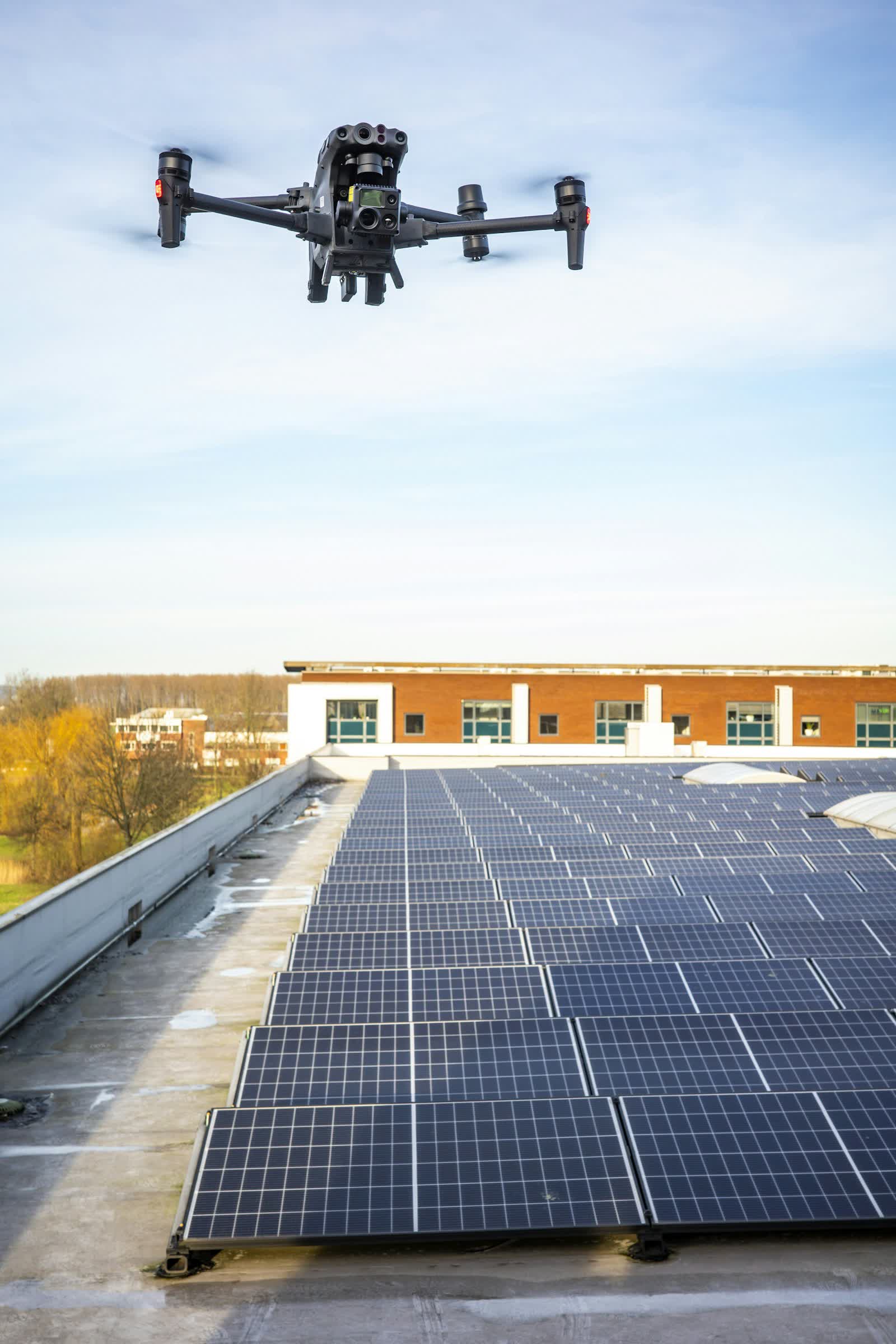
An industrial inspection drone carries a radiometric thermal camera — it does not just display a colour palette, it measures an actual temperature on every pixel of the image, which allows a hot spot to be objectively compared from one survey to the next rather than relying on a visual impression. The flight takes place at a safe distance from live parts, which cuts the arc-flash risk a technician faces working right next to an open cabinet — a safety benefit on top of the time saved. Every detected anomaly is geolocated on the site plan and tied to its thermal signature, for a report that tracks a given point's evolution precisely across several surveys.
A study published in 2023 in Scientific Reports by Lim, Jin and Bang (Ulsan National Institute of Science and Technology) describes a monitoring system combining a drone, a thermal camera and deep learning for automated anomaly detection on critical industrial installations, with reliable classification of overheating zones from aerial imagery alone (see the study). A reference review on infrared thermography in industrial maintenance, published by Bagavathiappan, Lahiri, Saravanan, Philip and Jayakumar in 2013 in Infrared Physics & Technology, notes that contact defects — poor tightening, oxidation, faulty crimping — are among the most frequent causes of overheating detected on electrical equipment by this method, well before they cause a failure (see the study). The drone does not change this underlying physics, it simply extends its reach to hard-to-access areas.
Flying over an electrical installation: regulations and safety
The aviation framework depends first on where the mission takes place. Inside a warehouse or an industrial hall — the most common case for busbar trunking suspended above storage racking — the flight takes place in an enclosed and covered space, outside the scope of the decrees governing the use of airspace: a principle detailed in our guide to tunnel and underground gallery drone inspection, which relies on the same exemption. Outdoors — an open-air medium-voltage substation, a technical rooftop, a ground-mounted solar farm — the mission most often falls under the open category, sub-category A2 or A3 depending on whether staff are nearby, with the remote pilot registered as an operator on AlphaTango.
In both cases, the main constraint does not come from the airspace but from the electrical risk itself: a safety distance from live parts must be agreed with the site's HSE department or electrical operations officer, on the same principle as the electrical clearance required of a technician working near a live installation. Thermography requires the installation to stay powered and loaded during the flight — unlike a job that needs a lockout, here the absence of load is what makes the mission pointless. Professional third-party liability insurance covers the flight, separate from the site-access authorisation issued by its operator.
The price of drone electrical thermography in 2026
Pricing mainly depends on the number of points to cover, how spread out they are across the site, and the height of the equipment. Orders of magnitude observed in France in 2026:
| Service | Observed price (excl. VAT) |
|---|---|
| Suspended busbar trunking, single warehouse or industrial hall | €500 to €1,200 |
| Outdoor medium-voltage substation, busbars and transformers | €800 to €1,800 |
| Solar farm campaign (per conversion station) | €80 to €200/station, tapered beyond 20 stations |
| Geolocated report with comparative tracking between surveys | +15 to 25% of the collection cost |
| Analysis by a qualified thermographer (level 1 or 2) | included or extra depending on the provider |
That price should be weighed against a manual round requiring a platform for elevated areas, or technician days billed to cover a site spread across several hectares. For a single cabinet that is easily reached in a technical room, a classic handheld camera often remains the simplest and cheapest solution: the drone earns its place once the installation stretches upward or across a large area, without replacing the mandatory periodic electrical check.
Frequently asked questions about drone electrical thermography
Does the drone replace the mandatory periodic electrical check? No: the annual check by an accredited body or a qualified person remains compulsory under the Labour Code. Drone thermography is a complementary preventive-maintenance tool, not a substitute for that obligation.
Does the power need to be cut for the inspection? No, quite the opposite: the installation must be live and under normal load for a hot spot to show up. A de-energised cabinet displays no thermal anomaly, even if it has one.
When is a drone genuinely more useful than a handheld camera? As soon as the installation stretches upward (suspended busbar trunking, an outdoor substation) or across a large area (a solar farm, a multi-building industrial site). For a single, easily reached cabinet, a handheld camera stays simpler and cheaper.
Who analyses the thermal images? A qualified thermographer, ideally certified to level 1 or 2 under the profession's standards, who interprets temperature differences in light of the equipment type and its load at the time of the flight.
Put it into practice
- Drone aerial thermal imaging: rates and cities covered from €500
- Aerial thermal imaging in Colmar Grand Est
- Aerial thermal imaging in Troyes Grand Est
- Aerial thermal imaging in La Roche-sur-Yon Pays de la Loire