C-DRONE GUIDE · 30 JULY 2026
Grain Silo Drone Thermal Monitoring: Self-Heating, Dust Risk, Price
A grain silo that is overheating gives no warning. The grain keeps respiring after harvest, insects and mould settle in as soon as one spot in the mass crosses a critical moisture threshold, and this biological activity releases heat that builds up at the core, invisible from the top of the cell. Two risks follow, distinct but linked: commercial degradation of the batch — mould, mycotoxins, lost value — and, in the worst cases, self-heating that feeds a silo fire, made worse by the grain dust suspended during handling, which can explode on contact with an ignition source. Agricultural cooperatives, grain traders and port silos monitor this risk routinely, most often with internal temperature cables. A thermal drone survey adds an exterior, fast, no-exposure complement: here is the method, its honest limits, the applicable regulatory framework and prices observed in 2026.
Published on 30 July 2026, reviewed on 21 September 2026 — regulations in force as of September 2026.
A biological risk before it is a fire risk
Harvested grain is not an inert material: it keeps respiring, consuming oxygen and releasing CO₂, water and heat, a phenomenon amplified by residual moisture and by broken grains or dust mixed into the batch. As soon as one spot in the mass crosses a critical moisture threshold, insects and mould settle in and take over that respiration: the resulting heat then builds up at the core of the mass, where air circulates least, and can locally push the grain dozens of degrees above ambient temperature — a self-heating hot spot that stays invisible for a long time from the top of the cell or the service gangway.
Beyond degrading the batch commercially — mycotoxins, weight and market-value loss — this hot spot can develop into slow combustion and, in the worst configurations, a silo fire. The risk is compounded by a second danger specific to the sector: grain dust suspended during handling operations — filling, transfer, unloading — forms an explosive atmosphere on contact with an ignition source, a mechanism well documented by silo explosions in France and abroad over several decades.
What a thermal survey reveals — and what it does not see
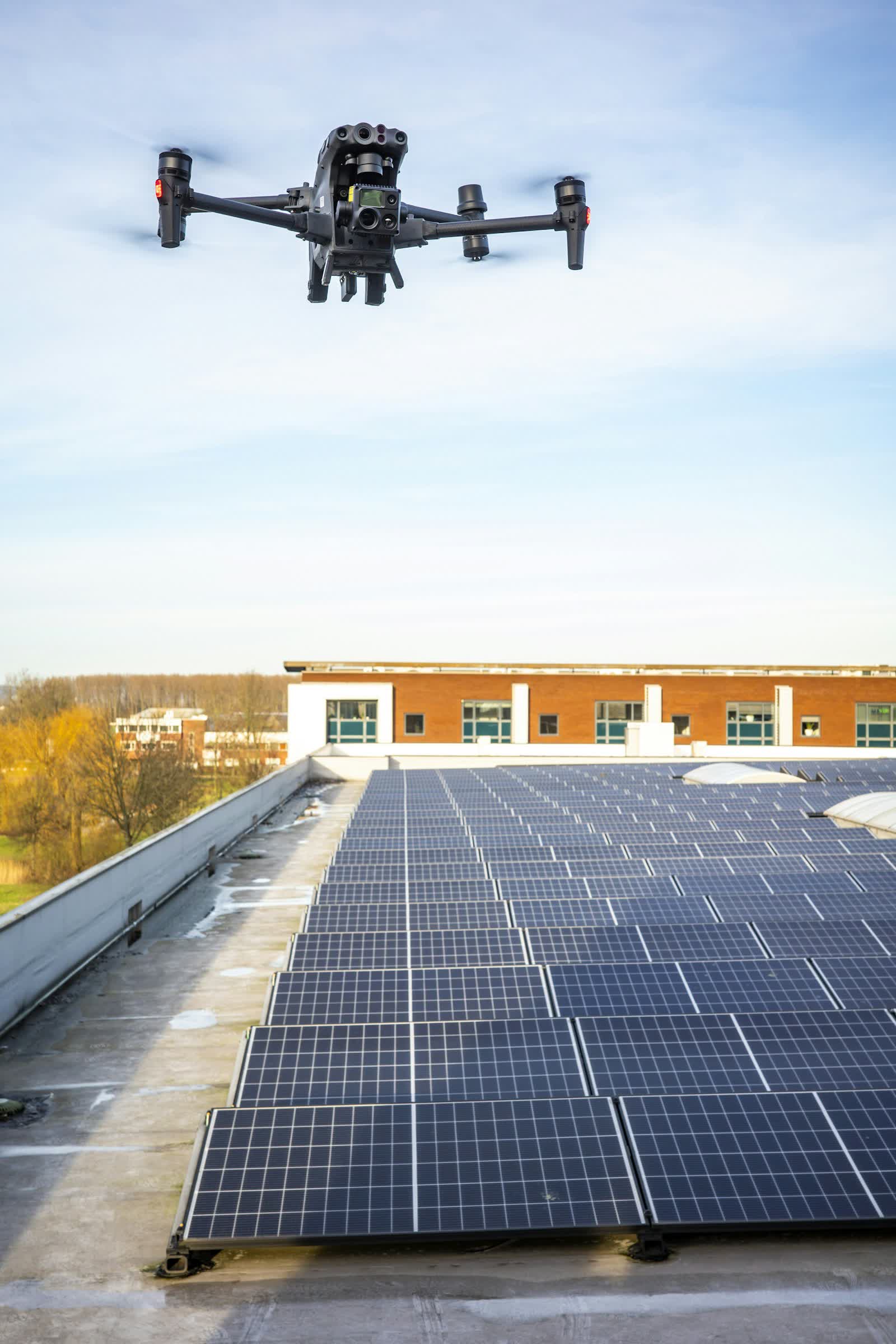
A drone fitted with a thermal camera flies over the cell or the whole site, ideally early in the morning when the gap with ambient temperature is clearest. On a metal silo, the galvanised wall reflects too much infrared radiation to be read directly: a high-emissivity surface treatment — dedicated paint or adhesive tape — is needed for the camera to return a reliable wall-temperature reading. The thermal image then reveals a localised hot spot, an area where the grain surface sinks abnormally, or steam visible in daylight that betrays active fermentation.
The limit must be stated honestly: a study by Manickavasagan, Jayas, White and Jian published in 2006 in Applied Engineering in Agriculture tested detection of an artificial hot spot placed at nine locations inside an experimental barley silo — the hot spot was only detected from the wall or grain surface when it sat within 0.3 m of the wall or below the surface (see the study on Google Scholar). A deep hot spot at the core of a large cell therefore stays out of reach of an exterior survey. A thermal drone does not replace the temperature cables that run vertically through large cells; it complements their point-based coverage with a fast exterior sweep of the whole site, cell by cell, at a frequency no manual round can match.
A mission that stays outside the hazard zone
The whole value of the survey lies in what it avoids: unlike an interior cell inspection — a confined space that requires authorisation, a lock-out procedure and sometimes breathing apparatus — the thermal drone operates from outside the silo, with no operator ever entering an atmosphere that may hold explosive dust. The mission is prepared with the operator: a plan of the cells and their numbering, the history of stored batches and their moisture on intake, and areas already flagged as sensitive by the temperature cables. The flight itself follows a systematic pass along each façade and, where the layout allows, an overhead shot of open loading hoppers.
Repeated at regular intervals — monthly during extended storage, more often on a batch already flagged as damp on intake — this monitoring turns a one-off check into comparable tracking from one visit to the next, with every anomaly dated and located on the site plan. It fits alongside the structural inspection of the envelope — corrosion, weatherproofing, hatch condition — detailed in our industrial chimney and silo inspection guide.
Regulatory framework: ICPE heading 2160 and ATEX zoning
Bulk storage of cereals, grains or any organic product releasing flammable dust falls under heading 2160 of the French classified-installations nomenclature: below 5,000 m³ of stored volume, the site stays under the threshold or under simple declaration; between 5,000 and 15,000 m³, it moves to declaration or registration depending on site configuration; beyond 15,000 m³, the authorisation regime applies, with stricter requirements on detection and firefighting. These thresholds, which sometimes distinguish flat silos from vertical ones, cover nearly every cooperative and port site of significant size.
Alongside this environmental regulation sits ATEX regulation: the French Labour Code (articles R. 4227-42 and following) requires the operator to classify zones where combustible dust can form an explosive atmosphere, produce an explosion-protection document, and provide specific training for staff entering those zones. A thermal survey flown from outside the cells does not change this zoning: it adds to existing prevention measures without exposing any extra personnel. On the aviation side, these sites generally sit in sparsely populated areas; near a built-up area, prior notification for populated-area flight applies, and the operator must be registered with AlphaTango and insured, as our choosing a professional pilot guide reminds.
Prices observed in 2026
Ranges observed in 2026 (excl. VAT), depending on the number of cells and chosen frequency:
- One-off thermal survey (site up to 10 cells, report with located hot spots): €450 to €950.
- Monitoring subscription (monthly pass during the storage period, alerts on temperature drift): €300 to €700 per visit depending on the number of cells.
- Multi-site campaign (several silos of the same cooperative, grouped round): 10 to 20% discount per site.
- Combined thermal survey + structural envelope inspection package: €700 to €1,500 per site.
Compare that with the cost of a downgraded batch or a cell fire: lost harvest, downtime, repairs. Request a quote stating the number of cells, their height and the desired monitoring frequency.
Put it into practice
- Drone aerial thermal imaging: rates and cities covered from €500
- Aerial thermal imaging in Le Havre Normandie
- Aerial thermal imaging in Aix-en-Provence Provence-Alpes-Côte d'Azur
- Aerial thermal imaging in Boulogne-Billancourt Île-de-France