C-DRONE GUIDE · 18 JULY 2026
Finding a swimming pool leak with drone thermal imaging: what actually works
A pool losing several centimetres a week, a water bill climbing with no explanation, a campsite or hotel whose aquatic park drinks more than it should: a swimming pool leak is an expensive fault to diagnose, because the point of loss and the place where the water shows up rarely coincide. Drone thermography has a real role to play here — though not always the one people expect. Here is exactly what it sees, what it does not, and what it costs in 2026.
Get up to 3 quotes from professional drone pilots in your area
Describe the mission in two steps. With your consent, it is passed on to partner professional pilots (3 at most), who contact you directly with their proposal.
Published on 18 July 2026, updated on 22 September 2026 — regulations in force as of September 2026.
Why a pool leak is so hard to pin down
The scenario is a familiar one for campsites, hotels and holiday residences: the pool level drops faster than evaporation alone can explain, or the site's water meter shows abnormal consumption with no puddle or damp patch giving anything away on the surface. A simple first check confirms the suspicion: the bucket test, which compares how fast the pool level drops against a control bucket placed on a step — if the pool drops faster, the leak is real, not just seasonal evaporation.
The question then is where to look. A campsite's or hotel's aquatic park is almost never a single, isolated basin: it is a network of buried pipes, sometimes running for tens or even hundreds of metres, connecting the main pool to the plant room, feeding a paddling pool or a heated coping. The traditional method — probing metre by metre with an acoustic listening device, or digging test trenches along the suspected route — takes part of the site out of action in high season and can run up a bill before anything has even been found. Narrowing down the likely area before digging is not a luxury: it is what decides whether the repair takes half a day or a week.
What the thermal camera actually detects — and what it does not
Thermography does not observe the leaking water itself: it observes how ground or a slab soaked with water releases heat differently from a dry area nearby. Late in the day, after a sunny spell, dry surfaces cool quickly while soil kept damp by a faulty pipe stays warmer for longer: the gap shows up clearly on the thermal image, particularly around the pool surrounds, the lawn above the pipe run, or the plant-room floor.
It is a useful method, but one that needs an honest frame: it picks up a surface signature, not the leak itself. A hairline crack in the pool shell or liner, or an old, deep leak on a pipe buried long ago, may well have created no detectable thermal gap at the surface. Drone thermography therefore does not replace the classic confirmation methods — fluorescent dye injected at the suspected point, pressure-testing the network, acoustic correlation at the precise spot — it directs them, narrowing a site of several thousand square metres down to a handful of priority areas to probe.
The drone's real advantage: covering the whole site in a single flight
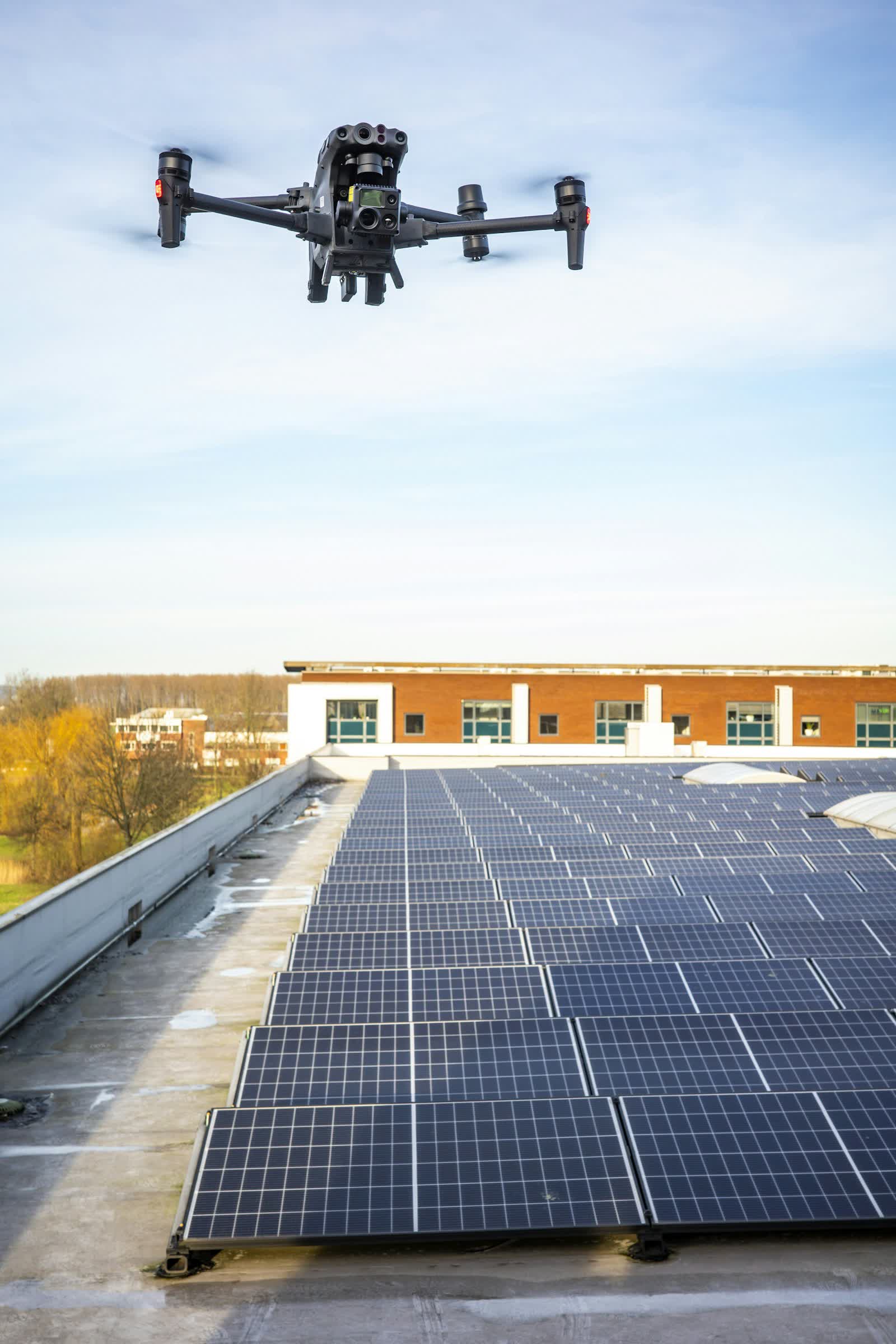
This is where the drone brings genuine added value, precisely because a campsite's or hotel's aquatic park covers a large area. Where a technician must move point by point with an acoustic listening device, a drone fitted with a radiometric thermal camera covers the whole pool, its surrounds, the likely pipe route and the plant room in a single mission, flying at 15-25 m. The pilot always pairs the thermography with visual photos, to match every anomaly with something identifiable on the ground (an inspection chamber, an expansion joint, a recently disturbed patch of soil).
The flight window is chosen accordingly: late afternoon or early evening after a sunny day, within the hour following sunset — a slot that stays legally within the aeronautical day, since aeronautical night only begins thirty minutes after sunset (see our guide flying a drone at night: what French law says), avoiding any need for a night waiver. A pool soaked by recent rain, on the other hand, will give an unreadable image: better to wait for two or three dry days, the same weather constraint as flat-roof thermography.
How a mission unfolds, and the regulatory framework
The mission starts with a daytime recce: the pilot checks the area on the Géoportail drone map, spots obstacles (light poles, inflatable structures, trees) and works with the site manager to identify the known pipe layout and the history of past works. If the site is in a built-up area, professional open-category flight over public space there has been allowed in daytime since 1 January 2026 (order of 23 December 2025); depending on the configuration, a prior declaration to the préfecture may be required, with ten working days' notice — a lead time worth building in as soon as the first signs of a leak appear, rather than under time pressure.
The thermal flight itself usually takes thirty to sixty minutes for a typical aquatic park, without draining the pool or interrupting its operation. The report, delivered within 48 to 72 hours, overlays a visual orthophoto with the thermal layer, locates the areas of abnormal temperature gap and ranks the priority spots to probe — enough to send the leak-detection contractor straight to the right area instead of letting them comb the whole site. Just check, as with any service, that the pilot is registered as a UAS operator on AlphaTango and covered by aerial third-party liability insurance meeting Regulation (EC) No 785/2004.
The price of drone pool leak detection in 2026
The price mainly depends on the area to cover (a residential pool has nothing to do with a multi-basin campsite aquatic park) and the extent of the suspected buried network. Ranges observed on the French market in 2026:
| Mission | Observed price (excl. VAT) |
|---|---|
| Targeted survey around a residential pool or small establishment | €350 – 550 |
| Full diagnostic of a collective basin and its buried network (campsite, hotel) | €550 – 950 |
| Large multi-basin aquatic park, network spread over several hectares | €950 – 1,800 |
| Multi-year preventive survey programme (per site, tiered pricing) | quote on request |
These amounts cover the flight, the radiometric analysis and the report, but not confirmation or repair. For comparison, a classic diagnostic by dye, pressure test or acoustic correlation is typically billed from €150 to €850 depending on the method used and the size of the job: drone thermography acts as a rough-cut stage that narrows the search area before those finer techniques are engaged, rather than replacing them.
Frequently asked questions about drone pool leak detection
Does the drone find the exact leak? Not always directly: it locates the areas where the ground or slab show an abnormal temperature gap, which sharply narrows the search area. For a leak close to the surface, the anomaly often coincides with the defect itself; for a deep or old leak, a confirmation test (dye, pressure test) is still needed.
Does the pool need to be drained for the flight? No, thermography is carried out with the pool full of water and in normal use, with no interruption for holidaymakers.
Can it be done in peak summer, at busy times? The thermal flight is scheduled for late afternoon or early evening, after closing or outside busy hours, which limits disruption for guests while still meeting the required weather window.
What about checking heat loss from a heated pool? That is a different use of the thermal camera, closer to an envelope audit: see our guide to drone thermography for energy renovation. For the rest of the thermal camera's uses, our drone thermal imaging page covers every service in detail.
Put it into practice
- Drone aerial thermal imaging: rates and cities covered from €500
- Aerial thermal imaging in Châteauroux Centre-Val de Loire
- Aerial thermal imaging in Gap Provence-Alpes-Côte d'Azur
- Aerial thermal imaging in Périgueux Nouvelle-Aquitaine