C-DRONE GUIDE · 27 JULY 2026
Wood energy chip stockpile monitoring by drone: self-heating detection, cubage, price
A freshly delivered pile of forest wood chips looks harmless enough — yet within the first hours, cellular respiration in the still-living wood, followed by bacterial and fungal fermentation, raises the temperature at the pile's core, sometimes to 60 or 70°C within days. On a wood-energy platform or in a biomass boiler plant's yard, this self-heating — invisible from outside — precedes the large majority of stockpile fires. A visual check or a probe planted at one spot only covers a single point; a thermal drone survey sweeps the whole surface of a pile in minutes and pinpoints the hot spot before it starts smoking. Here is how a thermal — and volumetric — monitoring mission is run on a wood-energy stockpile, the applicable regulatory framework, and prices observed in 2026.
Published on 27 July 2026, reviewed on 21 September 2026 — regulations in force as of September 2026.
A known risk: the pile that heats up from within
The phenomenon has long been documented in the wood-energy industry: a pile of moist forest wood chips still hosts living cells in the sapwood and cambium, whose respiration releases heat as soon as the pile is formed. This first phase quickly gives way to bacterial, then fungal, fermentation under partial aerobic conditions, which can bring the pile's core to 60-70°C within hours to days — a temperature that stays high for a long time at the centre, where air circulates least and heat cannot escape. Beyond a certain threshold, chemical oxidation takes over from biological activity and, in the worst configurations, can lead to spontaneous ignition.
A study by Li, Koseki and Momota published in 2006 in the Journal of Hazardous Materials assessed precisely this fermentation-induced spontaneous ignition danger on wood chip piles, prompted by a series of stockpile fires in Japan (see the study on Google Scholar). The risk is therefore not theoretical: every wood-energy storage platform or biomass boiler-plant yard stacking several thousand cubic metres of chips is exposed, all the more so when piles are tall and compacted. The same exothermic fermentation principle threatens other organic materials in piles — we detail it for green-waste composting platforms.
What a thermal survey reveals
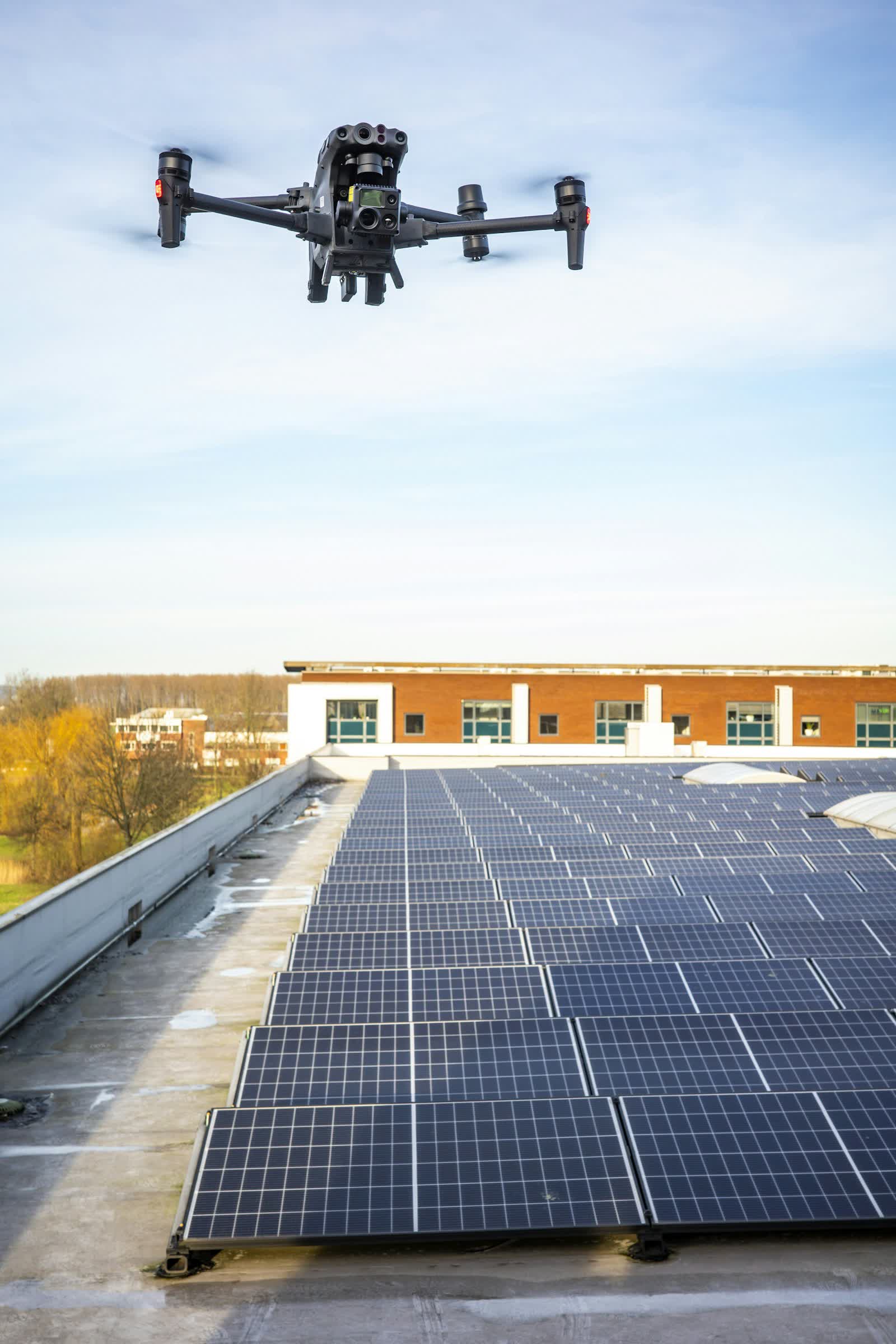
A drone fitted with a thermal camera flies over the pile or piles at constant altitude, ideally early in the morning when the gap with ambient temperature is clearest. The thermal image renders the pile's surface in false colour: a localised hot spot, a sunken area betraying an internal hot core, or steam visible in daylight that confirms active fermentation. Repeated at regular intervals — weekly during the peak delivery season, at every pile turnover — this sweep turns a one-off, localised check into systematic monitoring of the whole platform, pile by pile.
The limit must be stated honestly: the camera only sees the surface, while the hottest core often sits several metres deep under an insulating layer of cold chips. A thermal drone therefore does not replace temperature probes driven deep into the highest-risk platforms; it complements them, covering in minutes a surface no foot patrol sweeps as fast or as often, and objectively tracking how a suspect spot evolves from one week to the next.
Stockpile volume, in the same flight
The same flight — adding a standard visible-light photogrammetric pass — produces a digital surface model of the pile, from which the volume is derived by difference against the bare ground or platform. On a storage yard receiving regular deliveries and continuously feeding a boiler plant, this repeated cubage gives an objective read on actual stock — a figure visual estimation handles poorly on piles of several thousand cubic metres, irregularly shaped and constantly changing. The method is the same as detailed in our drone stockpile volume measurement guide, applied here to wood chips rather than aggregates.
Cross-checking the measured volume against delivery notes and the boiler plant's consumption acts as an accounting safeguard: an abnormal gap flags a weighing error, theft, or heavier pile compaction than expected — also useful for sizing the FIFO rotation that limits storage time, and therefore self-heating risk.
Regulatory framework: ICPE heading 1532 and flying over the site
Storing wood or similar combustible materials falls under heading 1532 of the French classified-installations nomenclature: beyond 1,000 m³ stored, the site moves to declaration or registration depending on configuration; beyond 20,000 m³, it shifts to authorisation with a public inquiry. These thresholds, often close to those of a mid-size wood-energy platform, come with requirements on distances between piles, detection means and access for emergency services — drone thermal monitoring fits naturally into this prevention logic, without replacing it.
On the aviation side, these platforms mostly sit in sparsely populated areas: flights fall under standard scenarios, with particular care if a boiler plant or a high-voltage line borders the site, as detailed in our industrial chimney and silo inspection guide. If the platform adjoins a built-up area, prior notification for populated-area flight applies — see our populated-area notification guide. As for any professional mission, the operator must be registered with AlphaTango and insured — the fundamentals gathered in our choosing a professional pilot guide.
Prices observed in 2026
Ranges observed in 2026 (excl. VAT), highly dependent on platform size and desired frequency:
- One-off thermal check (platform up to 1 ha, report with located hot spots): €400 to €900.
- Monitoring subscription (weekly or fortnightly passes during peak delivery season, alerts on temperature drift): €250 to €600 per visit depending on area.
- Volume survey alone (pile or piles cubage, stock tracking): €350 to €800 per campaign.
- Combined thermal + volume package (the most common choice on an active platform): €600 to €1,300 per visit, tapering with an annual subscription.
Compare that with the cost of a single stockpile fire — lost material, boiler plant shutdown, emergency response. Request a quote stating the platform's area, number of piles and desired frequency.
Put it into practice
- Drone aerial thermal imaging: rates and cities covered from €500
- Aerial thermal imaging in Boulogne-Billancourt Île-de-France
- Aerial thermal imaging in Montreuil Île-de-France
- Aerial thermal imaging in Nanterre Île-de-France