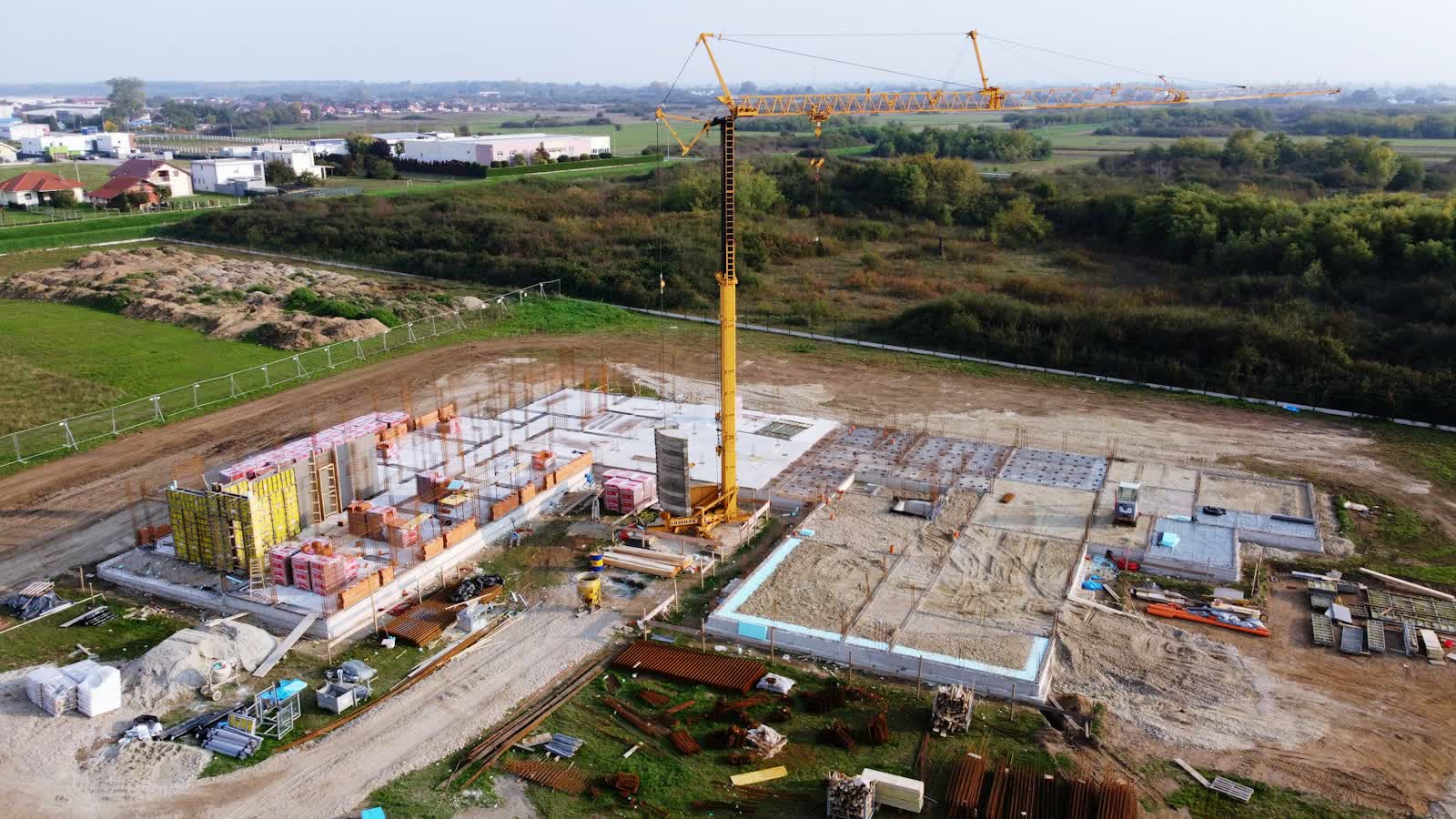
🏗️ CONSTRUCTION SITE MONITORING · NARBONNE (11) · €250–800 LE PASSAGE
Drone construction site monitoring in Narbonne
Housing estates, business parks, public facilities: around Narbonne, construction sites sprawl and are hard to track from the ground. A drone pass on a fixed date produces the same view month after month — progress becomes indisputable. In Narbonne as across the department (11), a local pilot travels with the equipment the mission requires — free quote within one working day.
The local economy relies on winegrowing (Corbières, La Clape), tourism (Narbonne-Plage, the Sigean African reserve) and renewables — the Aude is one of France's leading wind-power departments, a steady source of turbine inspection work. Other demand: vineyard monitoring, real estate, heritage and event coverage. Former capital of Gallia Narbonensis, Narbonne lines up the cathedral of Saint-Just-et-Saint-Pasteur with its unfinished Gothic choir, the Archbishops' Palace, remains of the Via Domitia and the Robine canal, UNESCO-listed as part of the Canal du Midi.
Typical missions in Narbonne
- Restoration works on monuments in Narbonne: progress records right up close to the scaffolding
- Hotel and residence builds and refits around Narbonne, monitored out of season
- Pre-works condition survey of neighbouring structures
- Monthly orthophoto that overlays onto execution drawings
Reference points in the area
On the mission-planning map, these places in Narbonne shape trajectories and framing:
- Cathédrale Saint-Just-et-Saint-Pasteur
- Palais des Archevêques
- Canal de la Robine (UNESCO)
- Pont des Marchands
- Abbaye de Fontfroide à proximité
Rates
€250–800 le passage — the range observed on the 2026 French market, including regulatory preparation, flight and delivery. Every mission in Narbonne is priced on its own facts: area to cover, flight height, expected deliverable and local formalities.
Flying in Narbonne: the local framework
A monitored site in Narbonne under controlled airspace (Aérodrome de Lézignan-Corbières à l'ouest) gets a standing protocol with air traffic control: once in place, each monthly pass needs only short notice.
Site monitoring is flown within the works footprint, open category on land closed to the public; in urban areas a specific-category declaration covers the project's duration and its repeated passes. Full regulations and rates: construction site monitoring across France →
Information checked against the regulations in force as of September 2026 (EU regulations 2019/945 and 2019/947, applicable French decrees).
Frequently asked questions
Construction site monitoring in Narbonne: what budget should you plan?
Allow €250–800 le passage — the 2026 French market range, including regulatory preparation, flight and delivery. In Narbonne, coordination with the local airspace is included in the quote and arranged within a few days.
How often should a site in Narbonne be flown?
The standard rhythm is monthly, tightened to fortnightly during structural work. In Occitanie, weather guides the scheduling; every flight repeats the same camera axes for rigorous month-on-month comparison.
How often should the drone fly over a site?
Monthly is most common: it matches progress-payment cycles. Fast phases (earthworks, lifting, structural work) justify fortnightly or even weekly visits for a dense timelapse.
Other drone services in Narbonne
- Roof inspection in Narbonne from €200
- Facade inspection in Narbonne from €300
- Aerial thermal imaging in Narbonne from €500
- Surveying & photogrammetry in Narbonne from €800
- Precision agriculture in Narbonne from €8/ha
- Security & surveillance in Narbonne from €600
- Immersive FPV video in Narbonne from €700
- All services in Narbonne
Construction site monitoring near Narbonne
- Construction site monitoring in Montauban Occitanie
- Construction site monitoring in Albi Occitanie
- Construction site monitoring in Carcassonne Occitanie
- Construction site monitoring in Sète Occitanie
- Construction site monitoring in Tarbes Occitanie
- Construction site monitoring in Rodez Occitanie
Construction site monitoring: every city →