DRONE CROP SPRAYING GUIDE · UPDATED OCTOBER 2026
Drone crop spraying in France: exemptions, buffers, cost per hectare
New
For €39 VAT included (€32.50 excl. VAT): a guide to have plots treated by drone within the French legal framework of 2026.
After payment
- The page after payment shows the link to your guide: you start reading right away.
- An email from C-DRONE (no-reply@tech-bharat.com) sends you this link again with your order details (amount, VAT, order number).
- Find my purchases gives you your links back at any time.
- No phone calls: nobody will ring you.
Guarantee: content as described, or your money back
For €110 more, the complete library: all 43 guides, this one included →
VAT included (€32.50 excl. VAT) · secure Stripe payment (card, Apple Pay, Google Pay) · terms of sale (in French)
What you get
- The online guide: 7 chapters, about 25 A4 pages, printable to PDF
- 6 ready-to-copy templates: specification for a drone spraying job · checklist of the operator's documents · drone treatment register · weather and drift sheet · information to residents · cost per hectare · and 2 more
- For: Wine growers and hillside farmers in France
- Delivery: instant online access right after payment; Stripe invoice by email
- Preview: the whole first chapter, free, further down this page
7chapters
25printable A4 pages
6templates to copy
29checklist items
Checked at the source
Reviewed by industry professionals. Every rule links to its text.
273links to official texts across our guides
71automated checks before every release
October 2026latest revision of this guide
- Primary sources: Légifrance, EUR-Lex, Anses, French Ministry of Agriculture.
- Every figure linked to its source, dated in the last chapter.
- Dated updates: you always read the latest version.
Who it is for
- Wine growers and hillside farmers in France who want to know whether their sloping plots can be treated by drone, and on what terms
- Cooperatives, machinery groups and producer groups considering a joint programme for their members
- Agricultural contractors and drone operators, French or foreign, preparing a compliant spraying offer in France
- Banana growers and vine nurseries (rootstock mother vines), eligible whatever the slope
In pictures
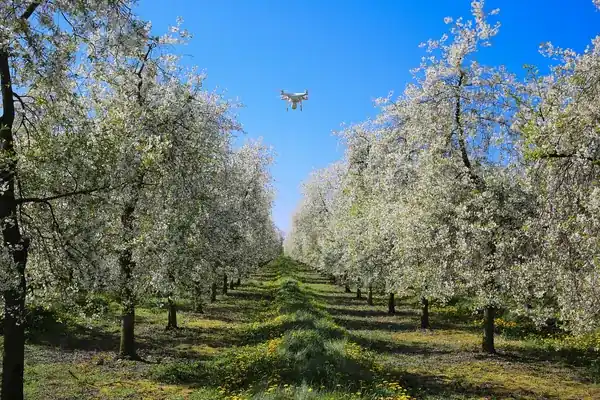
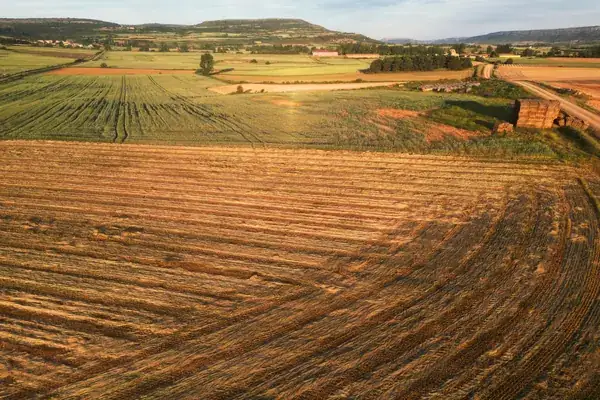
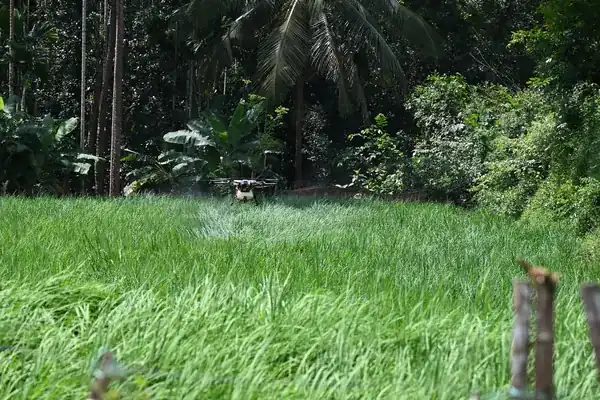
Illustrative photos, published by their authors under free licences.
Contents of the complete guide
- What French law allows in 2026: the dated legal framework (free extract below)
- The paperwork: programme, operator, equipment
- Buffer zones, distances to residents and information
- Weather and drift: deciding on the day
- Record-keeping: register, evidence and review
- Cost per hectare: drone, sprayer, knapsack, helicopter
- Templates to copy: specification, documents, register, weather, residents, cost
- Sources and dates consulted
Included: 29 checklist items and 6 decision or reference tables.
Introduction
Spraying plant protection products by drone is no longer banned in every case in France. Since the law of 23 April 2025 and its implementing texts of spring 2026, a drone may treat certain plots (slope of at least 20%, banana plantations, rootstock mother vines grown on the ground), with certain products (biocontrol, usable in organic farming, low-risk, and approved for this use), within a programme authorised by the regional prefect. Outside that scope, the ban stands. In between, many sales pitches and misconceptions circulate.
This guide is written for the person who has to decide: the grower who has plots treated, the cooperative or machinery group setting up a joint programme, the contractor preparing an offer, or the foreign estate owner or operator who works in France. It tells you what the texts allow, case by case; which documents the operator must be able to produce; which distances, wind conditions and record-keeping apply; and how to calculate, with your own figures, what a hectare treated by drone really costs compared with your sprayer, knapsack spraying or a helicopter. It ends with six ready-to-copy templates. French terms are given in brackets where your French counterparts will use them.
The guide is up to date as of 27 October 2026. Each rule is tied to its text and dated; the Official Journal references were checked on that date, in particular against the French Ministry of Agriculture page on aerial spraying (updated 12 June 2026). Texts change: before filing an application, reread the version in force on Légifrance and the ministry page. Studies are cited with their DOI.
What French law allows in 2026: the dated legal framework
The principle: the ban remains
Directive 2009/128/EC (article 9) bans aerial spraying of plant protection products, with supervised derogations. In French law, the principle is in section I of article L253-8 of the Rural and Maritime Fisheries Code (code rural et de la pêche maritime): aerial spraying is prohibited. A drone is an aircraft: it is covered just like a plane or a helicopter.
Law no. 2025-365 of 23 April 2025, "to improve the treatment of diseases affecting plant crops using remotely piloted aircraft", rewrote that article. It did not lift the ban: it created three precise openings, each with its own procedure.
The three openings
| Opening | Article | What it allows | Who decides | Implementing texts |
|---|---|---|---|---|
| Health emergency | L253-8, I bis A | A temporary authorisation for aerial spraying against a serious health danger that cannot be controlled otherwise (for example plots made inaccessible by a climatic event) | Joint order of the ministers for the environment, agriculture and health; requests to the Directorate-General for Food (DGAL) | Case by case |
| Drone application programmes | L253-8, I bis B | Drone treatment programmes on plots and with products listed restrictively | Regional prefect, for up to five years | Decree no. 2026-270 of 14 April 2026, order of 19 May 2026 (products), order of 29 May 2026 (conditions) |
| Trial programmes | L253-8, I ter | Trials on other crops or situations, to demonstrate clear benefits for health and the environment | Regional prefect, after the Ministry of Agriculture's opinion, for up to three years; led by an agricultural technical institute | Decree no. 2026-422 of 29 May 2026 |
Decree no. 2026-270 of 14 April 2026 makes the regional prefect the competent authority to authorise a programme, and the Minister of Agriculture the authority that approves products usable by drone. Applications are filed through a form on demarche.numerique.gouv.fr (Ministry of Agriculture page, 12 June 2026).
Eligible plots
Three situations, and only three, open a programme under I bis B:
- Agricultural plots with a slope of 20% or more, whatever the crop. Hillside vineyards are the most frequent case, but the text is not limited to vines.
- Banana plantations, whatever the slope.
- Rootstock mother vines grown on the ground, whatever the slope.
A flat plot of arable crops, trellised vines or orchard fits none of these. It can only be treated by drone in a trial programme run by a technical institute, or under an emergency authorisation.
The application must justify the eligibility of each plot. The texts we read do not impose a method for measuring slope: document it verifiably (IGN digital terrain model, topographic survey, drone photogrammetry) and keep the method with the file. A plot only part of which exceeds 20% may need to be split: ask the examining service before filing.
Eligible products
Within a programme, a drone may only apply products that meet two conditions:
- belong to one of the three families named by the law: biocontrol products (article L253-6 of the Rural Code), products usable in organic farming, low-risk products within the meaning of Regulation (EC) No 1107/2009;
- appear on the list of products approved for application by unmanned aircraft, set by the order of 19 May 2026 (issued after an opinion of the French food safety agency Anses of 30 April 2026).
A product usable in organic farming but missing from the list cannot be applied by drone. A listed product remains subject to its marketing authorisation: use, dose, number of applications, pre-harvest interval, distances on its label.
Organic farms
An organic-certified farm has no right to a drone as such: its plots must be eligible (slope, banana plantation, mother vines) like anyone else's. What changes is that it only uses products authorised in organic farming, so part of its spray programme may be on the 19 May 2026 list. Conversely, a conventional farm with an eligible plot may have a listed biocontrol product applied by drone without being certified.
What was never covered by the ban
The ban in article L253-8 targets spraying of plant protection products. Releasing beneficial insects (trichogramma), sowing cover crops or spreading granular fertiliser are outside it. They remain subject to aviation rules: any dropping of material takes the flight out of the open category (Implementing Regulation (EU) 2019/947, article 4) and requires the specific category, hence an operational authorisation (chapter 2).
Helicopters and planes
I bis B only covers aircraft flying with no one on board. A helicopter or plane cannot be used in a programme: on our reading of article L253-8 in force, only the temporary emergency authorisation (I bis A) remains. For a farm, the helicopter is no longer an option you choose; it can only reappear if an emergency authorisation opens it, on its own terms.
The decision table
| Your situation | Drone possible? | Route |
|---|---|---|
| Vines or another crop on a slope of 20% or more, product on the 19 May 2026 list | Yes | Programme authorised by the regional prefect |
| Same plot, conventional product not on the list | No | Ground treatment (knapsack, tracked carrier, winch) |
| Banana plantation, listed product | Yes | Programme authorised by the regional prefect |
| Rootstock mother vines grown on the ground, listed product | Yes | Programme authorised by the regional prefect |
| Plot under 20% slope, not bananas or mother vines | No, unless a trial | Trial programme run by an agricultural technical institute |
| Plots inaccessible after an exceptional event, serious health danger | Possibly | Temporary emergency authorisation, requested collectively (chamber of agriculture, trade body) |
| Trichogramma release, cover crop sowing, granular fertiliser | Yes, outside the plant protection regime | Specific category under aviation rules |
| Mapping, counting, vigour monitoring | Yes | Imaging, often in the open category |
Common mistakes
- Confusing an organic farm with an eligible plot. The label does not replace the slope.
- Assuming an organic-approved product is enough. It must also be on the 19 May 2026 list.
- Signing with an operator before the programme is authorised. Without a published prefectoral authorisation there is no legal treatment, and the grower's liability is engaged alongside the operator's.
- Forgetting the lead time. The file must be filed at least two months before the first planned application (order of 29 May 2026): a programme is prepared in winter for the following season.
How it works
- You pay on StripeBy card, Apple Pay or Google Pay, in one go, on the checkout page hosted by Stripe: your card details never go through our servers.
- You read it right awayRight after payment, you land on the complete guide's page. Bookmark it or print it to PDF; the link and the invoice are emailed to you, and everything stays findable with “Find my purchases”, at the bottom of every page.
- Guaranteed contentAs described, or your money back: email devis@c-drone.fr and we restore access or refund you (terms of sale, in French).
Frequently asked questions
What does “Drone crop spraying in France: exemptions, buffer distances, specifications and cost per hectare” contain and how much is it?
For €39 VAT included (€32.50 excl. VAT), you get drone crop spraying in France: exemptions, buffer distances, specifications and cost per hectare: 7 chapters online, about 25 printable A4 pages and 6 ready-to-copy templates, to have plots treated by drone (or treat them yourself) within the French legal framework of 2026: check that plots and products are eligible, prepare or check the application programme file submitted to the regional prefect, gather the operator's documents, comply with buffer distances to water and residents, wind conditions and record-keeping, and compare the full cost per hectare with your own quotes.
How do I receive the guide?
Right after payment you are redirected to the complete guide's page. Bookmark it, or print it to PDF (Ctrl+P or Cmd+P, “Save as PDF”). Stripe also emails you the receipt.
Do I get an invoice?
Yes: Stripe generates the invoice and emails it. You can enter your company name and VAT number at checkout. Seller: Lacangel Group (VAT FR21995268018); prices VAT included.
Is the guide kept up to date?
Yes. The guide's page is updated when the rules change; your access stays valid and you always read the latest version.
Which texts is the guide based on?
On the official texts in force (EU regulations, French decrees and codes), cited and dated with their links: you can check every rule at its source, which is authoritative. C-DRONE is an independent publisher.
Which device can I read it on?
Computer, tablet or phone: it is a web page, with no app or account to create. Print it to PDF to archive it or share it within your team.
What guarantee do I get?
The content matches its description, or you get your money back: email devis@c-drone.fr and we restore access or refund you (terms of sale, in French). This also applies to business purchases.
Other guides
New Drone light show guide
Organising a drone light show in France: budget, permits, contract
Town, company or wedding: check whether your project works, file the prefecture application on time, compare quotes, sign a contract that deals with the weather and run the night itself
€29 incl. VAT · €24.17 excl. VAT · 11 chapters · instant access
New CATS exam prep
Passing the French CATS drone exam: course and 104 practice questions
The eight subjects of the official DGAC syllabus summarised, 64 answered and explained questions, a 40-question mock exam and a four-week revision plan, with the French terms you will meet
€24 incl. VAT · €20.00 excl. VAT · 11 chapters · instant access
New Thermography guide
Drone thermography in France: commission, check and use the report
Roofs, facades, flat roofs, solar PV: choose the right measurement window, write the specification, check the flight conditions, read the report in fifteen minutes and turn it into repair decisions
€29 incl. VAT · €24.17 excl. VAT · 11 chapters · instant access
Free articles on the topic
- Agricultural drone spraying in France: what the law allows in 2026, who can do it, price
- Drone spraying in steep-slope vineyards in France: 2026 rules, method, price
- Drone spraying and seeding: price per hectare and legal framework
- Spraying by Drone After a Flood: The Emergency Derogation for Vineyards and Orchards
- Drone spraying in banana plantations against black Sigatoka: 2026 legal framework, method, price (French Antilles)
Instant access to your guide after payment · terms of sale (in French). Questions before buying: devis@c-drone.fr.