A professional drone pilot for this mission Request a free quote
C-DRONE GUIDE · 26 JULY 2026
Biogas plant inspection by drone: membranes, gas leaks, price
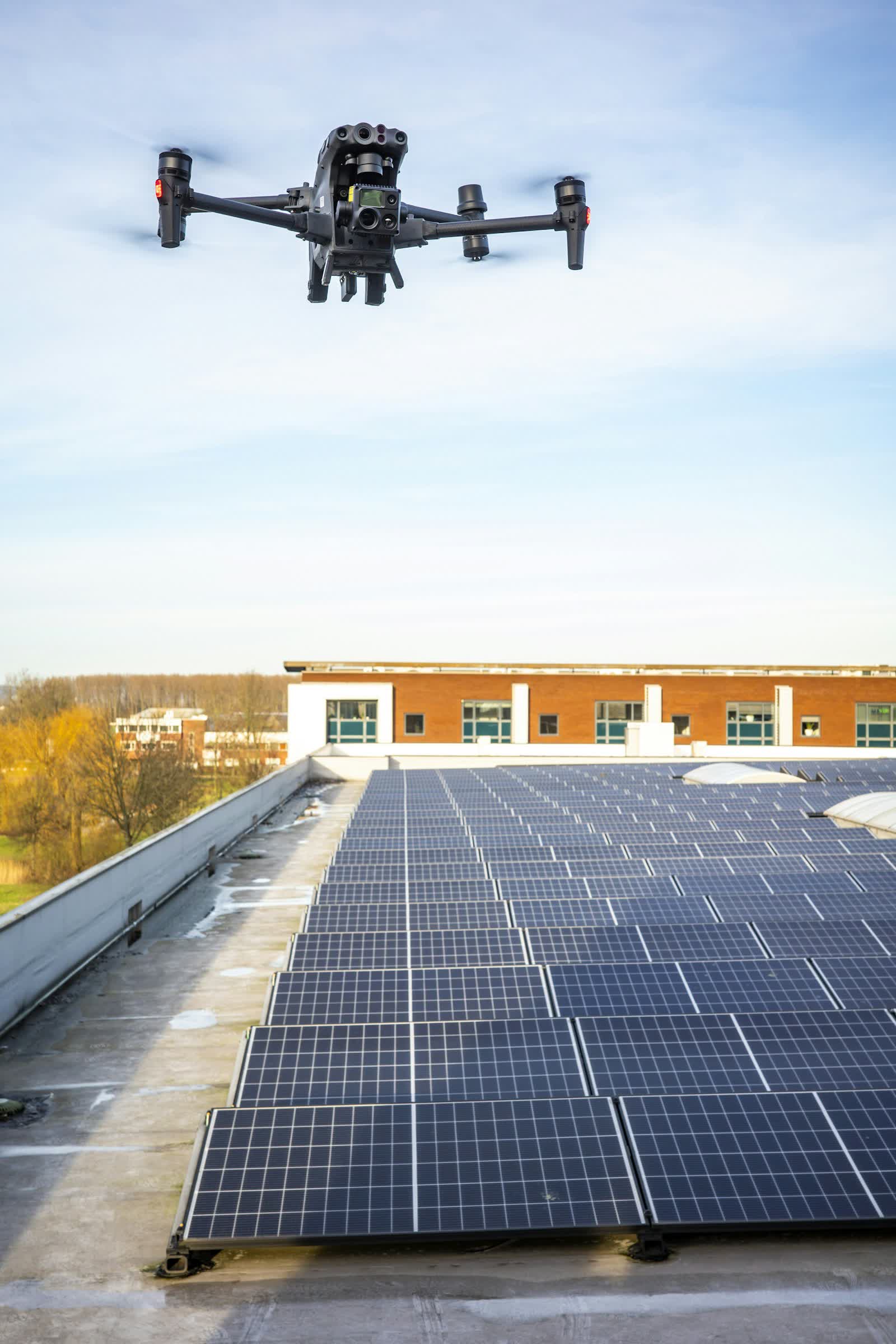
France now has more than a thousand anaerobic digestion plants — on farms, in rural districts or attached to wastewater treatment works — and each relies on equipment whose condition drives both output and safety: gas-holder membranes exposed to UV and abrasion, digester covers, insulation on heated tanks, the flare, biogas pipework. A fatigued membrane or a leaking flange means lost methane — lost revenue and a potent greenhouse gas released. Drones inspect this equipment with no scaffolding, no cherry picker and no shutdown, combining a visual zoom, thermography and, for leak surveys, dedicated methane sensors. Here are the method, the regulatory framework and 2026 prices.
Published on 26 July 2026, updated on 22 September 2026 — regulations in force as of September 2026.
What the drone sees at a biogas plant
The most closely watched weak point is the double-membrane gas holder: the outer membrane takes UV, hail and wind, the inner one works in contact with biogas. The drone's zoom documents, from a few metres away, chafing areas, folds, ageing repairs and the condition of straps and anchors — without touching the membrane or requiring a shutdown. On digesters and post-digesters, thermography reveals insulation defects on the heated tank (37 to 42 °C in mesophilic operation): any abnormally cold area on a wall that should be insulated, or warm area where it should not be, directs maintenance.
The flight also covers what rarely gets inspected for lack of access: covers and skylights, the flare and its surroundings, the roofs of the CHP or gas-upgrading buildings, the feedstock storage silos — whose self-heating is monitored like the windrows described in our composting site thermography guide. In half a day, the operator gets a complete photographic and thermal survey of the site.
Methane leaks: from thermography to dedicated sensors
A standard thermal camera does not "see" methane: it spots a leak indirectly through the temperature anomaly it creates (gas expansion, damp patch on a membrane). To visualise or quantify the gas itself, the drone carries either an OGI camera (optical gas imaging, filtered on methane's absorption band) or a TDLAS laser sensor measuring concentration along its beam — the same technologies described in our gas leak detection and LDAR guide. The drone methodically sweeps the singular points: relief valves, flanges, domes, membranes, the upgrading unit, the injection station.
Airborne methane mapping is well documented scientifically: a study by Gålfalk, Nilsson Påledal and Bastviken published in 2021 in ACS Earth and Space Chemistry showed that a drone fitted with a dedicated infrared sensor can map methane plumes from waste treatment facilities and estimate their fluxes without ground-based instrumentation. For a digestion plant, recovering even a few kilograms of methane per day quickly pays for the survey.
Permitting and ATEX: the framework the drone fits into
A French anaerobic digestion plant is a regulated environmental facility (ICPE heading 2781 — declaration, registration or authorisation depending on tonnage), with maintenance and monitoring requirements: the drone inspection does not replace statutory checks, but it documents the condition of membranes and equipment between them and feeds the monitoring file the operator keeps available for the environmental inspectorate. After hail or a storm, it also gives the insurer a dated, geolocated record of membrane condition.
On the safety side, the site has ATEX zones around relief valves, domes and vents: since a standard drone is not ATEX-certified equipment, the pilot keeps the safety distances agreed with the operator in the prevention plan, exactly as for the biogas zones of a treatment works described in our WWTP drone inspection guide. On the aviation side, most plants being in rural areas, the open category is usually sufficient — flights still require the operator's consent and a check of airspace restrictions.
How the mission unfolds
Preparation matters as much as the flight: a prevention plan with the operator, identification of ATEX zones and power lines, choice of time slot. For tank and membrane thermography, fly early morning or late afternoon, when the sun no longer masks internal contrasts; for OGI, favour light, steady wind that keeps plumes readable. The flight itself takes one to two hours for a typical farm plant: orbits around the gas holder, parallel passes over the tanks, hover points on singular equipment.
The typical deliverable includes an illustrated report ranking observations by equipment and criticality (membrane chafing, degraded insulation, thermal anomaly, suspected leak to confirm on the ground), the radiometric files, an orthophoto of the site and, if a gas survey was flown, a map of recorded concentrations. This report becomes the baseline: the same trajectory reflown a year later makes changes immediately comparable — the repeatability logic our confined space inspection guide describes for tank interiors, which the outdoor drone complements without replacing.
Observed prices in 2026
For a farm or district-scale digestion plant, ranges observed in 2026 (excl. VAT):
- Visual inspection + thermography of the full site (gas holder, digesters, roofs, flare): €800 to €1,500 for a half-day, report included.
- Leak detection survey with an OGI camera or TDLAS sensor: €2,000 to €5,000 depending on site size and the level of quantification required — the gas sensor, rare and expensive, explains the gap with thermography alone.
- Periodic monitoring (2 visits per year, campaign-to-campaign comparison): usual discount of 15 to 25% on the unit price.
Compare that with the cost of a cherry picker to approach a gas-holder dome, the operating hours lost in a shutdown — and the price of methane escaping through an undetected leak. For an inspection of your plant, request a quote stating the site configuration (gas holder, tank heights, upgrading or CHP).
Put it into practice
- Drone aerial thermal imaging: rates and cities covered from €500
- Aerial thermal imaging in Arras Hauts-de-France
- Aerial thermal imaging in Auxerre Bourgogne-Franche-Comté
- Aerial thermal imaging in Mâcon Bourgogne-Franche-Comté