A professional drone pilot for this mission Request a free quote
C-DRONE GUIDE · 31 JULY 2026
Cold-store and refrigerated-warehouse thermography by drone: thermal bridges, price
A refrigerated warehouse is an insulated envelope in permanent battle against the heat trying to get in. Every thermal bridge, every poorly jointed sandwich panel, every roof defect is paid for twice: in energy burned by the refrigeration plant, and in risk to the goods the day the set-point can no longer be held. Yet a logistics envelope covers thousands of square metres of often unreachable roof, and insulation defects are invisible to the naked eye. Drone thermography reads that envelope from outside, in a single flight, and ranks the zones to fix. Here is what the camera really shows on a cold roof, the conditions that separate a useful reading from a misleading image, and prices observed in 2026.
Published on 31 July 2026, updated on 22 September 2026 — regulations in force as of September 2026.
Why a cold store's envelope reads best from above
Industrial cold is a cost centre dominated by the envelope: the more the insulation leaks, the more the plant runs. Unlike a heated building, a cold store is colder inside than out for much of the year: a thermal bridge then shows as an abnormally cold zone seen from outside on a summer day, or abnormally warm seen from inside — the logic reverses relative to standard renovation thermography, but the principle holds: an insulation defect betrays itself through a surface-temperature difference.
The radiometric camera on the drone quantifies each pixel as a temperature, not just a colour. A study by Bianchi, Pisello, Baldinelli and Asdrubali published in 2014 in Sustainability experimentally validated, in a test cell, the ability of infrared thermography to locate and quantify the thermal bridges of a building envelope. It is this physics — a thermal bridge locally distorts the surface-temperature map — that makes a cold store's roof legible from the sky.
What the drone reveals on a warehouse roof
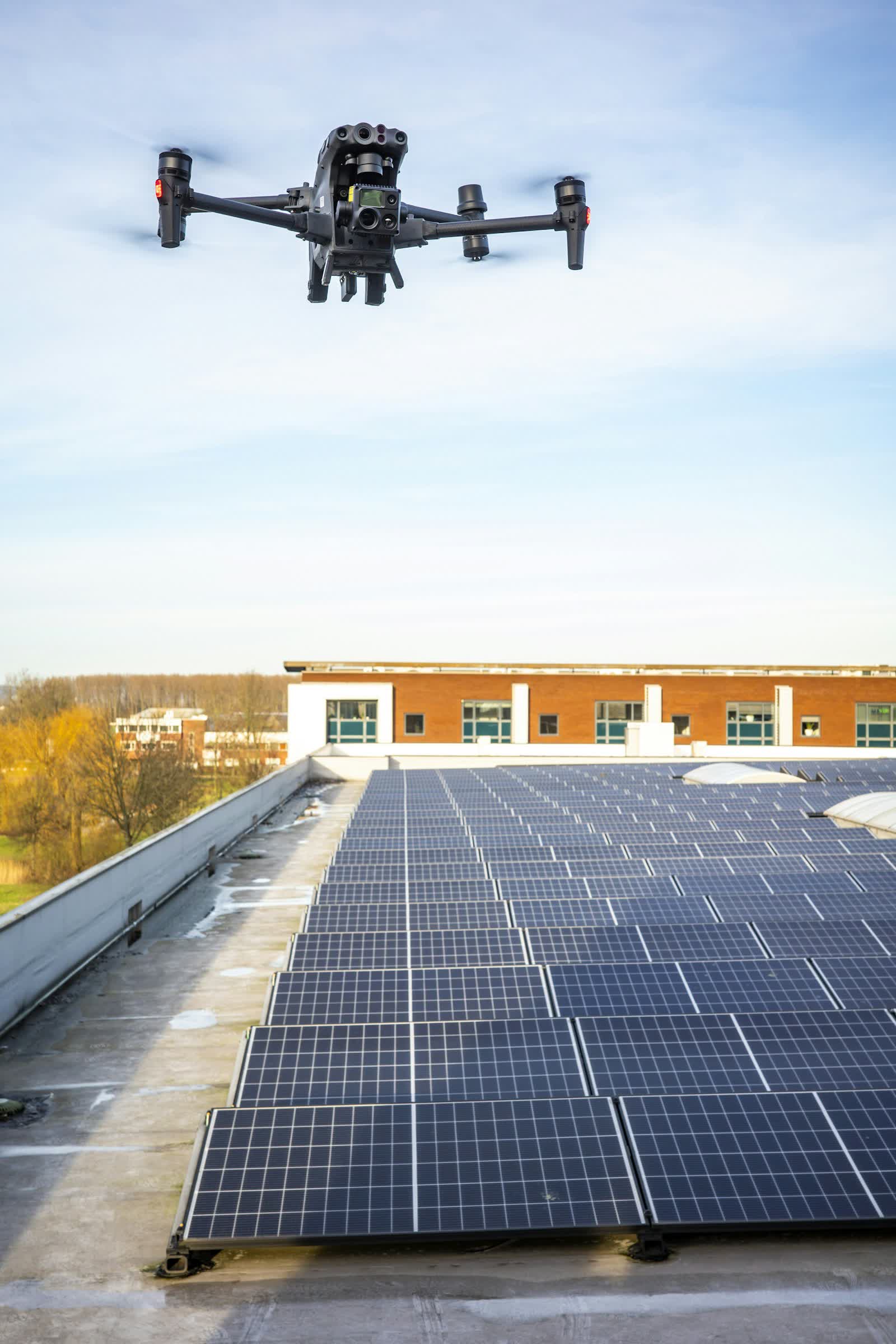
On a large logistics roof, four families of defect stand out. Deformed or decompressed sandwich-panel joints, where the insulation has lost contact; poorly sealed penetrations (service outlets, rooflights, ducts); water-ingress zones in the waterproofing build-up, which change the thermal signature; and linear thermal bridges along parapets and expansion joints. The thermal flight is always paired with a high-resolution visible flight to place each anomaly on the real roof and tell a genuine defect from a mere reflection.
The drone's value lies in scale: where a ground check is limited to façades and what a cherry picker can reach, the flight covers the entire roof — a warehouse's main heat-gain path — in a morning, without sending anyone onto an often fragile covering. The resulting map feeds directly into a waterproofing and insulation repair plan, with the same triage logic our drone thermography for energy renovation guide applies to a heated building.
Measurement conditions and honest limits
A cold-store thermal image cannot be read at any time. It needs a clear temperature difference between the set-point interior and the outside — which, for a cold store, often means summer rather than winter, the opposite of a heated building. Direct sun must be avoided as it heats the roof and hides defects, hence early-morning or overcast flights. And material emissivity must be entered: a lacquered steel deck, a bituminous membrane and gravel ballast do not radiate the same way.
The UAV building-thermography literature confirms that image quality depends strongly on distance, shooting angle and ambient conditions: a study by Mayer, Epperlein, Vollmer, Volk and Schultmann published in 2023 in Remote Sensing compares hundreds of aerial and ground thermal images to derive acquisition rules (distance, angle) you can hold a serious contractor to. The honest limit: the drone ranks and locates, it does not replace an energy audit or an adversarial waterproofing test — it says where to run them first.
Prices observed in 2026
Ranges observed in 2026 (excl. VAT):
- Roof thermography for a warehouse up to 5,000 m² (thermal + visible flight, anomaly map): €700 to €1,400.
- Logistics platform of 5,000 to 20,000 m² (several chambers, per-zone report): €1,400 to €3,000.
- Façade and dock option (dock-door and airlock thermal bridges): €400 to €900.
- Annual monitoring (envelope check before the warm season, year-on-year comparison): tapering packages.
Timing depends on the temperature differential: the summer window is booked ahead. Our thermal imaging drone page presents the service; request a quote stating roof area, number of chambers and set-point temperatures.
Frequently asked questions
Can a cold room be thermographed in winter?
It is less favourable: the reading needs a clear gap between the cold interior and the outside. For a freezer warehouse the gap exists year-round; for chilled storage the summer window is the most legible. We schedule the flight for the period that maximises contrast.
Does the drone enter the cold room?
No: the reading is done from outside, on the envelope and roof. A spot indoor check of an airlock or dock door can use a small protected drone, outside aviation rules, but the bulk of the envelope diagnosis is read from the sky.
Put it into practice
- Drone aerial thermal imaging: rates and cities covered from €500
- Aerial thermal imaging in Hyères Provence-Alpes-Côte d'Azur
- Aerial thermal imaging in Grasse Provence-Alpes-Côte d'Azur
- Aerial thermal imaging in Charleville-Mézières Grand Est