C-DRONE GUIDE · 22 JULY 2026
Asbestos roofing and drones: what an aerial survey can identify before works (and what it cannot replace)
Before climbing onto a fibre-cement roof to renovate or demolish it, one question almost always comes up for buildings dating from before 1997: does it contain asbestos? A roofer or project owner has every interest in knowing before sending a team to handle the sheets, and a drone fitted with a simple high-resolution camera can objectively assess a roof's condition — cracks, degraded sheets, moss trapping moisture — without a technician ever having to set foot on it. This aerial survey, however, never exempts anyone from the regulatory diagnostic carried out by a certified operator, the only one authorised to confirm the presence of asbestos through sampling. Here is exactly what a drone brings, what it cannot replace, and what such a mission costs in 2026.
Published on 22 July 2026, reviewed on 27 July 2026 — regulations in force as of July 2026.
Why so many French roofs still raise the asbestos question
Fibre-cement — a mix of cement and fibres, long reinforced with asbestos for its mechanical strength and weatherproofing — covered decades of farm buildings, industrial warehouses, garages and house roofs before asbestos was banned in France on 1 July 1997. Any building whose planning permission predates that date can therefore be concerned, which still represents a considerable share of the built stock, particularly agricultural and industrial buildings where these grey corrugated sheets remain very common.
The risk does not come from the intact material: as long as the fibres stay bound within the cement matrix, exposure is minimal. It appears when the roof deteriorates — sheets cracked or eroded by acid rain or by poorly controlled high-pressure cleaning — or during work that drills, cuts or drops the sheets, releasing inhalable fibres. It is precisely before this kind of intervention that French law requires a diagnostic, and that the roof's visual condition — hence its observation by drone — becomes useful information for preparing the worksite.
What a drone can actually observe on a suspect roof
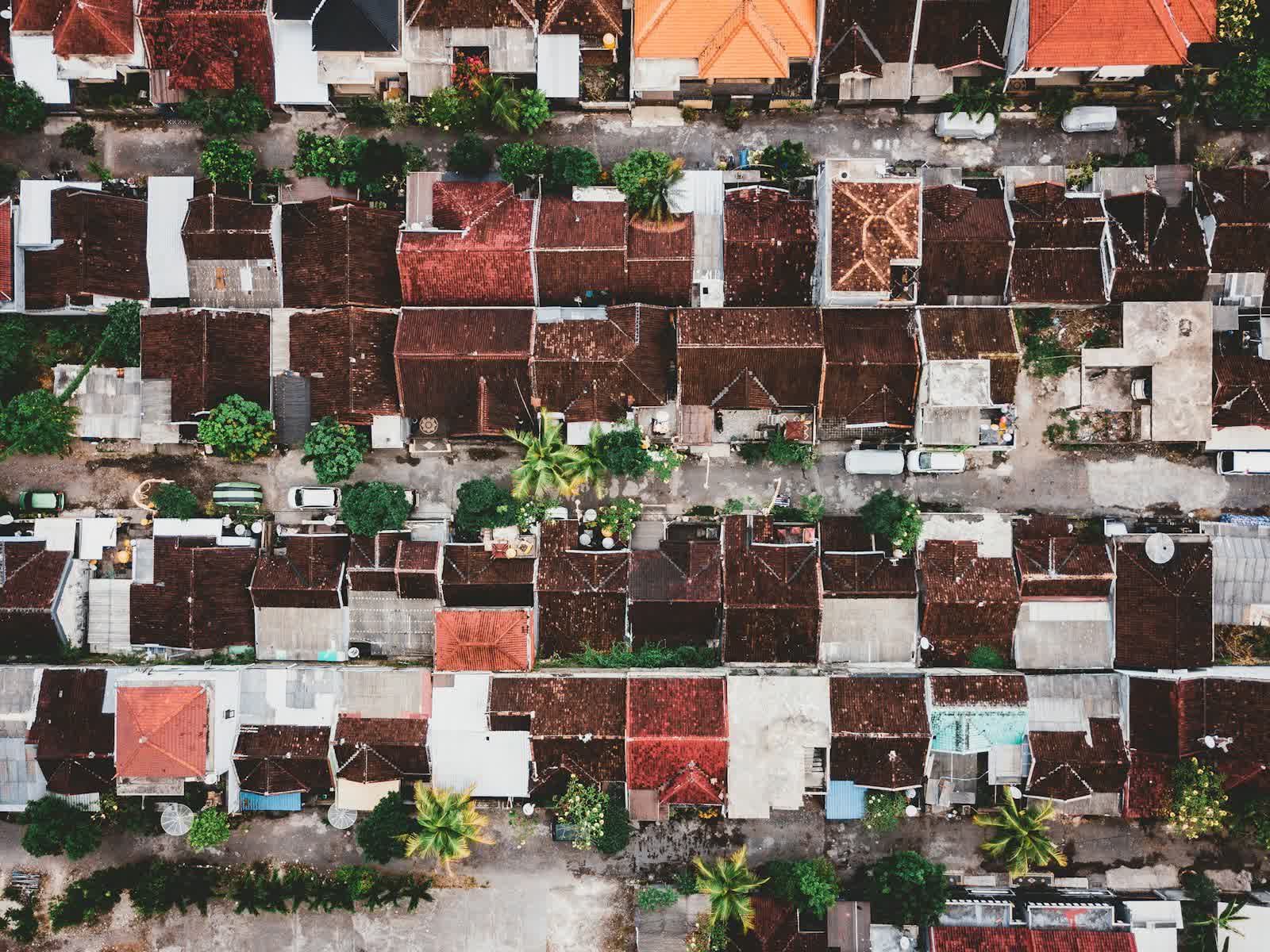
A low-altitude flight with a high-resolution camera produces a sharp image of every sheet: cracks, chips, areas where freeze-thaw and moss have lifted the material, corrosion marks on fixings, or conversely sheets in apparently good condition. This imagery forms the basis of an orthophoto of the entire roof, useful for quantifying the affected surface and prioritising the most degraded areas before a certified operator intervenes. Several research teams have worked on automating this reading: a study by Baek, Lee, Kim, Seo and Park published in 2023 in the journal Sensors (see on Google Scholar) describes a deep-learning model trained on drone images to automatically classify fibre-cement slate sheets, while another study by Seo, Woo, Kim, Hong, Kim and Baek published in 2022 in the journal Drones (see on Google Scholar) reports a location accuracy close to 99% with a Faster R-CNN network, validated against on-site surveys.
This imagery nonetheless remains a remote visual observation: it spots signs of degradation and, in some cases, the wavy texture typical of fibre-cement, but it cannot smell or chemically analyse a sheet's composition. Two visually identical roofs can have one containing asbestos and the other not — only a laboratory analysis of a sampled fragment can settle the question.
The regulatory framework: the asbestos diagnostic before works remains mandatory and separate
The asbestos survey before works (often abbreviated DAAT in French), defined in article R.4412-97 of the French labour code, is mandatory whenever an operation — renovation, drilling, demolition — presents a risk of worker exposure, on any building whose planning permission predates 1 July 1997. It must be entrusted to a certified survey operator, who samples the suspected material and has it analysed by an accredited laboratory; it is this diagnostic, and this one alone, that carries regulatory weight. For the common areas of multi-unit buildings and certain premises open to the public, a separate document, the asbestos technical file (dossier technique amiante, DTA), continuously records any presence of asbestos in the building.
The drone does not substitute for either of these two obligations: it is not mentioned in any regulatory text on asbestos and cannot sample material. Its added value is operational: giving the project owner an overview of the roof before commissioning the certified operator, to target the areas to sample and anticipate the surface to be treated, rather than discovering the extent of the problem once the team is already on site. On the aviation side, a low-altitude roof flyover most often falls under open category A1 or A3 depending on the proximity of third parties, as we detail in our guide to open versus specific category; checking regulated zones on the Géoportail map before any mission remains systematic, particularly in farmland close to an aerodrome.
A service that complements standard roof inspection
This visual survey extends our drone roof inspection: the same high-resolution imagery that detects a cracked tile or a blocked gutter can also map the condition of a fibre-cement roof. It follows the same logic as the roof diagnostic before installing solar panels: objectifying the condition of the substrate before committing a team, whether to install modules or to strip an asbestos-containing roof. On farm buildings and industrial premises, where fibre-cement remains most common, the mission is often combined with an industrial silo or chimney inspection carried out during the same campaign.
The typical deliverable combines a high-resolution orthophoto of the roof, an annotated plan flagging the visually most degraded areas (cracks, displaced sheets, damp zones) and, on request, an estimate of the affected surface to help the certified operator calibrate their sampling. The report systematically states that it does not constitute a regulatory asbestos diagnostic.
Price of a drone fibre-cement roof survey in 2026
The price mainly depends on the roof surface, its complexity (multiple pitches, adjoining sheds) and the level of detail expected. Orders of magnitude observed in France in 2026:
| Service | Observed price (excl. VAT) |
|---|---|
| Visual survey and orthophoto, house roof (<150 m²) | €150 to €300 |
| Visual survey, farm shed or warehouse (150 to 1,000 m²) | €300 to €700 |
| Large multi-building industrial site, per campaign | €800 to €2,500 |
| Annotated plan with degraded-surface estimate | +€80 to €200 |
| Regulatory asbestos diagnostic (DAAT, certified operator, separate from the drone) | priced separately by the certified surveyor |
This last line is not a drone price: it is a reminder that the aerial survey and the regulatory asbestos diagnostic are two distinct services, invoiced and carried out separately, with only the latter being legally binding in the event of an inspection or a claim.
Frequently asked questions about drones and asbestos roofing
Can a drone confirm the presence of asbestos in a roof? No: only a laboratory analysis of a sample taken by a certified operator carries regulatory weight. The drone identifies visual signs of degradation, not the material's composition.
Does a drone survey exempt a building from the asbestos diagnostic before works? No, never. The DAAT remains mandatory for any building predating 1 July 1997 as soon as an operation presents a risk of exposure, regardless of any imagery already available.
Why use a drone if the diagnostic remains mandatory anyway? To get an overview of the roof's general condition before commissioning the certified operator: targeting the most degraded areas, estimating the affected surface, and avoiding discovering the full scope of the works once the team is already mobilised.
Can a drone fly over an isolated farm shed without a special permit? Usually yes, under open category A1 or A3 away from third parties, after checking regulated zones; the presence of people or proximity to an aerodrome can change this framework.
Put it into practice
- Drone roof inspection: rates and cities covered from €200
- Roof inspection in Rouen Normandie
- Roof inspection in Tourcoing Hauts-de-France
- Roof inspection in Poitiers Nouvelle-Aquitaine