C-DRONE GUIDE · 28 JULY 2026
Electrical substation drone inspection: thermography, method, price
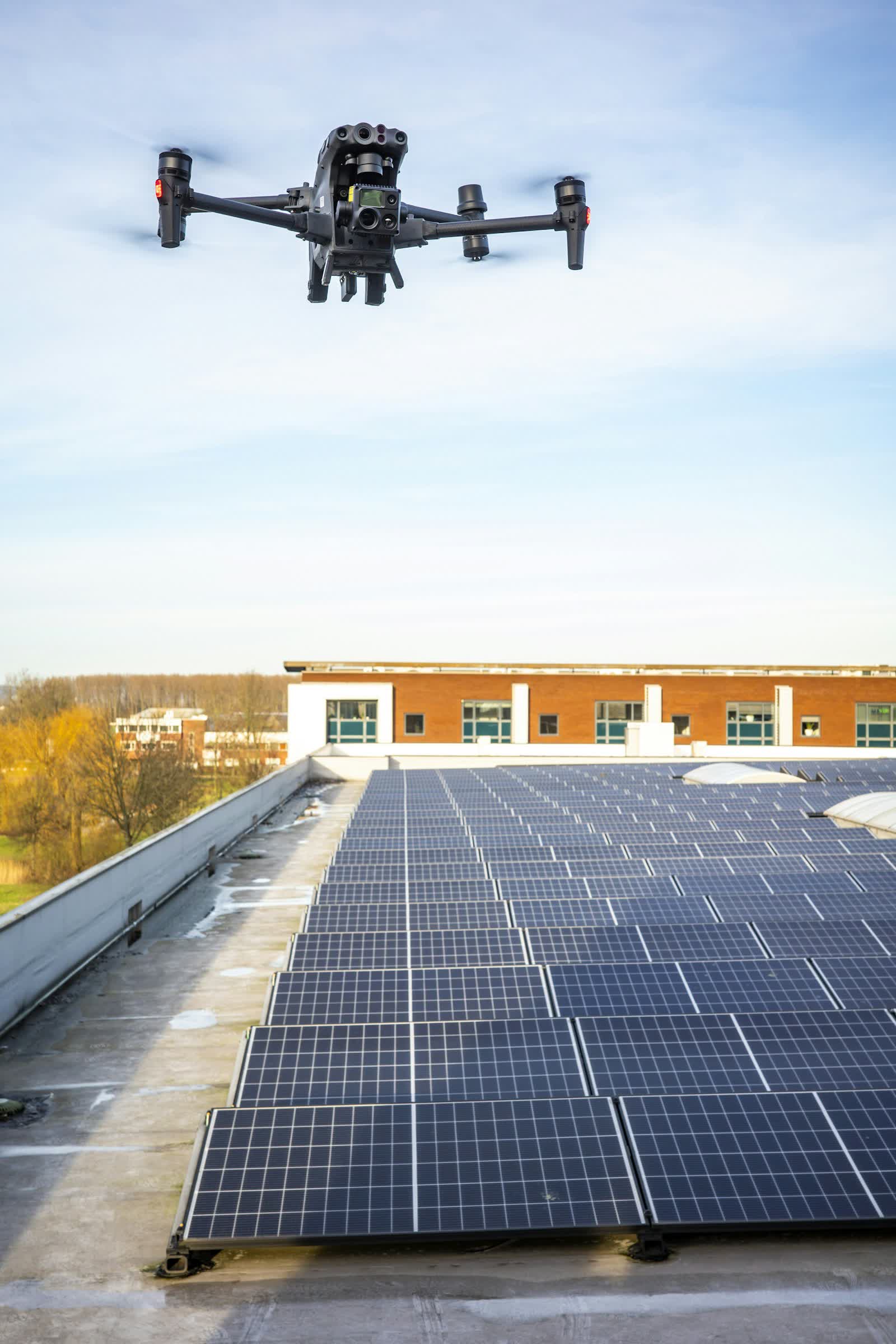
A high or medium-voltage substation — an RTE-Enedis primary substation, a factory's delivery substation, or the grid connection point of a solar or wind farm — packs into a few hundred square metres equipment whose slightest failure is costly: busbars, power transformers, circuit breakers, disconnectors. Almost all of their failures announce themselves in advance through a rise in temperature, but a classic handheld thermal-camera round runs into electrical safety clearances and the height of the equipment: a technician never approaches live busbars, and some hot spots stay out of reach from ground level. The drone removes that constraint: an onboard radiometric thermal camera covers an entire substation in a single flight, without anyone crossing the regulatory clearance distances. Here is what this inspection brings, how it is organised with the operator, and prices observed in 2026.
Published on 28 July 2026, reviewed on 22 September 2026 — regulations in force as of September 2026.
The hot spot precedes the failure, but the site keeps technicians at a distance
A substation ages through its connections: a fitting that loosens, a contact that oxidises, a joint poorly redone after maintenance work — each of these defects locally raises electrical resistance, and so temperature, well before degenerating into an electrical arc or a transformer fire. Spotting that hot spot early avoids an unplanned outage and, in the worst cases, the destruction of a power transformer whose replacement takes months. That is why infrared thermography has long been the reference tool for preventive electrical maintenance — the same principle we detail for industrial switchboards and TGBTs, but at the scale of an open-air substation.
The catch is that a substation is precisely designed to keep people away from live parts: electrical safety clearances, elevated busbars, fencing and enclosed bays. A handheld thermal camera, held at ground level or from a lift at the edge of the site, only sees part of the equipment, rarely from an ideal angle. A drone, by contrast, can position itself anywhere in the substation's airspace without ever crossing the electrical safety clearance: it sees the top of the transformers, the whole of the elevated busbars, and the circuit-breaker connections from the angle that reveals the hot spot.
What aerial thermography reveals: busbars, transformers, circuit breakers
The thermal flight systematically maps every at-risk piece of equipment: bolted busbar connections, transformer bushings and terminations, circuit-breaker and disconnector contacts, cable lugs at bay outlets. Every abnormal temperature deviation — beyond normal heating under load — is dated, geolocated on the substation's plan, and compared against the load recorded at the time of the flight, an essential condition for correctly interpreting a thermal image.
Combining drones with infrared imaging to detect faults on electrical infrastructure is documented in the research literature: a study by Bushra Jalil, Giuseppe Riccardo Leone, Massimo Martinelli, Davide Moroni, Maria Antonietta Pascali and Andrea Berton, published in 2019 in Sensors, describes a multimodal aerial system — visible and infrared imaging — able to automatically spot hot spots and damaged components on electrical equipment. The same principle, applied routinely to a substation, is found in our guide to drone power line inspection, of which the substation is often the endpoint.
A second, high-resolution visible-light pass completes the diagnosis: condition of insulators, corrosion of metal structures, vegetation encroaching on a safety clearance, partial-discharge traces on an insulator. The delivered report overlays both image sets on a single plan of the substation.
Method: flying over live equipment without touching it
A substation stays in service throughout the mission: that is the whole point of using a drone, which avoids a lockout or a scheduled outage solely to allow an inspection. The pilot scrupulously follows the flight plan agreed with the operator — RTE, Enedis, or the industrial site's electrical department — and electrical safety clearances apply to the drone too: they are built into the trajectory during planning, not improvised in flight.
Coordination with the operator is the real time factor: site access, staff accreditation, verification of any electrical authorisations required to move near the bays, and a slot that avoids ongoing maintenance work. On strategic substations — a primary substation, the grid connection of an energy production site — inspection is often part of a fixed-frequency preventive maintenance plan, usually annual, supplemented by an extra pass after an incident (overload, lightning) or ahead of a period of heavy demand (winter peak). The provider's aerial liability insurance, whose principles are detailed in our professional drone liability insurance guide, is systematically checked by the operator before site access.
Aviation regulations: a sensitive site, often isolated but not always
Most substations are fenced sites with no public access, which simplifies the flight scenario: with no third parties overflown, an open-category operation under subcategory A3 is often sufficient, as our guide to the open versus specific category explains. But some substations sit close to residential areas or busy roads, which requires checking the aeronautical map and restricted zones beforehand via our Géoportail drone zone map guide — primary substations and large transformer stations sometimes rank among the installations whose proximity calls for extra precautions, or even a specific prefectural authorisation when they are classified as a vital point of national importance.
On the data side, footage of an isolated substation generally captures no one; when the site borders housing or a busy road, the same data-protection rules detailed in our GDPR and professional drones guide apply to any incidentally captured images. The provider systematically checks the UAS operator number and the insurance certificate before any work on a sensitive site, exactly as for any other professional mission.
Prices observed in 2026
Ranges observed in 2026 (excl. VAT):
- Full thermography of a medium-voltage substation (busbars, bays, distribution transformer, commented report): €500 to €1,000.
- Thermography of a primary or high-voltage substation (extended site, power transformers, multiple circuit breakers): €1,200 to €2,800.
- Visible + thermal pack (insulator and structure condition alongside the hot-spot survey): €300 to €700 extra.
- Preventive maintenance contract (annual campaign across a substation fleet): volume discount from the third site, typically 15–25% per site.
Against the cost of a power transformer or an unplanned outage, a few hundred euros for a thermal flight remains a minor maintenance investment. Request a quote stating the substation type (medium voltage, high voltage, primary), the number of sites and the desired frequency.
Put it into practice
- Drone aerial thermal imaging: rates and cities covered from €500
- Aerial thermal imaging in Valenciennes Hauts-de-France
- Aerial thermal imaging in Boulogne-sur-Mer Hauts-de-France
- Aerial thermal imaging in Épinal Grand Est