A professional drone pilot for this mission Request a free quote
C-DRONE GUIDE · 27 JULY 2026
Floating solar farm drone inspection: thermography, floats, price
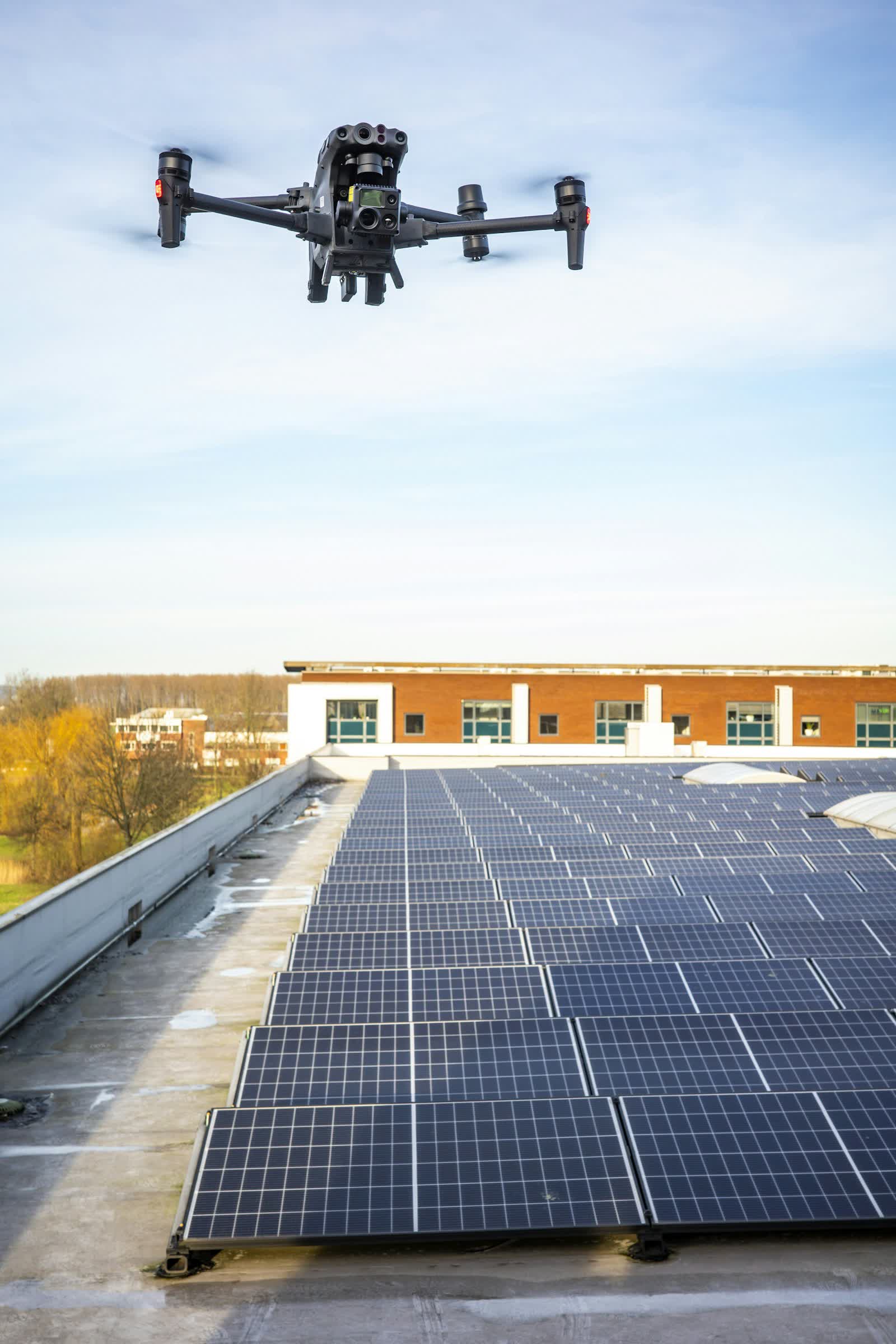
Floating photovoltaics has left the prototype stage: since O'MEGA1 was commissioned at Piolenc (Vaucluse) in 2019 — France's first floating plant, on a former gravel pit — projects are multiplying on artificial water bodies: quarry lakes, irrigation reservoirs, industrial basins. The idea is elegant — generating power without consuming land, with yields improved by the water's cooling — but operations have one radical particularity: you cannot walk between the rows. Any on-foot inspection means walkways and a boat; the drone overflies the plant like any solar field. Here is what specifically needs inspecting on a floating plant, the method, and prices observed in 2026.
Published on 27 July 2026, updated on 22 September 2026 — regulations in force as of September 2026.
Why drones matter even more than on ground-mounted plants
On a ground-mounted plant, the technician can walk the rows; on a floating plant, every access is a small nautical operation, slow and not risk-free. The result: without a drone, the operator has almost no regular view of the modules' real condition. A thermographic flight captures in one session the electrical state of the whole field — cell hot spots, entire strings down, bypass diodes, connectors — following the same IEC 62446-3 standardised methodology we detail in our solar farm thermography guide.
The sector itself is scientifically well documented: a study by Cazzaniga, Cicu, Rosa-Clot, Tina and Ventura published in 2018 in Renewable and Sustainable Energy Reviews analysed the performance and design solutions of floating photovoltaic plants — floats, anchoring, cooling, tracking — and set the field's references (see the study). Those design specifics are exactly what inspection must watch.
What is specific to floating plants: floats, anchors, cables
Beyond the modules, visual inspection targets the floating platform itself: punctured, discoloured or low-riding floats — a float taking on water shows in the row's trim — fatigued float-to-float connections, deformed technical walkways. The anchor lines are checked from the surface (asymmetric tensions, plant drift after a storm, abnormal angles) and correlated with the water level range: an irrigation reservoir varies by several metres, and that is the governing load case. The floating power cables to the bank, finally, are a singular fatigue point.
Add the fouling specific to the environment: bird droppings (floating plants make prized roosts) creating hard shading and hot spots, and evaporation scale. This fouling justifies cleaning campaigns targeted by thermography — no point cleaning clean rows. The water body itself (silting, banks, floating vegetation nearing the anchors) can call for drone bathymetry during ten-yearly campaigns.
Method and flight conditions over water
The typical campaign combines a thermographic flight under standardised conditions (sufficient irradiance, clear sky, midday) and a high-resolution visual flight for the platform and anchors. Flying over water calls for professional precautions: no emergency landing available, so reinforced energy margins and tracks hugging the walkways; surface reflections that fool obstacle-avoidance sensors; and thermal calibration accounting for the cooler air just above the water. Nothing insurmountable for a pilot seasoned on solar plants, but a selection criterion to check.
Regulation-wise, these water bodies are private or industrial estates, often in open rural areas: the framework is the favourable one of enclosed sites — checking official map zones, coordinating with the operator and, where relevant, with the water body's uses (irrigation, fishing, nearby leisure area). Plants on gravel pits sometimes border sensitive natural areas: nesting seasons are respected, as for any mission described in our environmental impact study guide.
Prices observed in 2026
Ranges observed in 2026 (excl. VAT), close to ground-mounted plants of equal capacity, minus the nautical access:
- IEC 62446-3 thermography of a floating plant: €500 to €900 per MWp, tapering above 5 MWp, defect-classification report included.
- Visual inspection of platform and anchoring (floats, connections, cables, trim): €600 to €1,500 depending on area, often coupled with thermography in the same mobilisation.
- Combined annual campaign (thermal + visual + operator report): €1,500 to €4,000 for a 3 to 10 MWp plant.
- Post-storm check (targeted anchoring and trim check): €500 to €900.
Compare that with a full nautical inspection — and above all with the lost revenue of a faulty string left undetected for months. Request a quote stating the capacity, water body area and bank access.
Put it into practice
- Drone aerial thermal imaging: rates and cities covered from €500
- Aerial thermal imaging in Villeurbanne Auvergne-Rhône-Alpes
- Aerial thermal imaging in Tours Centre-Val de Loire
- Aerial thermal imaging in Besançon Bourgogne-Franche-Comté