Drones in construction: structure, roof, facade and site inspection
Buy — €15 Contents and free extract
VAT included · secure Stripe payment · instant access: by paying you request immediate access to the digital content and acknowledge you lose your right to cancel.
C-DRONE GUIDE · 9 AUGUST 2026
Regulatory energy audits for companies: drone thermography for the building component
Since 1 October 2025, France's regulatory energy audit no longer targets only large companies with more than 250 employees or crossing the historic financial thresholds (€50 million in turnover, €43 million in balance-sheet total): any company whose average final energy consumption exceeds 2.75 GWh a year, across all energy vectors, over the last three financial years, now falls within scope — regardless of headcount or sector. This audit, governed by the NF EN 16247 standard, includes a building component where aerial drone thermography delivers an envelope diagnosis that ground-based thermography cannot match on an industrial roof spanning several thousand square metres. Here is who is affected in 2026, what this audit actually covers, what a drone adds to it, and what a thermography campaign costs.
Published on 9 August 2026, updated on 22 September 2026 — regulations in force as of September 2026.
Who must carry out a regulatory energy audit in 2026
The energy audit obligation has existed since 2015: the Energy Code (Articles L233-1 to L233-4), stemming from decree no. 2013-1121 of 4 December 2013 and detailed by the order of 24 November 2014, requires large companies — more than 250 employees, or more than €50 million in turnover combined with more than €43 million in balance-sheet total — to have an audit carried out under the NF EN 16247 standard every four years, or to hold ISO 50001 certification covering at least 80% of their energy bills.
The DDADUE act no. 2025-391 of 30 April 2025, transposing the EU's 2023/1791 energy efficiency directive, and its implementing decree no. 2025-1382 of 29 December 2025, have added a second criterion since 1 October 2025, independent of size: any company averaging 2.75 GWh of final energy consumption a year over the last three financial years — across all energy vectors, electricity, gas, fuel oil, purchased steam — now also falls within scope. An energy-intensive industrial SME, previously outside the obligation for lack of sufficient headcount or turnover, is now subject to it. Newly covered companies must have their first audit carried out before 11 October 2026, then renew it every four years like other obligated entities. Covered legal entities report their audit's completion on ADEME's platform; failing that, the administrative fine can reach €100,000, or 2% of worldwide turnover excluding tax — 4% on repeat offence.
What the NF EN 16247 standard covers — and why it is not the tertiary decree
The NF EN 16247 standard comes in parts: a general section (16247-1) sets the auditor's method and ethics, then three sector-specific parts cover buildings (16247-2), industrial processes (16247-3) and transport (16247-4). The audit must cover at least 80% of the company's energy bill and result in a costed action plan: identified savings opportunities, cost of works, expected savings, payback time. The building component takes centre stage as soon as a site has heated or air-conditioned floor area: offices, workshops, logistics warehouses.
This obligation should not be confused with France's tertiary decree: that scheme specifically targets tertiary-use buildings of 1,000 m² and above, with a results obligation (-40% by 2030, -60% by 2050) reported on OPERAT, regardless of the size of the company occupying them. The regulatory energy audit, by contrast, targets the company as a whole — including its industrial and logistics sites outside the tertiary scope — with a means obligation: carry out the diagnosis, not guarantee a numerical result. A single company, if it holds a tertiary head office over 1,000 m² and a factory consuming more than 2.75 GWh, can therefore be subject to both texts at once, on two separate schedules.
What aerial drone thermography adds to the envelope diagnosis
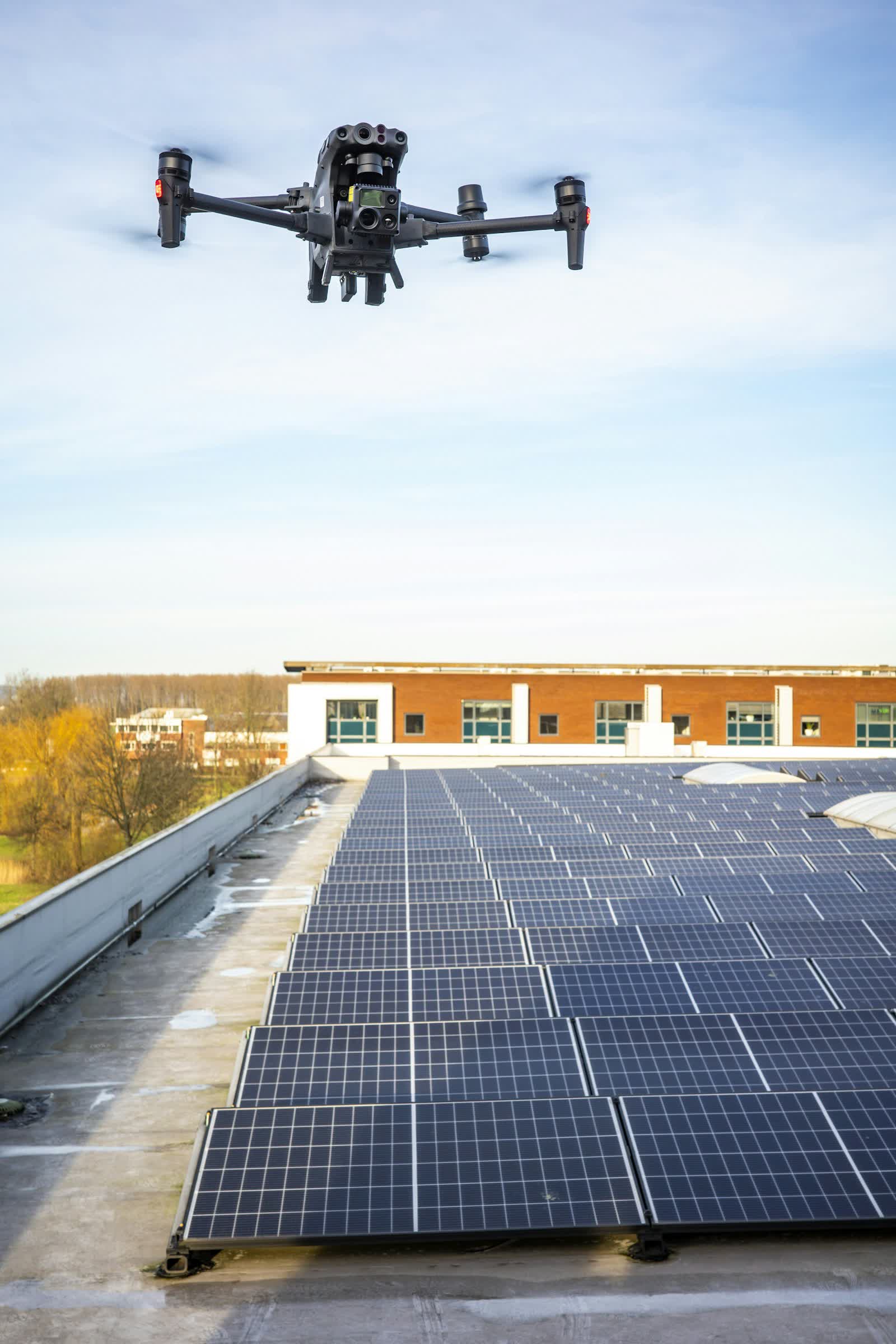
The building component of the NF EN 16247-2 audit identifies heat-loss items: envelope insulation, thermal bridges, airtightness. On an industrial or logistics site, the roof — often several thousand square metres, in steel decking or membrane, hard to access without a cherry picker — frequently accounts for the largest share of losses. A ground-held thermal camera only sees a portion of a facade; a drone methodically flies the entire roof on one cold morning, capturing visible and thermal imagery simultaneously, and locates on a plan every area of missing, compressed or wet insulation, every thermal bridge at a parapet.
The relevance of this aerial approach to building energy audits is documented: a landmark review published in 2018 in Renewable and Sustainable Energy Reviews by Elena Lucchi, synthesising more than fifty years of literature on building infrared thermography, confirms the value of aerial surveys — by drone, aircraft or helicopter — for detecting heat loss at building or site scale, complementing ground-based methods (see the study). One methodological point to always keep in mind: the drone provider delivers a thermographic report — not the regulatory audit itself. That document feeds into the file drawn up by the qualified NF EN 16247 auditor, who alone signs off the report submitted to ADEME.
Flight framework and the price of a 2026 thermography campaign
Envelope thermography is flown on a cold, calm morning, ideally under overcast skies or before sunrise, to avoid solar radiation artificially warming the roof and skewing the reading; a gap of at least 10 to 15 °C between heated interior and exterior remains the baseline condition. On an operating industrial site, the flight is coordinated with the site's prevention plan: vehicle traffic zones, sensitive storage, any classified-installation status. The provider needs up-to-date professional liability insurance and a valid AlphaTango registration; checking the Géoportail restricted-zone map remains standard practice, particularly for sites near an aerodrome or a classified industrial zone.
Prices observed in France in 2026 (excl. VAT):
| Service | Observed price (excl. VAT) |
|---|---|
| Thermography of one building or standalone site (roof + facades, localised report) | €600 to €1,500 depending on area and complexity |
| Multi-site campaign (group, property company — several sites in the same area) | lower per-site rate, quoted |
| Radiometric report usable by the NF EN 16247 auditor | included or optional, +€100 to €250 |
Set against the budget of a full audit — and above all the fine incurred for non-compliance, up to 2% of turnover — this targeted thermography remains a modest expense. A landmark study published in 2019 in Resource and Energy Economics by Schleich and Fleiter, covering more than 1,400 audited German companies, shows that the audit genuinely raises the adoption rate of energy-efficiency measures — insulation, heating, lighting — by 10 to 20 points compared with non-audited companies (see the study) — provided, precisely, that the initial diagnosis is precise enough to lead to targeted works. Our how much does a drone service cost page details a mission's cost items; request a quote stating your roof area and audit timeline.
Does a drone replace the regulatory energy audit? No: it documents the building component that the NF EN 16247 auditor incorporates into their report; it does not remove the need to have the full audit carried out by a qualified professional.
Does a company already ISO 50001 certified still need its buildings thermographed? The certification exempts it from the regulatory audit, but not from the operational value of an envelope diagnosis for prioritising works.
Is the 2.75 GWh threshold assessed per site or for the whole company? It is calculated on the legal entity's average annual consumption, across all sites and all energy vectors, over the last three financial years.
Can the tertiary decree and the regulatory energy audit apply at the same time? Yes: a company can be subject to both if it occupies a tertiary building over 1,000 m² and consumes, across all its sites, more than 2.75 GWh a year.
Put it into practice
- Drone aerial thermal imaging: rates and cities covered from €500
- Aerial thermal imaging in Roubaix Hauts-de-France
- Aerial thermal imaging in Asnières-sur-Seine Île-de-France
- Aerial thermal imaging in Cherbourg-en-Cotentin Normandie