A professional drone pilot for this mission Request a free quote
C-DRONE GUIDE · 29 JULY 2026
EV charging stations in car parks: drone siting surveys and thermal maintenance, price
France's Climate and Resilience Act set a deadline that is now behind us: since 1 January 2025, every outdoor car park of more than 20 spaces run under a public service delegation, in-house management or a public contract must have at least one electric vehicle charging point. For car park managers — retail chains, commercial property funds, local authorities, fleet operators — the job does not stop at ordering the charging units: someone first has to know exactly where to put them, how far from the switchboard, along which cable trench route, and without getting the actual usable space count wrong. Once the stations are live, another issue appears: a charging point or electrical cabinet running abnormally hot is an early warning sign of failure, sometimes of fire. Drones step in at both ends of this project — the initial survey and thermal maintenance — without ever closing the car park. Here is how, and prices observed in 2026.
Published on 29 July 2026, updated on 22 September 2026 — regulations in force as of September 2026.
An obligation now in force, two laws to know
The legal framework was built in two stages. The LOM Act of 24 December 2019 first imposes pre-wiring: every new car park of more than ten spaces (building permit filed after 11 March 2021) must include the ducts and cable routes needed on at least one space in five, and any major building renovation — works representing at least 25% of the building's value excluding land — triggers the same obligation on its car park. The Climate and Resilience Act of 22 August 2021 goes further for existing sites: since 1 January 2025, public car parks of more than 20 spaces must be equipped, not merely pre-wired — one charging point per 20-space bracket, at least two points above 200 spaces, one of them reserved for reduced-mobility users. Exemptions exist (connection cost above 7% of the renovation cost, small businesses below certain financial thresholds), but they need to be justified on file, not assumed.
On a large retail or business-park car park, this electrical project often overlaps with the solar canopy the APER law imposes on car parks over 1,500 m²: same trenches, same connection point, sometimes the same procurement round. Our guide on solar car park canopies details that complementary side of the project.
Before the works: the survey that avoids redrawing the plans twice
A car park plan drawn up by an engineering firm never tells the whole story: spaces actually marked out or worn away, trees and shading that will affect certain spots, the exact distance between each parking zone and the main low-voltage switchboard, the shortest route for the cable trench, buried obstacles visible at the surface (manholes, gullies). A photogrammetric flight produces, in one to two hours, a georeferenced orthophoto and a digital model of the site: the engineering firm counts usable spaces on it, positions each charging point to the metre and calculates the trench length before launching the tender — rather than discovering on site, works already open, that a tree or a slope rules out the spot shown on the plan.
This baseline data matters all the more because siting is never a purely technical choice: a systematic review by Jason Banegas and Jamal Mamkhezri, published in 2023 in Environmental Science and Pollution Research, surveying geographic-information-system-based site-selection methods for charging stations, notes that these methods' reliability depends directly on the quality of ground input data — distances, actual land use, accessibility (see the study). The drone orthophoto is precisely that input data, current and site-scaled, rather than an as-built plan that is sometimes years out of date.
After commissioning: thermography that gets ahead of the fault
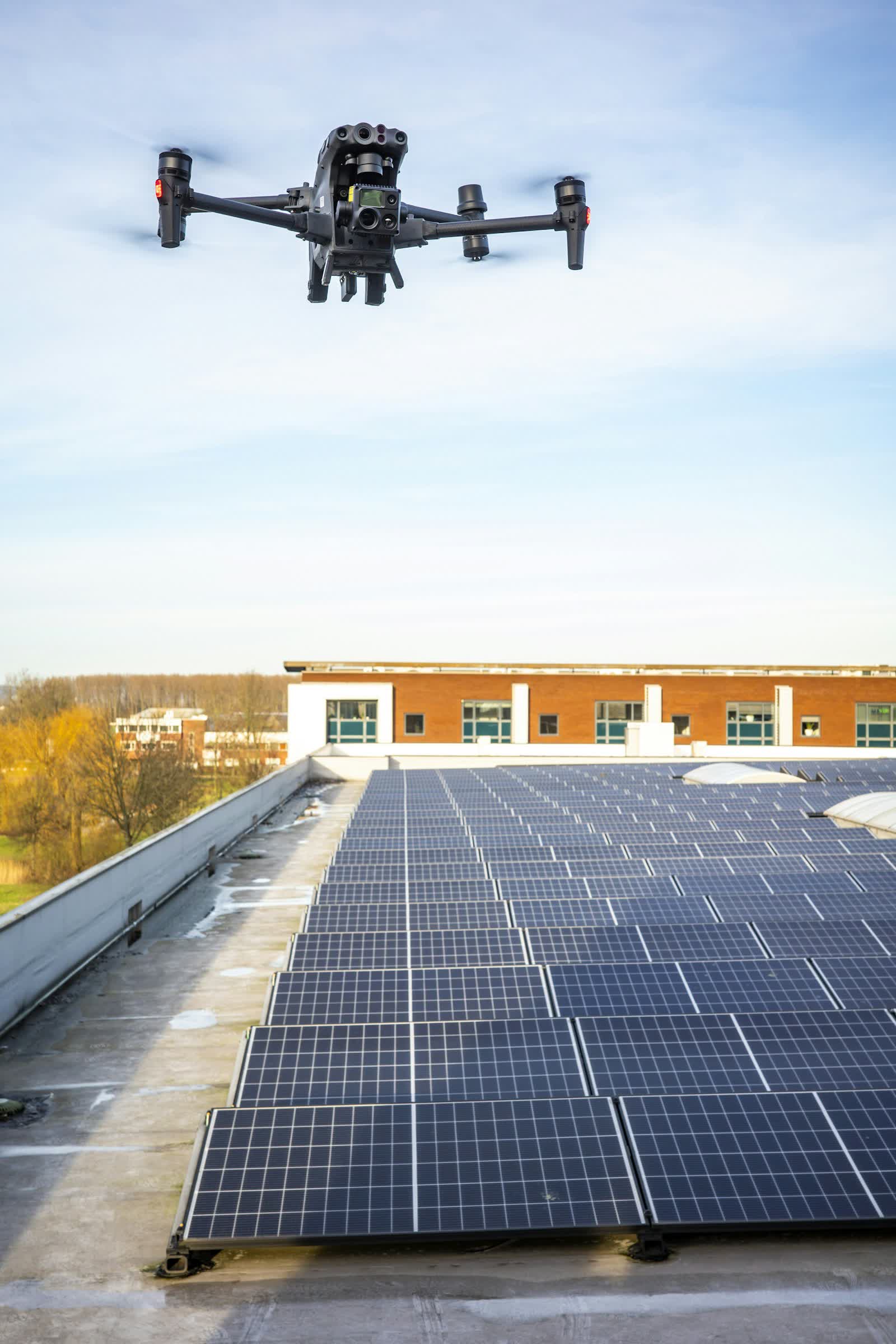
A charging station and its supply cabinet accumulate contact points carrying high currents: power connections, circuit breakers, the grid connection terminal block, sometimes a dedicated transformer on a site with several dozen charging points (fleet depot, electrified logistics platform). A connection that loosens or oxidises slightly sees its resistance rise; the point heats up under load, with no warning light showing it until the fault — or the start of a fire — is already declared. A thermal flight at night or under full load, flown with a radiometric camera, maps every charging point and its supply cabinet in a single pass: each temperature anomaly is located and ranked by priority, following exactly the method we detail for industrial switchboards and busbar systems.
The reliability of this reading is long documented: a landmark review by Sudhakar Bagavathiappan, Bishnu Lahiri, T. Saravanan, John Philip and T. Jayakumar, published in 2013 in Infrared Physics & Technology, establishes infrared thermography as a proven, non-intrusive monitoring method for detecting abnormal heating in electrical equipment (see the study). Across a fleet of several dozen charging points, this aerial reading beneficially replaces a point-by-point handheld camera round, without taking a single space out of service.
Flight rules: a car park is rarely isolated from everything
A supermarket, retail-park or town-centre car park almost always sits within a built-up area: the flight follows the specific-category scenarios we describe in our flying in cities guide, with prior declaration to the préfecture. A car park isolated on the outskirts or within an enclosed industrial site more often qualifies for the open category, provided it stays well clear of the public. Either way, the mission is scheduled during quiet hours — early morning for late-night thermography, a closing day for the survey — to limit the number of vehicles and people caught in the camera's field.
Car park images almost always capture number plates and sometimes people: blurring on delivery and data minimisation follow the rules recalled in our GDPR and professional drones guide. A well-run mission report keeps only what serves the project — space count, charging-point positions, thermal map — and nothing more.
Prices observed in 2026
Ranges observed in 2026 (excl. VAT):
- Siting survey (georeferenced orthophoto, space count, proposed trench route, car park up to 5,000 m²): €500 to €1,100.
- Large site or business park (several car parks, several hectares): €900 to €2,200.
- Maintenance thermography (charging points, cabinets and associated transformer, per-point report): €400 to €900 for a fleet under twenty charging points, above that on quote depending on numbers.
- Annual thermal-check programme (same points, pass-to-pass comparison): 15 to 25% lower per recurring pass.
The initial survey pays for itself as soon as it avoids a single wrongly positioned trench being redone; maintenance thermography compares against the cost of downed charging points or an electrical incident. Our surveying and photogrammetry and drone thermal imaging pages present these two services; request a quote stating the car park's area, the number of charging points planned or installed, and the project stage.
Put it into practice
- Drone aerial thermal imaging: rates and cities covered from €500
- Aerial thermal imaging in Versailles Île-de-France
- Aerial thermal imaging in Saint-Maur-des-Fossés Île-de-France
- Aerial thermal imaging in Calais Hauts-de-France