C-DRONE GUIDE · 26 JULY 2026
Solar car park canopies: drone survey, construction monitoring and thermography
France's law no. 2023-175 of 10 March 2023 on accelerating renewable energy — the APER law — requires existing outdoor car parks over 1,500 m² to fit solar canopies over at least half their area, on a phased timetable and under threat of annual penalties. For retail chains, business park managers, local authorities and property companies, it is a nationwide programme: identifying the car parks in scope, sizing projects, building, then operating power plants amid customer and vehicle flows. At each stage, the drone brings data the ground cannot offer — without closing the car park. Initial survey, construction monitoring, commissioning and O&M thermography: here is the drone's role in a canopy project, and 2026 prices.
Published on 26 July 2026, reviewed on 21 September 2026 — regulations in force as of September 2026.
What the APER law requires of car parks
Article 40 of the APER law targets outdoor car parks over 1,500 m²: at least half their area must be fitted with canopies incorporating renewable energy production — in practice, photovoltaics. Deadlines are phased by park size (largest first), with framed exemption cases (technical, heritage or security constraints, or disproportionate costs, to be demonstrated) and annual penalties for non-compliance. Added to this are the solar obligations on roofs of new or heavily renovated buildings — covered on the roof side by our survey before solar panels guide.
For a multi-site manager, step one is an inventory: which car parks exceed the threshold, what usable area remains once accesses, green areas and manoeuvring zones are subtracted, what power potential. That is measurement work — exactly what a photogrammetric flight produces quickly and accurately.
Design stage: the drone survey that anchors the layout
A one-hour photogrammetric flight delivers the car park's scaled orthophoto and digital surface model: exact areas, slopes and drainage, road markings and true space counts, overhead networks, lighting, trees and their cast shadows, neighbouring buildings. The design office lays out the canopy bays, checks circulation clearances and computes solar masks on evidence rather than on an approximate cadastral plan. With an RTK drone, accuracy is sufficient for detailed design — our RTK/PPK guide details the requirement levels.
The same survey serves the planning file (building permit or prior declaration as applicable, with landscape insertions from the aerial views — see our aerial photo and building permit guide) and any exemption case: proving a car park is ineligible (actually available footprint, operating constraints) is better done with measurements than estimates. During works, periodic flights document progress — the mechanics of our drone construction monitoring page, applied to a site that must coexist with customers.
Commissioning and operations: canopy thermography
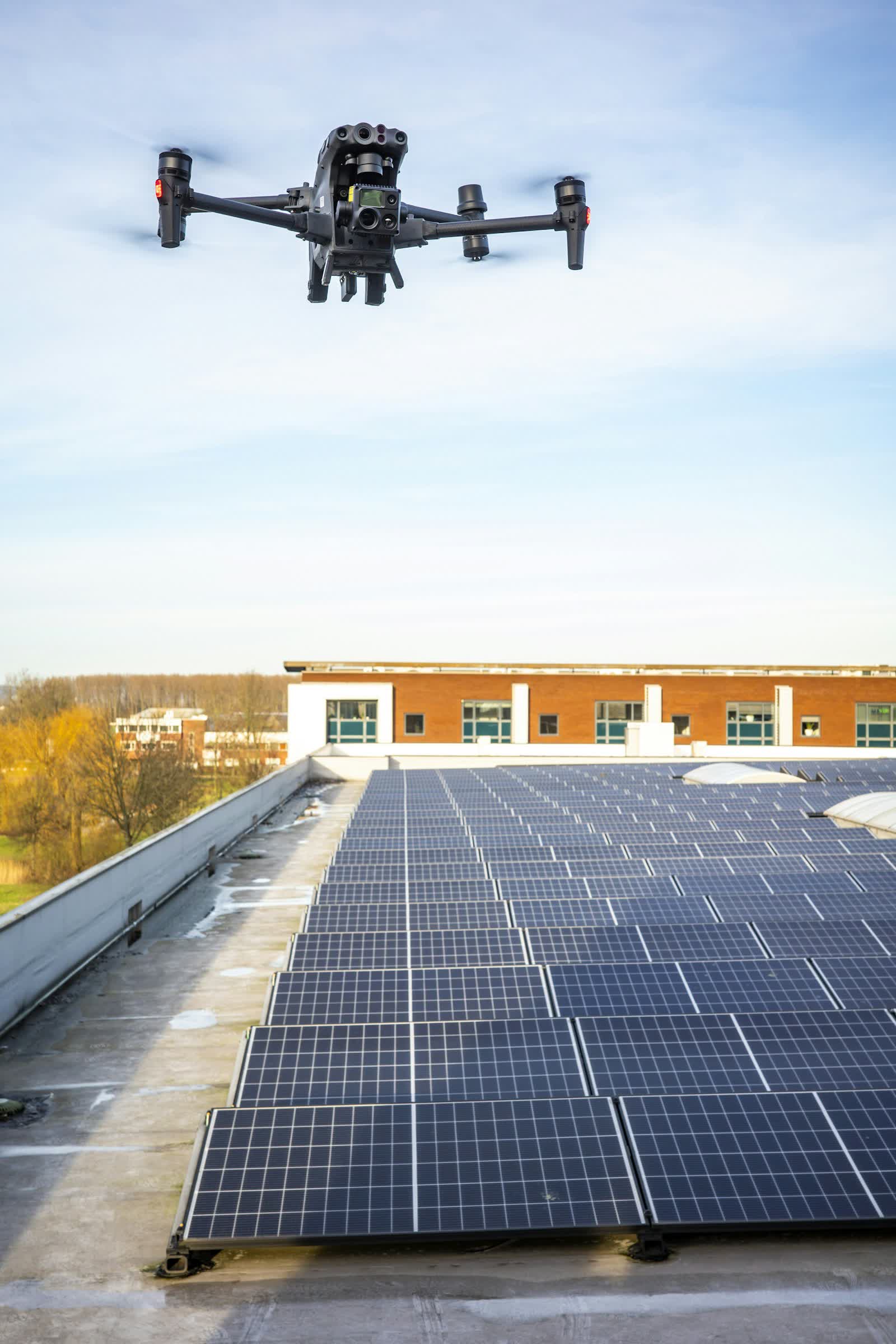
Once the plant is connected, the drone switches to the production side. Commissioning thermography checks module by module for defects — hot cells, failed bypass diodes, whole strings down — before reserves are lifted; in operations, an annual or biennial pass spots the degradations and soiling that erode output. Thermographic diagnosis of PV modules is a scientifically mature field: the reference review by Tsanakas, Ha and Buerhop published in 2016 in Renewable and Sustainable Energy Reviews catalogues the thermal signatures of crystalline-silicon module faults and the conditions for reliable diagnosis (see the study on Google Scholar).
Canopies have their quirks: tilted modules above vehicles that reflect and radiate heat, difficult underside access once the car park fills, and a commercial built-up flight environment requiring the appropriate authorisations. The protocol — minimum irradiance, viewing angle, the car park's off-peak hours — follows the state of the art detailed in our PV plant thermography and IEC 62446-3 guide; panel cleaning completes the operating cycle.
Observed prices in 2026
Ranges observed in 2026 (excl. VAT), for a typical retail or business-park car park:
- Design-stage photogrammetric survey (orthophoto, DSM, area plan): €600 to €1,500 per site, tapering on multi-site campaigns.
- Construction monitoring: €300 to €600 per visit, depending on frequency.
- Commissioning or O&M thermography: €500 to €1,200 per site depending on capacity, string-level report included.
For a property company or retail chain, the economic lever is the grouped campaign: surveying or thermographing dozens of car parks in one region within a week sharply cuts unit cost — and yields a consistent inventory, invaluable for steering the portfolio's APER compliance. Request a quote with your site list and approximate areas.
Put it into practice
- Drone aerial thermal imaging: rates and cities covered from €500
- Aerial thermal imaging in Saint-Malo Bretagne
- Aerial thermal imaging in Châteauroux Centre-Val de Loire
- Aerial thermal imaging in Gap Provence-Alpes-Côte d'Azur