C-DRONE GUIDE · 31 AUGUST 2026
Solar Parking Canopies in France: the APER Law Obligation, Exemptions, Fines and Where Drones Fit In
A solar parking canopy is a structure that shelters parking bays and carries solar panels on its upper surface, producing electricity that is either used on site or sold to the grid. Since France's APER law, existing outdoor car parks over 1,500 m² must be fitted with them over at least half of their surface area: since 1 July 2026 for those of 10,000 m² or more, by 1 July 2028 for those between 1,500 and 10,000 m², or face a penalty of up to €20,000 or €40,000, renewable every year. Now that the first deadline has passed, many operators of retail sites, logistics warehouses and park-and-ride facilities are only now grasping the scale of the file to build — and mid-sized car parks have until 2028 to prepare, rather than waiting for the last quarter. Here is exactly what the law requires, how to tell whether your car park is in scope or exempt, how a drone survey de-risks the file before construction, what changes with post-installation thermography once the canopies are up, and 2026 prices.
Get up to 3 quotes from professional drone pilots in your area
Describe the mission in two steps. With your consent, it is passed on to partner professional pilots (3 at most), who contact you directly with their proposal.
Published on 31 August 2026, updated on 12 October 2026 — regulations in force as of September 2026.
What the APER law requires of car parks, and since when
The text passed almost unnoticed when it was adopted, but its deadline has just hit a swathe of France's commercial and industrial real estate hard. Article 40 of law no. 2023-175 of 10 March 2023 on accelerating renewable energy production — the "APER law" —, detailed by decree no. 2024-1023 of 13 November 2024, requires outdoor car parks over 1,500 m² that already existed on 1 July 2023 to be fitted with canopies incorporating a renewable-energy generation process — in the vast majority of cases, photovoltaic panels — over at least half of their surface.
The deadlines are staggered : car parks over 10,000 m² had to comply by 1 July 2026 — a date already past as we write —, while those between 1,500 and 10,000 m² have until 1 July 2028. The préfecture may exceptionally grant extra time, subject to conditions. Past the deadline, the owner faces a penalty of up to €20,000 for a car park of 1,500 to 10,000 m², and up to €40,000 from 10,000 m², proportionate to the seriousness of the breach, imposed after an adversarial procedure and which can be imposed again every year until compliance — and therefore potentially cumulative across several financial years (official Service Public Entreprendre factsheet, in French).
The decree and the accompanying amended order of 5 March 2024 provide exemptions many operators discover late — excessive costs, technical or ground constraints, aggravated risk, protected areas, car parks already shaded by trees —, detailed in the next section. Car parks built into a building (indoor or underground) are not affected. For an operator of a large retail site, a logistics warehouse, a business park, or a local authority running a park-and-ride facility, the first step is therefore not choosing an installer, but precisely documenting the existing situation — which is exactly where a drone survey earns its place, before the first shovel goes in the ground.
Is my car park in scope? Surface area, responsibility, exemptions
Before talking to an installer, three questions are enough to place a car park, according to the official French public-service factsheet.
- What is its surface area in the legal sense? It includes parking bays off the public highway and the lanes, walkways and toll areas giving access to them, between the car park's entrances and exits. It excludes green spaces, storage, handling, loading and unloading areas, parts within 10 metres of a classified (ICPE) installation, and lanes used specifically by goods vehicles over 7.5 tonnes. A car park close to the 10,000 m² threshold on the land register can therefore fall below it — and change deadline.
- Who bears the obligation? The owner, or the concession holder, delegate or holder of the public-domain occupation permit where the car park is run that way — in which case the timetable depends on when the contract was signed or renewed. Owners of adjacent car parks on the same land unit may pool their obligation.
- Does an exemption apply? Excessive works costs (above 10 % of the existing car park's market value, net of discounted electricity sales over 20 years) or costs threatening the owner's viability, technical, ground or usage constraints, aggravated natural or technological risk, listed monument, heritage site or protected site, a car park already shaded by broad-canopy trees over half its surface, at one tree per three bays. The exemption is justified by a certificate with a non-technical summary and, for photovoltaic canopy exemptions, a techno-economic study by a qualified firm or one holding an "RGE Études" quality mark.
All three answers rest on measurements, which is where a drone earns its place before any project: a georeferenced orthophoto of the car park makes it possible to measure the surface area under the calculation rules above, zone by zone, count bays and trees and measure the shade their canopy actually casts — factual evidence to attach to the certificate or the techno-economic study, rather than an area taken from an old plan. On funding, the official factsheet notes that where a third-party investor funds the canopies in return for operating them, only any remaining cost charged to the owner counts towards the works cost; the feed-in or reference tariff of the electricity-generation support schemes is the basis for the revenue taken into account. For a multi-site estate, our guide to parking canopies from survey to construction monitoring details the sequence of flights, from inventory to commissioning.
Before construction: the drone survey that de-risks the file
A parking canopy project runs into constraints that the cadastral plan alone never reveals : the exact position of existing lighting masts and lamp posts, the clearance height needed for lorries in delivery areas, trees whose shade reduces expected output or that the operator wants to preserve to justify a partial exemption, the ground's real slope, buried networks visible at the surface, and the exact usable area once parking bays, circulation aisles and existing charging points are accounted for. An aerial drone survey, delivered as a georeferenced 3D model of the whole car park, gives the design office the topographic base it needs to size the canopy layout without multiplying site visits — the same logic detailed in our guide to drone-based sunlight and shading studies on a 3D model, applied here to a car park surface rather than a roof.
The survey also helps document the regulatory file : prior planning notice or full planning permission is generally required beyond certain canopy-surface thresholds, and attaching a precise 3D model of the existing site — neighbouring buildings, tree heights, real hour-by-hour solar masks — speeds up the review and limits requests for extra documents. For large sites where part of the roof is already fitted with photovoltaics, cross-checking against the solar register already produced for the buildings makes it possible to reason about the site's total expected output, roof and car park combined, rather than project by project. And where the operation is part of a property acquisition or disposal, the same survey feeds into a technical due diligence that prices the real expected output before signature, rather than relying solely on the declared surface area.
After installation: why a parking canopy is not inspected like a ground-mounted solar farm
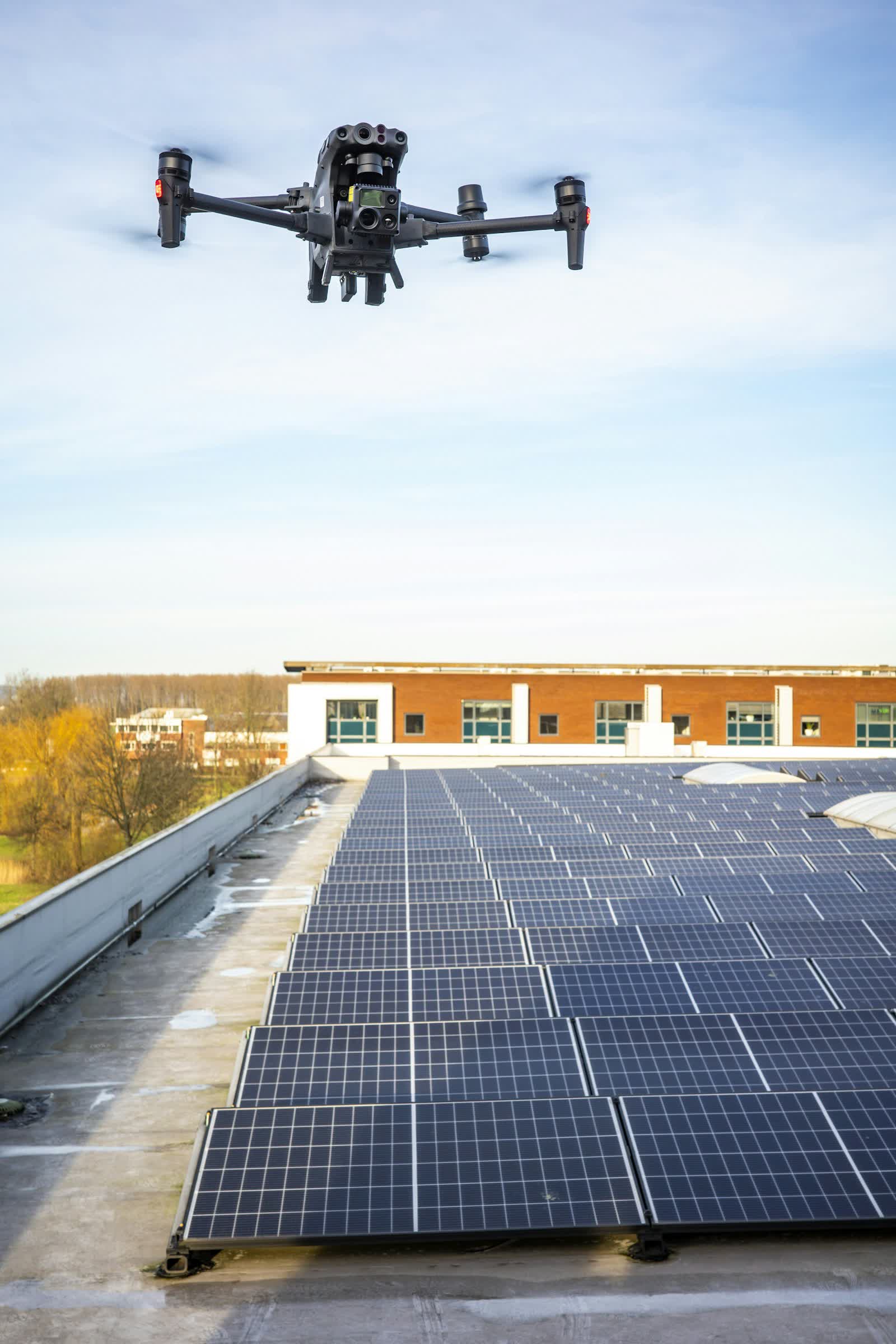
Once the canopies are up, the obligation does not end on the day of commissioning : a hot spot on a cell, a faulty connector or an underperforming string of modules reduce expected output — and for a site that invested under regulatory pressure, that output is what partly funds the installation. Airborne infrared thermography, following the method set out in standard IEC 62446-3, remains the reference tool for spotting these anomalies without dismantling a single module — we detail the full method, directly transposable here, in our guide to drone thermography of a photovoltaic plant.
The difference lies in geometry and flight environment. A parking canopy sits low — often 2.5 to 4 metres above the vehicles —, interspersed with lighting masts, CCTV cameras and, increasingly, electric-vehicle chargers wired directly into the structure ; the site generally stays in use during the flight, with vehicles and pedestrians moving about, which calls for a more constrained flight plan than over open farmland, usually scheduled outside peak hours. A study by R. del Prado Santamaría and co-authors, published in 2025 in EPJ Photovoltaics, specifically tested the effect of drone flight altitude and irradiance level on defect detection by thermography : the most critical hot spots — a short-circuited bypass diode, heavy soiling — remained detectable even at reduced irradiance and higher flight altitude, which supports the case for flying these inspections at a height suited to a car park's low obstacles without losing reliability (see the study). One component ground-mounted farms do not have : a visual inspection of the structure itself — corrosion on posts and brackets, the condition of weatherproofing seals on the canopy roof, fixings for suspended equipment — an exercise close to the one we describe for inspecting a floating solar farm, where structure and output are checked in the same outing.
Beyond the fine: the real benefits, and 2026 prices
Reducing the topic to the mere threat of a fine would miss the point : a well-sized parking canopy delivers a concrete service. It shields vehicles from direct exposure that, in summer, speeds up the ageing of interior plastics and makes the cabin barely bearable ; it limits heat build-up on the asphalt surface ; and it gives a fleet operator or a site open to the public a natural anchor point for deploying chargers powered in whole or in part by local generation. A study by H. Fakour, M. Imani and co-authors, published in 2023 in Scientific Reports, modelled this pairing on a car park in Kaohsiung, Taiwan : the solar roof sized for the site there produces around 140 MWh a year, enough to power more than 3,000 one-hour charging sessions a month, for roughly 94 % less CO2 than conventional grid supply (see the study). The figures do not translate as-is to a French car park — sunlight, site size and the electricity mix all differ —, but they show why more and more operators are pairing a canopy with charging infrastructure at the design stage rather than treating the two as separate projects.
2026 prices (excl. VAT) : €600 to €1,500 for an upfront drone feasibility survey (georeferenced 3D model of the car park, solar-shading study, layout note) on a car park up to 1 hectare, €1,500 to €3,500 beyond that, depending on surface area and the number of layout scenarios to compare ; €800 to €1,800 for a post-commissioning control thermography, including the IEC 62446-3 pass, a visual structural check and a non-conformity report ranked by severity ; €400 to €900 for an annual follow-up check once the first baseline thermography has been carried out. Administrative steps (prior planning notice, planning permission) remain the design office's or architect's responsibility and are priced separately. Request a quote stating the car park's surface area, its regulatory deadline (2026 or 2028) and whether the project is at the feasibility or post-installation control stage.
Frequently asked questions
Which car parks are subject to the solar canopy obligation, and since when?
Any outdoor car park over 1,500 m² that already existed on 1 July 2023 falls under the APER law. Car parks of 10,000 m² or more had to comply by 1 July 2026 — a deadline already passed — while smaller ones, between 1,500 and 10,000 m², have until 1 July 2028. Covered or underground car parks are not affected.
What is the penalty if a car park is not fitted with solar canopies?
A penalty of up to €20,000 for a car park of 1,500 to 10,000 m² and up to €40,000 from 10,000 m², proportionate to the seriousness of the breach and imposed after an adversarial procedure. It can be imposed every year until the car park complies.
How is a car park's surface area calculated under the APER law?
It includes parking bays and the lanes, walkways and toll areas leading to them, between the car park's entrances and exits. Green spaces, storage, delivery and handling areas, land within 10 metres of an ICPE and lanes used specifically by goods vehicles over 7.5 tonnes are excluded. A drone orthophoto makes it possible to measure each zone on a verifiable basis.
Does a car park already shaded by trees need solar canopies?
No, if at least half of its surface is shaded by broad-canopy trees spread across the whole car park at one tree per three bays. The owner must be able to demonstrate this with a certificate.
Can a drone replace the design office for a parking canopy project?
No, and that is not its role : the drone supplies the topographic data and the georeferenced 3D model the design office relies on to size the layout, calculate expected output and build the regulatory file. It is a survey tool, not a substitute for engineering — the same relationship described in our guide to drone-based sunlight and shading studies.
How does thermography on a parking canopy differ from a ground-mounted solar farm?
In geometry and surroundings : a canopy sits low, surrounded by lighting masts and often EV chargers, and the car park generally stays in use during the flight, which calls for a more constrained flight plan than over open ground. It also adds a structural component — corrosion, weatherproofing, fixings — that thermal inspection alone does not cover.
Put it into practice
- Drone aerial thermal imaging: rates and cities covered from €500
- Aerial thermal imaging in Le Mans Pays de la Loire
- Aerial thermal imaging in Perpignan Occitanie
- Aerial thermal imaging in Argenteuil Île-de-France