Flying a drone in France? The complete 2026 guide in English: how to read the zone map, register on AlphaTango step by step, and the rules for cities and Paris.
Buy — €10 Contents and free extract
VAT included · secure Stripe payment · instant access: by paying you request immediate access to the digital content and acknowledge you lose your right to cancel.
C-DRONE GUIDE · 14 AUGUST 2026
Storm and hail damage: mass drone surveys for insurance after a natural disaster
A hailstorm can cross a town in twenty minutes and leave several hundred damaged roofs behind it: split tiles, punctured skylights, torn-off flashing. For the insurer or the loss-adjustment firm, the problem is no longer technical but logistical: how do you visit, within a few days, a volume of claims that one or two adjusters simply cannot cover safely on storm-weakened roofs? A growing number of insurers now answer with a grouped drone survey campaign, run as a logistics operation rather than a string of individual appointments. Here is how such a campaign is organised, what does — and does not — change in the rules after a natural disaster, and what it costs in 2026.
Published on 14 August 2026, updated on 22 September 2026 — regulations in force as of September 2026.
The complete guide to French drone regulations 2026 — procedures, checklists and templates · €10 →
The bottleneck of a mass-loss event
A windstorm or a hailstorm does not produce one claim, it produces hundreds at once, concentrated along the same few kilometres and filed within the same few-day window. An insurer or broker covering a mid-sized town can therefore receive, in a single week, a volume of roof claims it would normally process over several months. Yet the number of adjusters who can be mobilised stays constant: each can only visit a handful of sites a day, cherry picker or ladder in hand, and the roof still needs to be safely accessible — a shifted tile or a wind-weakened frame makes direct access riskier right after the event, not less.
This bottleneck forms exactly when policyholders are most anxious for an answer. A delayed assessment in turn delays the temporary tarpaulin, the start of repair works and, ultimately, the payout. It is this mismatch between a sharp spike in workload and a structurally flat ground-based assessment capacity that is pushing more and more insurers to think in terms of a campaign rather than isolated visits, with the drone as the large-scale collection tool.
How a commune-wide survey campaign is organised
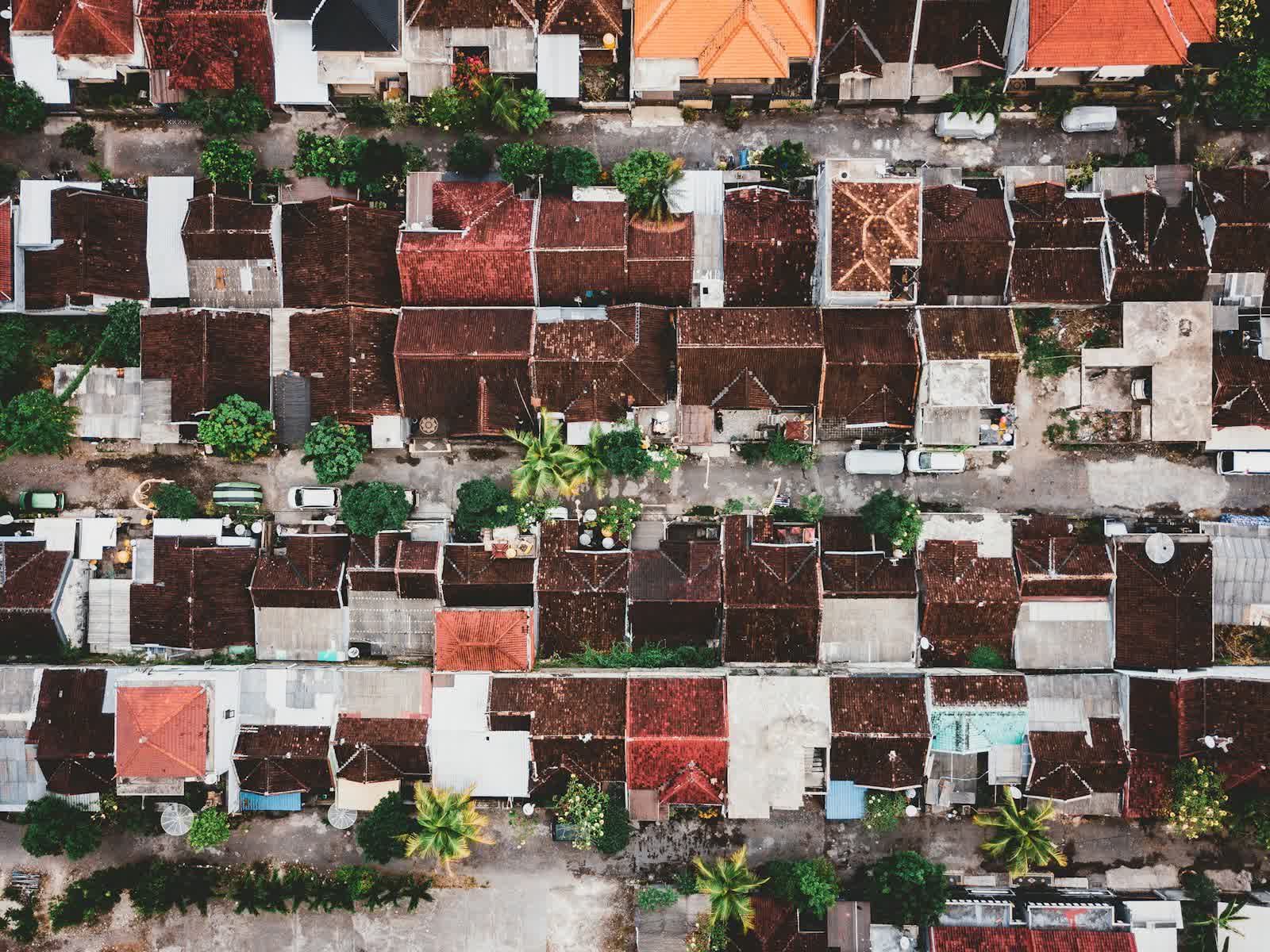
As soon as the wind drops below the flyable threshold, several remote pilots are mobilised at once across the affected area, rather than a single provider working through addresses one after another. Each building follows a short, standardised protocol: a nadir orthophoto, four to six oblique shots covering every roof slope from a different angle, and, optionally, a thermal pass that reveals water ingress under a cracked covering before any stain even appears on the ceiling. Allow ten to fifteen minutes per address, set-up included — against thirty minutes to an hour for a full ground visit with height access.
Every image is automatically geotagged and time-stamped by the drone, then uploaded the same day to a shared platform: adjusters, from their desks, triage the whole batch of files without travelling to every site, reserve a physical visit for the heaviest cases (structural damage, doubt over the true extent) and settle the simplest files directly from the aerial footage. A study by Kucharczyk, Nesbit and Hugenholtz published in 2025 (Remote Sensing, MDPI) trained deep-learning segmentation models on drone orthomosaics captured after Hurricanes Irma and Maria to automatically tell apart two classes of roof damage — damaged roof decking and roof holes — reaching F1 accuracy scores of 0.88 and 0.80 across nearly 1,500 test samples (see the study). That level of reliability shows why automated triage of a large volume of aerial imagery is becoming a credible prioritisation tool, even though it never excuses the human adjuster from confirming and pricing each retained file.
The regulatory framework: what changes, what doesn't
No special drone regime kicks in simply because a natural disaster has just been officially recognised: the usual categories remain the reference. An isolated house outside a built-up area is most often flown in the open category (A2 or A3 depending on distance to people); a dense town centre shifts into the specific category — the European standard scenario STS-01 — with a CATS-certified pilot, as detailed in our guide to the open versus specific category. For any flight over public space in a built-up area outside the simplified cases introduced in 2026, a prior declaration to the DGAC is still required with ten working days' notice — a planning constraint that serious insurers anticipate ahead of time, through a framework agreement with one or more providers before storm season, rather than scrambling the day after a loss event.
This operational timeline should not be confused with the administrative natural-disaster timeline: the state of natural disaster is officially recognised by an interministerial decree published in the Journal Officiel, and only from that publication date — sometimes several weeks after the event — does the policyholder's claim-filing window start running, raised from 10 to 30 days since 1 January 2023 (article L125-1 of the French insurance code). In practice, the drone campaign often starts in the field as soon as the weather allows, well before the decree is published, as a preservative record; the file then moves into the formal CatNat process once the decree is out. One thing stays constant regardless of the context: flying over private property on an insurer's behalf still requires the policyholder's agreement, usually obtained when they request the assessment — a declared natural disaster creates no automatic right to overfly.
What a drone report doesn't replace, and 2026 campaign prices
A study by Alzarrad, Awolusi, Hatamleh and Terreno published in 2022 (Frontiers in Built Environment, DOI 10.3389/fbuil.2022.1026225) evaluated a convolutional neural network trained on drone imagery to automatically detect and locate roof defects, missing shingles included. This kind of assistance speeds up spotting damage, but replaces neither the adjuster's judgement on material wear, nor the application of the policy's terms (excess, coverage cap), nor the signature on the assessment report that binds the insurer — the drone objectifies the condition observed, the adjuster draws the contractual conclusions.
Ranges observed in France in 2026 (excl. VAT):
- Stand-alone roof assessment (outside a grouped campaign, orthophoto and oblique shots): €250 to €450.
- Mass campaign, per property (dozens to hundreds of addresses mobilised on the same event, tapering rate): €90 to €180 per roof.
- Additional thermal pass (residual water-ingress detection): +€80 to €150 per address.
- Comparative commune-wide orthophoto (before/after, when a baseline image exists): quoted case by case.
This service draws on our roof inspection drone offer, complemented where useful by our drone thermal imaging offer; it also extends what we detail for drone flood damage assessment and the risk-prevention survey ahead of a loss event. Request a quote stating the approximate number of addresses, the geographic area and the desired turnaround to size the mobilisation.
Frequently asked questions
Does the drone replace the adjuster's site visit?
No: it objectifies the roof's condition remotely and allows files to be triaged quickly, but the adjuster remains the sole judge of wear, pricing and how the policy's clauses apply. The heaviest or most ambiguous cases still get a physical visit.
Can a drone fly the day after the storm, before the natural-disaster decree is issued?
Yes: the flight follows the usual aviation rules, independent of the administrative recognition of the natural-disaster status. Many insurers launch the survey campaign as soon as the weather allows, as a preservative record, well before the decree that starts the policyholder's declaration window is even published.
Who authorises flying over private property for a post-loss drone assessment?
The policyholder themselves, usually when they request the assessment — recognising a natural disaster creates no automatic right to overfly. In a built-up area, the provider must also follow the usual préfecture declaration rules.
Put it into practice
- Drone roof inspection: rates and cities covered from €200
- Roof inspection in Grenoble Auvergne-Rhône-Alpes
- Roof inspection in Brest Bretagne
- Roof inspection in Metz Grand Est