C-DRONE GUIDE · 30 JULY 2026
Drone thermal monitoring of waste sorting centres: lithium battery fires, price
A waste sorting centre almost never catches fire because of a short circuit in an electrical cabinet: it catches fire because a lithium battery, wrongly dropped into a recyclables bin, gets pierced by a grapple claw or crushed on a sorting belt, and goes into thermal runaway in the middle of tonnes of perfectly combustible paper, cardboard or plastic. The phenomenon is no longer marginal: several operators attribute roughly half of their fire starts to it, and France's BARPI industrial-accident bureau records a steady rise in battery-related incidents across the waste sector. A ministerial order of 22 December 2023 tightened fire prevention accordingly for sorting, transfer and treatment facilities. Drone thermography replaces no regulatory obligation there — it complements, on the areas fixed detection covers least well, a surveillance operators have every interest in professionalising. Here is where it fits, what it changes, and prices observed in 2026.
Published on 30 July 2026, reviewed on 21 September 2026 — regulations in force as of September 2026.
Why lithium batteries set sorting centres on fire
The mechanism is well documented: a damaged lithium-ion battery — pierced, crushed, bent — can enter thermal runaway: an internal short circuit raises the temperature until the electrolyte ignites, anywhere from seconds to hours later depending on state of charge and the type of damage. The trouble for sorting centres is that these batteries almost never arrive on their own: they are buried in a stream of household or bulky waste where no one has identified them, then they go through mechanical stages — grapple, conveyor belt, baler, shredder — which are exactly the kind of impact capable of triggering runaway.
A 2021 review published in the journal Processes by Nigl, Baldauf, Hohenberger and Pomberger quantified this risk stage by stage along the waste treatment chain: it concludes that a fire confined to a collection vehicle is a manageable risk, but that a fire fully developing inside a treatment facility — precisely the configuration of a sorting centre, with its combustible stockpiles sitting close to one another — crosses the threshold into unacceptable risk under the assessment methods the authors used (see the study on Google Scholar). It is this gap in severity between an isolated hot spot and a full-blown fire that justifies investing in early detection, well before flames are visible.
What the 22 December 2023 order now requires
The order of 22 December 2023 on fire-risk prevention applies to classified installations subject to authorisation under headings 2710 (waste collection from the original producer), 2712 (end-of-life vehicles), 2718 (transfer, grouping or sorting of hazardous waste), 2790 and 2791 (treatment of hazardous and non-hazardous waste) — most recyclables and commercial-waste sorting centres fall under one or more of these 27xx headings depending on the streams handled. Two amending orders from May 2025 further clarified the definition of certain battery categories covered by the text.
The text requires operators to set up an identification procedure for waste containing batteries that results from upstream sorting errors, with such waste refused or isolated, and a dedicated prevention and response procedure for fires triggered by such a sorting failure. These obligations add to the baseline already in place since the post-Lubrizol tightening: generalised detection systems, first-response equipment, staff training. For local authorities and joint boards that operate or contract out these facilities, compliance often runs through a public procurement contract — see our guide on buying drone services under public procurement.
Where drone thermography complements detection — and where it does not replace it
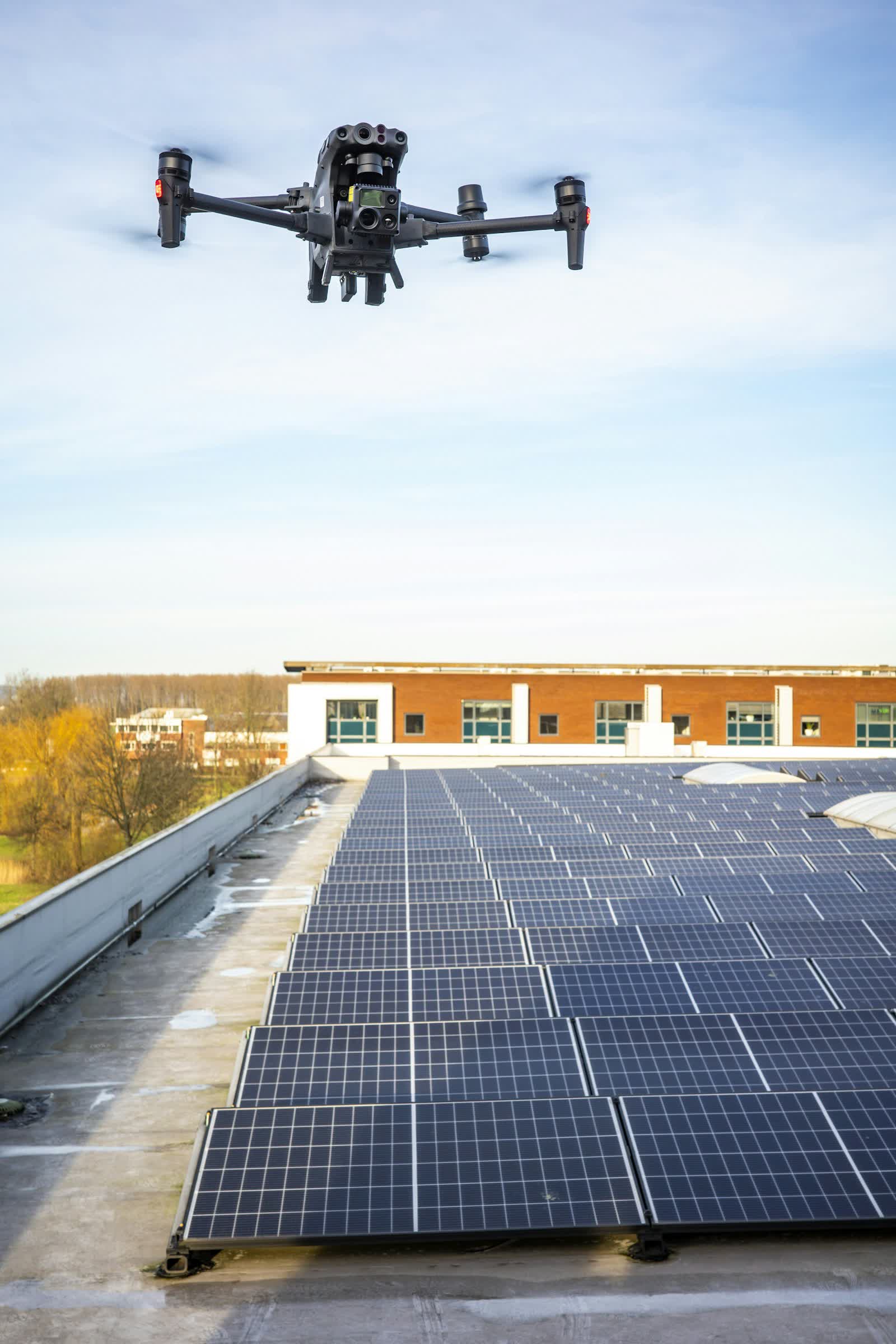
Let's be direct: a drone never replaces the fixed automatic detection required on sorting lines and inside buildings — fixed thermal cameras, linear detectors, automatic extinguishing. That detection must be continuous and immediate, and no periodic flight can substitute for it. Where a drone brings real value is on the outdoor storage areas that fixed CCTV covers poorly: RDF (refuse-derived fuel) bale yards, paper and cardboard stocks awaiting collection, end-of-life vehicle lots, green-waste windrows at the site entrance — a problem close to the one covered in our guide on composting and self-heating, and transferable to wood chip stockpiles.
Three concrete uses come up repeatedly: a periodic thermal round of outdoor stockpiles (weekly, or after every large delivery), catching a smouldering hot spot before it is visible at the surface; a post-incident check, when the order requires confirming a stockpile's temperature has dropped before authorising a restart after a contained fire start; and an initial survey of the regulatory distances between storage islands, which feeds the site's risk assessment study and is documented with a dated orthophoto rather than an approximate drawing. A drone covers in roughly twenty minutes an area that on-foot rounds with a handheld camera take an hour to walk, with an overhead view no ground-level fixed point offers.
Setting up periodic surveillance without replacing the operator
The typical mission is structured as a subscription rather than a one-off visit: a weekly or fortnightly pass over the outdoor storage areas identified with the operator, delivered as a dated thermal map and a list of anomalies ranked by temperature gap. The pilot does not assess fire risk in place of the site's HSE manager — the pilot delivers usable data, folded into the surveillance procedure already in place, alongside human rounds and fixed detection. It is the same complementary logic as our guide on grain silo thermal monitoring: one more measurement point, not a stand-alone security system.
The flight is prepared like any mission in a built-up or industrial area: prior notification where required, coordination with the operator on timing (moving machinery, grapples, heavy trucks), and attention to existing CCTV — a subject our GDPR and professional drones guide covers in detail for any site where people can appear in the camera's field of view.
Prices observed in 2026
Ranges observed in 2026 (excl. VAT):
- One-off pass (thermography of a storage site, anomaly map): €500 to €900.
- Monthly subscription (several passes, trend tracking over time): €300 to €600 per pass, discounted on an annual commitment.
- Post-incident check (confirming cooling before restarting operations): €300 to €500, with a short response time to agree contractually.
- Initial mapping of regulatory distances (orthophoto and dimensioned plan for the risk assessment study): €600 to €1,500 depending on site size.
Our aerial thermography page presents the service as a whole; request a quote stating the site's ICPE heading, the area of outdoor storage zones and the intended flight frequency.
Put it into practice
- Drone aerial thermal imaging: rates and cities covered from €500
- Drone security & surveillance: rates and cities covered from €600
- Aerial thermal imaging in Laval Pays de la Loire
- Aerial thermal imaging in Brive-la-Gaillarde Nouvelle-Aquitaine
- Aerial thermal imaging in Sète Occitanie