A professional drone pilot for this mission Request a free quote
C-DRONE GUIDE · 29 JULY 2026
Data centre drone inspection and thermography: method, price
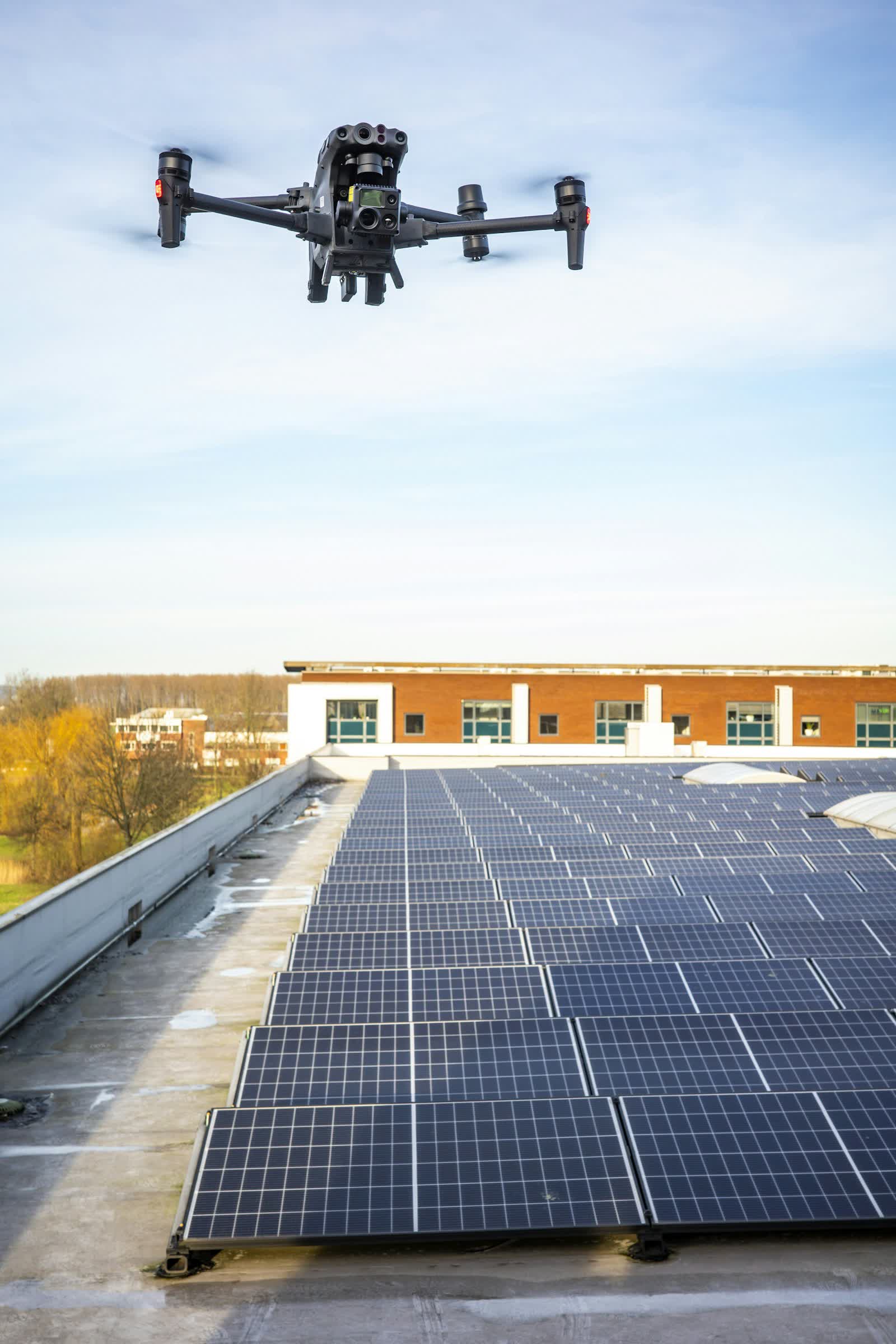
A data centre is a paradoxical building: everything happens inside, in rooms no outsider ever visits, yet its survival depends on equipment installed outdoors — chillers, dry coolers, air handling units, generator sets — sitting on a roof or around the perimeter, exposed to weather and fouling. And above server rooms hosting data worth fortunes, there is a waterproofing membrane like on any other building. For the operator, every human roof inspection is a procedure: prevention plan, controlled access, imposed walkways between live equipment. The drone offers another route: documenting roof condition and thermally surveying the cooling plant without a technician going up, without interrupting anything, in half a day coordinated with site security. Here is how a data centre mission unfolds, and prices observed in 2026.
Published on 29 July 2026, updated on 22 September 2026 — regulations in force as of September 2026.
A critical building whose weak points are outdoors
A data centre's availability rests on a cooling chain sized with redundancy — N+1 or 2N depending on the target service level — whose outdoor links work around the clock: dry coolers and condensers exchanging with the air, chillers, pumps, air handling units. A review by Alfonso Capozzoli and Giulio Primiceri published in 2015 in Energy Procedia recalls that cooling accounts for a major share of a data centre's consumption and that its performance directly drives the operator's PUE indicator (see the study): a fouled heat exchanger or a stopped fan means redundancy silently consumed and kilowatt-hours wasted.
The other weak point is more mundane: the roof itself. A membrane punctured by hail, tired upstands around a cable penetration, a blocked gutter — above a server room, water damage is no ordinary loss. These cluttered roofs are ill-suited to walking rounds; they suit drones very well, like the large logistics and retail roofs they resemble in build.
Thermal survey of the cooling plant: reading actual redundancy
Seen through a thermal camera, a data centre roof tells the story of its operation: each dry cooler shows its signature — even coil patterns when all is well, cold zones where a bundle is fouled or blocked, a stopped fan standing out from its neighbours, an abnormally hot motor or bearing. The thermal flight, done while equipment runs under load, maps the fleet's actual state in one pass: what works, what compensates, what sleeps. The operator compares this image with the redundancy diagram and knows whether the N+1 still truly exists.
The same pass covers the generator sets and their circuits, outdoor cable trays and façade plant rooms. Electrical anomalies spotted from a distance — a heating connection, an unbalanced transformer — follow the same reading we describe for switchboards and main distribution boards: the drone does not replace statutory checks, it says where to send the technician first.
The roof above the server rooms: water, enemy number one
The second part of the mission is a high-resolution photographic inspection of the waterproofing: membrane, upstands, expansion joints, penetrations — every duct, cable or fluid crossing is a singular point to document —, gutters, rainwater outlets, ballast where present. On a site operating for ten or fifteen years, the images reveal blisters, folds, lifted fixings and ponding areas that precede a leak. After a hailstorm or gale, the same flight provides the dated condition report the insurer expects.
The drone's benefit here is operational as much as technical: nobody goes up, so no heavy prevention plan, no walking among live equipment, no risk of unplugging anything. The mission repeats identically every year and images compare from one pass to the next, following the monitoring logic we detail for flat-roof leak detection.
Security, confidentiality and flight rules
A data centre is inherently a sensitive site: the mission is not improvised. It is prepared with the security manager — validated flight perimeter, time slots, pilot identification, on-site escort — and fits the applicable airspace framework: most sites sit in built-up or business areas, hence the specific category (STS scenarios) with the steps we describe in our flying in cities guide. Sites near aerodromes add a protocol with the airspace manager.
Confidentiality is handled contractually: non-disclosure undertaking, images delivered to the operator only, no publication or reuse, media wiped after delivery — the same framework as for real-estate due diligence. Views stay framed on the buildings: no car parks, no staff, within the rules recalled in our GDPR and professional drones guide.
Prices observed in 2026
Ranges observed in 2026 (excl. VAT):
- Visual roof inspection (site up to 10,000 m², located photo report): €700 to €1,500.
- Thermal survey of cooling plant and generators (flight under load, per-equipment report): €900 to €2,000.
- Combined visual + thermal mission: €1,300 to €2,800 depending on area and equipment count.
- Annual or half-yearly programme (same trajectories, pass-to-pass comparison): 15 to 25% lower per recurring pass.
Security coordination (perimeter validation, escort) is included in the preparation; it explains part of the fixed cost. Our thermal imaging drone page presents the service; request a quote stating roof area, number of cooling units and the site's access constraints.
Put it into practice
- Drone aerial thermal imaging: rates and cities covered from €500
- Aerial thermal imaging in Fréjus Provence-Alpes-Côte d'Azur
- Aerial thermal imaging in Saint-Quentin Hauts-de-France
- Aerial thermal imaging in Évreux Normandie