C-DRONE GUIDE · 29 AUGUST 2026
Drones and Battery Gigafactories: Construction Monitoring and Thermography in France's Battery Valley
Since Automotive Cells Company (ACC) opened its plant at Douvrin in May 2023, four factories making battery cells for electric vehicles have opened or are under construction along a corridor roughly a hundred kilometres long, running from the former coal-mining basin of the Pas-de-Calais to the Dunkirk coastline — a stretch the business press has nicknamed France's "Battery Valley". Verkor inaugurated its Bourbourg-Craywick gigafactory there on 11 December 2025, near Dunkirk: a building of nearly 100,000 m² on a site of more than 150 hectares. Taiwan's ProLogium launched construction of its own plant there on 10 February 2026, backed by a €5.2 billion investment. These outsized footprints, under construction for years and then classified among the most closely monitored industrial sites in France, pose a very concrete problem for operators: how to document a building or a construction site of this scale without tying down entire teams? Here is what a drone brings, phase by phase, and what it does not replace.
Get up to 3 quotes from professional drone pilots in your area
Describe the mission in two steps. With your consent, it is passed on to partner professional pilots (3 at most), who contact you directly with their proposal.
Published on 29 August 2026, updated on 22 September 2026 — regulations in force as of September 2026.
Four gigafactories between the coalfield and the coast
At Douvrin, not far from Arras, the ACC joint venture (Stellantis, Mercedes-Benz and TotalEnergies through its Saft subsidiary) brought its first production line online in 2023. At Douai, in the Nord département, Envision AESC has for several years operated a plant inherited from Renault's former battery site. The most advanced project in the corridor remains Verkor's: the Grenoble-based start-up inaugurated its gigafactory on 11 December 2025, straddling the communes of Bourbourg and Craywick near Dunkirk, with a capacity of 16 GWh a year from 2025-2026, set to rise to 50 GWh by 2030, and first cells for the Alpine A390 reaching the market in 2026. On 10 February 2026, Taiwanese group ProLogium in turn launched construction of its own gigafactory, also near Dunkirk: a €5.2 billion project whose start of production, originally hoped for 2026, is now expected at the end of 2028.
These four sites share the same challenge: documenting outsized industrial footprints from the air, under construction for several years and then in continuous operation, and often classified among the most closely monitored facilities in France. Our regional guide to drone services in Hauts-de-France covers the region's general airspace framework, notably shaped by the no-fly zone around the Gravelines nuclear plant; this one focuses on what a gigafactory's scale actually changes.
The construction site: tracking a mega-project over several years
A gigafactory is built on a timeline few construction sites reach: at ProLogium, where construction began in February 2026 for a start of production announced for the end of 2028, that means close to three years of earthworks, civil engineering and then industrial fit-out before the first cell rolls off the line. On such a schedule, periodic drone-based photogrammetric monitoring — monthly or fortnightly flights, an orthophoto and point cloud compared from one pass to the next — is the method that stays legible over time: it documents the real progress of earthworks, foundations and then the building frame, without depending on a single one-off site visit. A review by Nicolás Jacob-Loyola, Felipe Muñoz-La Rivera, Rodrigo F. Herrera and Edison Atencio, published in 2021 in Sensors, formalised this drone-based physical-progress-monitoring method and its reliability conditions — flight frequency, overlap, ground control points — on large-scale construction sites. Our guide to drone-based construction progress monitoring covers the principle; at the scale of a 150-hectare site, it above all gives the project owner and financiers a single shared set of images to objectively track progress, without multiplying organised site visits.
On the ground, this kind of site remains first and foremost a private, badge-access site: zone analysis, coordination with the site manager before every take-off, and often open category A3 where the site is well fenced and isolated from residential areas.
Once in production: thermography of a 100,000 m² building
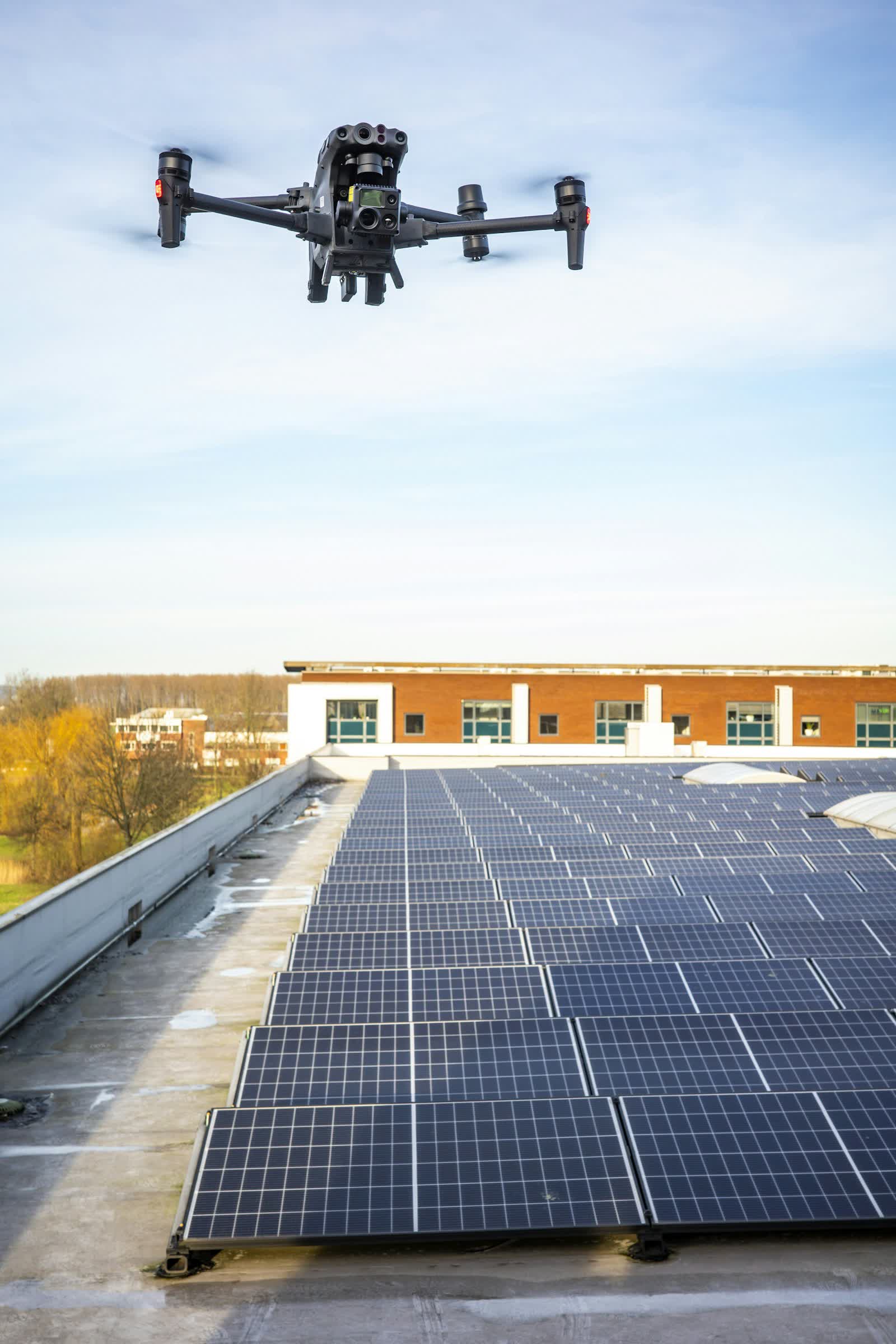
Once production is underway, the scale changes in nature. Verkor's building at Bourbourg-Craywick alone covers nearly 100,000 m² of roof — the equivalent of some fifteen football pitches under a single complex. At this size, periodic inspection of the roof covering (waterproofing, smoke-extraction vents, rooftop plant) and its thermography (heat loss, hot spots on industrial cooling equipment and the dry rooms needed for cell manufacturing) cannot reasonably be done on foot or by sampling: an exhaustive ground check would take several days and tie down a rope-access team, whereas a drone covers the same area in a few hours. The method follows the one detailed in our guide to roof inspection of logistics and retail buildings, scaled up to an even larger industrial footprint: a grid flight at constant altitude, a high-resolution orthophoto for asset tracking, a night-time thermal pass for thermography.
This check also overlaps with a regulatory requirement: like any large-footprint tertiary or industrial building, a gigafactory may fall under the French tertiary decree for its administrative and staff areas, and periodic thermography of the large industrial roofs follows the same energy-monitoring logic as for any XXL warehouse in the region.
Upper-tier Seveso: what the classification changes for a drone mission
Cell manufacturing handles significant quantities of flammable solvents (NMP, used to coat the electrodes) and hazardous materials: Verkor's Bourbourg-Craywick gigafactory is accordingly classified as an upper-tier Seveso site, under ICPE headings 3670-1 (surface treatment) and 4120-1 (storage of more than 50 tonnes of category-2 acutely toxic substances) among others. That classification changes nothing about the flight technique, but everything about access: on a Seveso site, a drone mission is arranged with the operator's HSE department, under a formal prevention plan — see our guide to hosting a drone mission on an industrial site — with explosive-atmosphere zones, solvent stores and evacuation routes identified in advance and never overflown at low altitude.
This classification is also a reminder of why aerial imagery has real value on this kind of site in the event of an incident. A technical report by Hartmut Surmann, Dominik Slomma, Stefan Grobelny and Robert Grafe, published in 2021, describes deploying aerial robots to survey a Berlin industrial hall containing hazardous substances after a major fire, in a setting too unstable for immediate human access (see the study). It is an extreme case, but it illustrates a principle that also holds in routine use: on a classified hazardous site, a drone documents from a distance what a ground-level check would take long, or be dangerous, to verify.
Method, flight framework and prices
A mission on a Battery Valley site is prepared along the same lines as any large classified industrial site: written approval from the operator, a prevention plan, identification of areas barred from close overflight, a safety briefing before every flight. Three mission profiles come up repeatedly: periodic monitoring during construction (ProLogium, until 2028), roof inspection and thermography once the site is in production (Verkor, ACC, Envision AESC), and one-off campaigns tied to an extension or a regulatory check.
Orders of magnitude observed in France in 2026 for this kind of site (excl. VAT):
- Monthly photogrammetric monitoring of a construction site spanning several dozen hectares: €1,500 to €3,500 per pass, tapering with a subscription for the site's whole construction period.
- Inspection and thermography of an industrial roof spanning several tens of thousands of m²: €0.05 to €0.15/m² depending on roof complexity and the number of rooftop installations, i.e. several thousand euros for a building the size of Verkor's.
- Baseline survey before commissioning (zero-state of the site and its surroundings): €1,000 to €2,500.
- Multi-year framework contract for an operating site (annual thermography, roof inspection, extension monitoring): quoted individually, with a significant discount compared with one-off call-outs.
On this kind of site, the factor that weighs most on price is not the area flown but access time: staff clearances, an HSE escort, time slots compatible with industrial activity. For a Battery Valley site, request a quote stating the project phase (construction or operation) and the site's ICPE classification.
Put it into practice
- Drone aerial thermal imaging: rates and cities covered from €500
- Drone construction site monitoring: rates and cities covered from €250
- Aerial thermal imaging in Antibes Provence-Alpes-Côte d'Azur
- Aerial thermal imaging in Valence Auvergne-Rhône-Alpes
- Aerial thermal imaging in Lorient Bretagne