C-DRONE GUIDE · 31 AUGUST 2026
Drones in Hauts-de-Seine (92): Where You Can Actually Fly, La Défense and the Office Stock
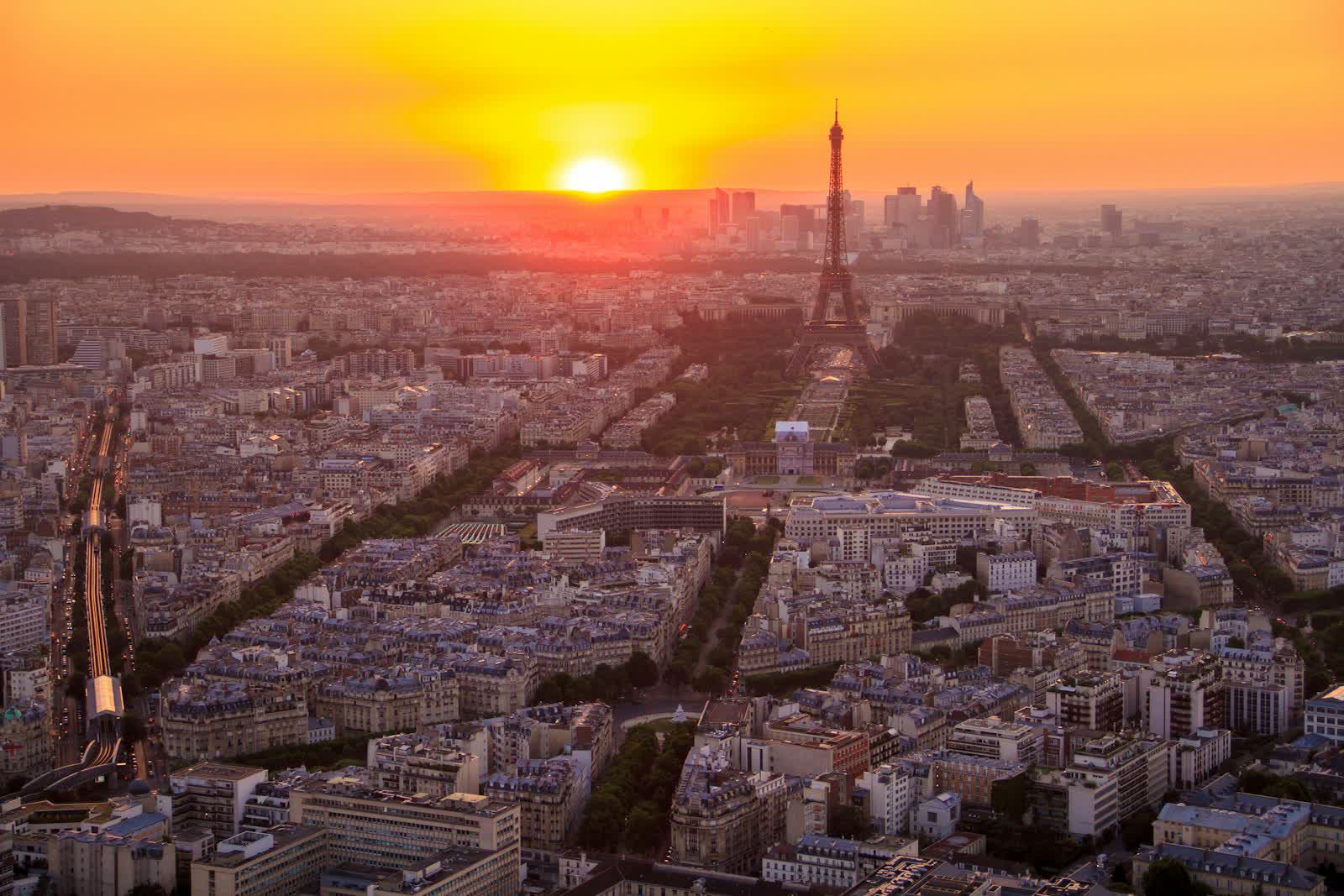
Hauts-de-Seine fits into 176 km² — less than a thirtieth of neighbouring Seine-et-Marne — and houses close to 1.66 million people, that is 9,400 residents per square kilometre : the densest French département after Paris. There is no open field in the 92 from which to take off quietly : its 36 communes form one continuous urban fabric, pressed against the Paris no-fly zone and entirely inside the control zone of the Paris airports. The consequence is simple and rarely spelled out : every professional flight in Hauts-de-Seine is a built-up-area flight, with the regulatory framework and lead times that come with it. In exchange, it is one of France's richest sources of B2B missions — the La Défense towers, an ageing office stock, large condominiums, Grand Paris Express construction sites, the port of Gennevilliers, corporate events. Here is where you can genuinely fly, on what conditions, and what it costs.
Get up to 3 quotes from professional drone pilots in your area
Describe the mission in two steps. With your consent, it is passed on to partner professional pilots (3 at most), who contact you directly with their proposal.
Published on 31 August 2026, updated on 22 September 2026 — regulations in force as of September 2026.
176 km², 36 communes, no countryside: the densest département after Paris
Hauts-de-Seine covers 176 km² and 36 communes, with around 1,654,700 residents in 2023 — France's seventh most populous département, on one of the smallest land areas in the country. The resulting density, 9,401.8 residents per square kilometre, places the 92 just behind Paris and well ahead of Seine-Saint-Denis (7,221.7) and Val-de-Marne (5,820). Eleven of its communes directly border Paris (for jobs on the other side of the boundary, see drone services in and near Paris) : Boulogne-Billancourt, Clichy, Issy-les-Moulineaux, Levallois-Perret, Malakoff, Montrouge, Neuilly-sur-Seine, Puteaux, Saint-Cloud, Suresnes and Vanves. All 36 have belonged to the Métropole du Grand Paris since 1 January 2016.
What matters for an aerial mission fits in one sentence : there is no unbuilt area in the 92. The county parks, the Meudon and Saint-Cloud hillsides and the Seine meanders punctuate a continuous built fabric, but none of them amounts to « countryside » in the regulatory sense. The few open spaces — the Saint-Cloud estate, the Île de Monsieur, the Meudon state forest, the Gennevilliers riverbanks — are themselves busy, often protected, and lined with housing a few dozen metres away.
Economically, the contrast with Seine-et-Marne, the other Île-de-France département we have covered, is absolute. Where the 77 offers cereal plateaus, quarries and isolated warehouses, the 92 lines up Europe's leading business district straddling Courbevoie, Puteaux and Nanterre, the département's most populous town — Boulogne-Billancourt, with 122,825 residents in 2022 —, an office stock exceeded in France only by that of Paris, tens of thousands of condominium flats built in the 1960s to 1980s, a 400-hectare river port and two of the largest sports and cultural venues in the region. Demand there is overwhelmingly B2B and institutional : property funds, asset managers, managing agents, social landlords, major contractors, corporate real-estate departments, towns and the county council. For the wider regional picture, our Île-de-France guide places the 92 within the eight départements.
Where you can actually fly: P23, the Paris CTR, the heliport and hospital helipads
Start with the good news. The LF-P23 permanent no-fly zone, renewed by the order of 2 April 2025 published in the Official Journal on 5 April, covers central Paris from the surface to 6,500 feet (1,981 m) and is active around the clock. Its outline inherits the line of the old city fortifications, between the boulevards des Maréchaux and the ring road : no Hauts-de-Seine commune falls inside it. The département runs alongside it without entering it along its entire eastern edge. Entry authorisation into P23 requires a formal request filed at least ten working days in advance : that is the lead time to know if a framing overshoots to the other side of the ring road.
Then comes the real constraint, and it is total. Hauts-de-Seine lies entirely inside the Paris CTR, a single class D control zone grouping the procedures of Charles-de-Gaulle, Orly, Le Bourget and Villacoublay, from the surface to 2,000 feet (610 m), permanently active, doubled by an LF-R 275 Paris restricted area with the same limits. No flight therefore escapes zone analysis and, depending on the exact position within the CTR, the maximum permitted height often drops to 50 m, sometimes less. The procedure is the one set out in our guide to drone missions in a CTR and airfield protocols, applied to a département that is in a CTR from end to end.
Three families of obstacles complete the picture, and they are specific to the 92. Helicopters first : the Paris - Issy-les-Moulineaux - Valérie-André heliport (ICAO LFPI), the only heliport inside Paris proper, sits south of the Porte de Sèvres in an extension of the 15th arrondissement immediately adjoining Issy-les-Moulineaux ; helicopters departing from or arriving there hold a standing exemption from P23 by following published procedures, and those tracks run across the south-east of the département. Medical helipads next : the Percy military teaching hospital in Clamart has a landing pad serving its burns centre and its 24-hour emergency department, and several AP-HP hospitals in the département receive medical evacuations — a hospital landing pad demands constant vigilance and an immediate abort as soon as an aircraft approaches, as detailed in our guide to helipad and landing-area inspection. Sensitive estates last : the Mont-Valérien fort in Suresnes, a military site and national memorial, and various institutional sites fall under military-overflight restrictions and under the regime of ZICAD zones where aerial data capture is prohibited. The rules cited are those in force in August 2026, and temporary restrictions are re-checked the day before the flight.
Every flight in the 92 is a built-up-area flight: what that changes in practice
This is the département's structural peculiarity, and it is rarely stated plainly : with 36 communes urbanised without a break, there is no address in Hauts-de-Seine that is not in a built-up area. An operator working on the Brie plateau or in Normandy still chooses, site by site, between a light framework and a heavy one. In the 92 there is no choice : the heavy framework is the default across all 176 km².
There are four practical consequences. The regulatory framework first : the most permissive open-category subcategories require staying clear of residential areas or using very light aircraft, which rules out most professional missions carrying a payload ; the specific category, with a declaration and a risk assessment, becomes the norm. Our guides to built-up-area flight authorisation and to prior notification for flights over populated areas set out both procedures and how they read in practice.
Ground safety next, which becomes the real issue. You need a ground exclusion area that is actually held, so a courtyard, a private car park, a roof terrace, or a stretch of street closed off with the town's agreement : in the 92, the take-off area is negotiated rather than chosen. Overflight of uninvolved third parties is prohibited, which pushes slots to early morning, end of day or weekends on office sites. Privacy third : at this density, every façade inspected faces dozens of residential windows less than thirty metres away. Framing must be strictly confined to the structure under examination, neighbours informed, and non-useful images deleted — the subject of our guide to flying over people and private property. Wind last : between tall buildings, gusts and downdraughts bear little resemblance to a weather bulletin, a point we return to below and which our guide to weather limits for flying covers in detail.
The economic corollary is clear : in Hauts-de-Seine, flight time is a small share of the mission. Most of the cost and the lead time sits upstream — zone analysis, declaration, manager's consent, booking the take-off area, informing occupants. A contractor promising a « within 48 hours » intervention on an office tower has not read the file.
La Défense: curtain walls, technical roofs and wind between the towers
Europe's leading business district, La Défense covers 564 hectares straddling Courbevoie, Puteaux and Nanterre, with around 3.7 million m² of offices and 245,000 m² of retail spread over dozens of high-rise towers. Such a stock generates constant inspection demand : checking curtain-wall fixings and joints, tracing water ingress, assessing technical roofs crowded with chillers and cooling towers, surveying façades before refurbishment or repositioning for letting. Rope access or a cherry picker remains essential for the actual repair, but it is slow and expensive for a mere survey : the drone covers most of the visual and thermal diagnosis and then lets the rope technician be aimed at identified points. Our guide to high-rise façade and curtain-wall inspection details the method, and our drone façade inspection page the corresponding offer.
The limiting factor at La Défense is neither regulation nor the camera : it is airflow. Between towers of 150 to 230 metres, the flow is channelled, accelerates through gaps and sheds into vortices ; a 25 km/h wind forecast at ground level can produce, halfway up a north façade, gusts and downdraughts bearing no relation to that figure. A review by Hongyuan Jia, Chao Lin, Mahiro Iwabuchi and Hideki Kikumoto, published in 2026 in Building and Environment, frames exactly this question as ten open problems for the safe operation of light aircraft in cities, and stresses a directly useful point : acceleration zones form predictably alongside tall buildings and between buildings, which argues for wind and turbulence-intensity thresholds set site by site rather than from a weather bulletin (see the study).
A study by Zack Krawczyk, Rohit K. S. S. Vuppala, Ryan Paul and Kursat Kara, published in 2025 in the journal Drones, goes further by coupling urban wind fields from large-eddy simulation to a flight-dynamics model : the authors show that high-risk zones can be identified by correlating the aircraft's response with the spatial distribution of turbulent kinetic energy, and that peak load factors coincide with abrupt turbulence transitions rather than with mean wind speed (see the study). Their test case is a fixed-wing drone, but the mechanism described holds for any light aircraft : it is the crossing from calm air into turbulent air that destabilises, not steady wind. In practice at La Défense this means flying close to the façade, hand-flying in re-entrant corners, keeping a larger battery margin than usual, and accepting a fallback date written into the contract.
Ageing office stock and large condominiums: energy decree, thermography, collective EPC
The 92 holds France's second-largest office stock after Paris, and that stock has an age problem. Vacancy shows it : at the end of 2025, more than 500,000 m² of offices stood empty at La Défense, a rate close to 14.5%, within a regional market whose immediate vacancy rate reached 11.2% against a one-year supply of 7.6 million m². A significant share of that vacancy is structural : 1970s to 1990s buildings with deep floorplates, poorly performing façades and end-of-life plant, which the market will no longer let without heavy works. Add tens of thousands of flats in large post-war condominiums, in Nanterre, Colombes, Asnières-sur-Seine or Bagneux.
Two regulatory obligations turn this ageing into a works programme, and therefore into demand for aerial diagnosis. On the commercial side, the French tertiary energy decree imposes a consumption-reduction trajectory on the buildings concerned, with annual reporting : our guide to the tertiary decree and drone thermography sets out the timetable and what thermography brings to the preliminary audit. On the residential side, the collective energy performance certificate and the multi-year works plan require condominiums to establish the condition of their envelope before deciding : the subject of our guide to the collective EPC and multi-year works plan, extended by the one on surveys before external wall insulation.
On these buildings the drone delivers three things no ground visit provides. A complete infrared survey of the envelope, façade by façade and roof included, mapping thermal bridges, insulation defects, untreated slab edges and zones of differential heat loss — a thermal camera reads a surface temperature ; it does not on its own establish energy performance, and interpretation remains the thermal engineer's. A visual record of the upper parts : parapets, railings, spandrels and cladding elements, whose inspection connects to our guide to balcony, loggia and railing inspection. And a 3D model usable at design stage, for a sunlight study ahead of a rooftop extension or solar installation : in a fabric this dense, the shading cast by neighbouring buildings matters as much as orientation.
Automated detection is advancing on exactly this ground. A study by Yue Fan, Jinghua Mai, Fei Xue, Stephen Siu Yu Lau, San Jiang, Yiqi Tao, Xiaoxing Zhang and Wing Chi Tsang, published in 2025 in Sensors, combines drone-borne visible and infrared imaging, deep learning and 3D visualisation to detect cracks and water ingress on existing residential buildings in a very dense urban fabric ; the authors note in particular that a medium standoff, of the order of 20 to 25 metres, gives the best trade-off between coverage rate and detection accuracy on tall buildings (see the study). That is precisely the trade-off sought on a fifteen-storey housing block in Nanterre : one fast coverage pass, then close-range points wherever the imagery flagged something. These services are grouped on our drone thermal imaging page.
Along the Seine: the port of Gennevilliers, Grand Paris Express and major venues
The Seine crosses the département in two great meanders — Gennevilliers to the north, Boulogne to the south — and shapes most of its heavy activity. At the centre of the northern loop, the port of Gennevilliers occupies 401 hectares (including 272 ha of business premises, 51 ha of water bodies and 78 ha of landscaped public space), around 510,000 m² of buildings, some 250 companies and on the order of 8,000 direct jobs : it is the leading port platform in Île-de-France, and the one that makes HAROPA PORT France's leading river port. The full range of industrial-site missions is found there : container yard inventory and monitoring — see our guide to container inventory at a port terminal —, aggregate stockpile volumes, inspection of gantries and operating buildings, topographic survey of the platform. The constraint not to underestimate : a port is an enclosed site with permanent co-activity, where access is prepared with the port authority and the terminal operator, backed by a prevention plan.
On the same loop, the Grand Paris Express is the département's biggest generator of construction-monitoring work. Line 15 South — 33 km, 16 stations, from Pont de Sèvres to Noisy-Champs, 22 communes and four départements — starts on Hauts-de-Seine soil and its opening is now announced for 2027 after several postponements ; line 15 West, running north from Pont de Sèvres via Saint-Cloud, Rueil, Nanterre, La Défense, Bois-Colombes and Gennevilliers, is due to close the orbital loop around 2031. Two needs recur on these sites : photogrammetric progress monitoring, comparing actual state against the programme without multiplying manual surveys, and the pre-construction condition survey of neighbouring buildings — a critical issue when a tunnel boring machine passes beneath a fabric this dense. These services are grouped on our drone construction monitoring page ; they never replace precision topographic survey for underground civil works, nor a judicial officer's record where the evidential stakes are high. Urban regeneration generates the same kind of orders outside the GPE, notably around Rueil-Malmaison and the station districts.
The third source is events and corporate, concentrated on three sites. Paris La Défense Arena, in Nanterre, opened in October 2017, is Europe's largest indoor venue : up to around 40,000 places in concert configuration, 30,681 seats in sports configuration. The Yves-du-Manoir county stadium, in Colombes, main venue of the 1924 Games, was fully rebuilt between 2021 and 2023 for around €101 million and hosted the field hockey events of the Paris 2024 Games. Île Seguin, in Boulogne-Billancourt, the former Renault factory site, has been home to La Seine Musicale since 2017. Around these venues revolve seminars, conventions, openings and employer-branding operations for which aerial capture has real value — provided it is set up properly. A public gathering rules out flying over attendees, requires a ground exclusion area that is actually held and, as soon as crowds are counted or filmed, an assessment under the GDPR : our guide to crowd estimation and the GDPR framework at events covers both points. The corresponding audiovisual deliverables belong to our aerial video page.
Method, lead times and 2026 prices
A mission in Hauts-de-Seine follows a heavier sequence than elsewhere, and it is best to know that before ordering. Zone analysis at the exact address (position within the Paris CTR and the associated maximum height, distance to the Issy heliport and to hospital helipads, sensitive estates, temporary restrictions, proximity to the Paris boundary and therefore to P23). Choice of regulatory framework : in the 92, the specific category with a declaration is the rule, the open category the exception. Ground preparation, which is the real critical path : written consent from the owner or managing agent, access to the take-off area — courtyard, private car park, roof terrace —, holding the exclusion zone, notice to occupants and neighbours, a municipal order where a stretch of pavement must be closed, a prevention plan on an industrial or port site. Flight, processing, delivery last. Allow two to four weeks for an office building or condominium, longer on a sensitive site ; only 24 to 72 hours in an emergency, where the client is the owner and the take-off area is private. Our guide to the rules for flying in Paris and Île-de-France covers the authorisations in detail. Rules in force in August 2026.
Orders of magnitude observed in Hauts-de-Seine in 2026 (excl. VAT) :
- Half-day flight (corporate coverage, one-off inspection, simple survey) : €500 to €950 ; full day : €900 to €1,800 — above the national average, because of administrative preparation time and access constraints.
- Tower or high-rise façade inspection : €1,200 to €3,000 depending on height and number of elevations ; thermography option : +€600 to €1,200.
- Envelope thermography of an office building or condominium (tertiary-decree audit preparation, collective EPC, external insulation project) : €800 to €2,000 per building ; €400 to €900 per building in a grouped campaign from five buildings in the same portfolio.
- Roof-terrace and plant-room inspection (waterproofing, chillers, smoke vents) : €600 to €1,400 per building.
- Photogrammetric construction monitoring (monthly or fortnightly) : €450 to €950 per pass, with a declining rate on an annual subscription.
- Pre-construction condition survey of neighbouring buildings : €900 to €2,500 depending on how many adjoining buildings must be documented.
- Corporate event coverage (seminar, opening, convention) : €800 to €2,200 per day, excluding permits and extended post-production.
- Marketing aerials (office building, floor plate, land) : €400 to €900 per site.
- Administrative preparation : €150 to €400 for a specific-category declaration with CTR zone analysis ; €250 to €600 for a prefectural authorisation or a public-land filming permit ; €300 to €800 for a P23 waiver request where the perimeter spills into Paris, with a minimum of ten working days of processing.
Three limits, finally, that an honest contractor states up front. The drone replaces neither rope access nor a cherry picker for the actual work : it aims, it does not repair. It replaces neither the thermal engineer nor the certified surveyor : an infrared image is an input, not an energy performance assessment. And it replaces neither a chartered surveyor for a legally binding survey, nor a judicial officer where the evidential stakes are high. Add a fourth reality specific to the 92 : between the towers and above the Seine meanders, wind forces postponements, and a fallback date written into the contract is worth more than a promise kept by a whisker. For a project in Hauts-de-Seine, request a quote stating the exact address, the nature of the site (office tower, condominium, construction site, port platform, public-access venue), the building height and the expected turnaround.
Frequently asked questions
Can you fly in Boulogne-Billancourt or Neuilly-sur-Seine without a P23 waiver?
Yes for P23, no for everything else. The LF-P23 permanent no-fly zone, renewed by the order of 2 April 2025, covers central Paris : no Hauts-de-Seine commune is inside it, not even the eleven that touch the ring road. A flight in Boulogne-Billancourt, Neuilly-sur-Seine or Levallois-Perret therefore needs no prefectural P23 waiver. It remains, however, a dense built-up-area flight, inside the Paris CTR, often next to a helipad or a public-access building : the specific-category declaration, zone analysis at the exact address and the site manager's consent all still apply. And if the mission perimeter spills a few dozen metres into Paris — a building straddling the ring road, a wide shot over the Seine — the P23 request becomes necessary again, with a minimum of ten working days of processing.
Do you need a special authorisation to fly over La Défense?
You need several, and none of them is strictly an airspace one. La Défense is neither a prohibited nor a restricted zone : the constraint there is first of all on the ground and contractual. The district is managed by the public body Paris La Défense, each tower has an owner, a manager and a security team, and the pedestrian deck carries tens of thousands of people continuously on weekdays. A flight therefore requires the written consent of the relevant building manager, the booking and marking of a ground exclusion area, coordination with deck security, often an early-morning or weekend slot, and the matching regulatory declaration. Allow two to four weeks of preparation for a tower façade inspection : the paperwork, not the flight, drives the schedule.
How long does it take to set up a drone mission in the 92?
Two to four weeks for a standard office building or condominium, longer if the site backs onto a hospital helipad, a military estate or an operating construction site. Breaking that down : a few days for zone analysis and the specific-category declaration ; one to three weeks to obtain the owner's or managing agent's consent, access to the roof terrace or inner courtyard used as a take-off area, and notice to occupants ; a few days to agree a slot with the town when a stretch of pavement has to be closed off. Conversely, an emergency mission — façade damage threatening the public way, a loss event — can be arranged within 24 to 72 hours provided the client owns the site and the take-off area is private.