C-DRONE GUIDE · 1 SEPTEMBER 2026
Drone Inspection and Thermography of a Battery Energy Storage Site (BESS): Method, French ICPE Framework, Price
Seen from ground level, a battery energy storage site looks like a car park of white containers lined up behind a fence, next to a transformer compound. Nothing moves, nothing smokes — and that is exactly the problem : most of what can go wrong inside a BESS happens within a closed steel envelope, monitored by a battery management system nobody sees either. In France, installed capacity went from a few megawatts at the start of the decade to 1.6 GW in service on 31 December 2025 according to grid operator RTE's annual review ; the largest site, at Cernay-lès-Reims in the Marne département, lines up 240 MW and 480 MWh across 3.5 hectares. These assets are now old enough to raise an ordinary operator's question : how do you check the condition of a container park without sending someone into it, and what does an aerial thermal pass add to a periodic inspection plan? Here is what a drone actually documents, what it cannot see, where France's ICPE framework stands, and what a campaign costs in 2026.
Get up to 3 quotes from professional drone pilots in your area
Describe the mission in two steps. With your consent, it is passed on to partner professional pilots (3 at most), who contact you directly with their proposal.
Published on 1 September 2026, updated on 22 September 2026 — regulations in force as of September 2026.
A container park, a substation, kilometres of cable: what there actually is to inspect
A grid-connected battery energy storage system — a BESS in industry shorthand — is not a building but an assembly of objects sitting on a platform. Rows of containers, each housing racks of lithium-ion modules, a battery management system, fire and gas detection, and an HVAC unit that keeps the cells inside their temperature window. Power conversion systems (bidirectional inverters) turning the batteries' direct current into alternating current. Step-up medium-voltage transformers, then a delivery substation connecting the whole thing to the grid. And, threaded between all of it, cable trays, access roads, a perimeter fence, CCTV, sometimes a water reserve.
The scale has changed fast. According to RTE's 2025 annual electricity review, France had 1.6 GW of batteries in service on 31 December 2025, around a third of it connected to the transmission network and the rest to distribution ; high-capacity installations on the transmission grid numbered just over twenty, and distributed low-voltage batteries accounted for only 140 MW. The largest French site, at Cernay-lès-Reims (Marne), lines up 240 MW and 480 MWh : 140 pre-assembled storage units, 70 medium-voltage transformers and two 225 kV transformers over 3.5 hectares. For a sense of the distance travelled, TotalEnergies' Dunkirk site, commissioned in December 2021, held the national record with 61 MW and 61 MWh.
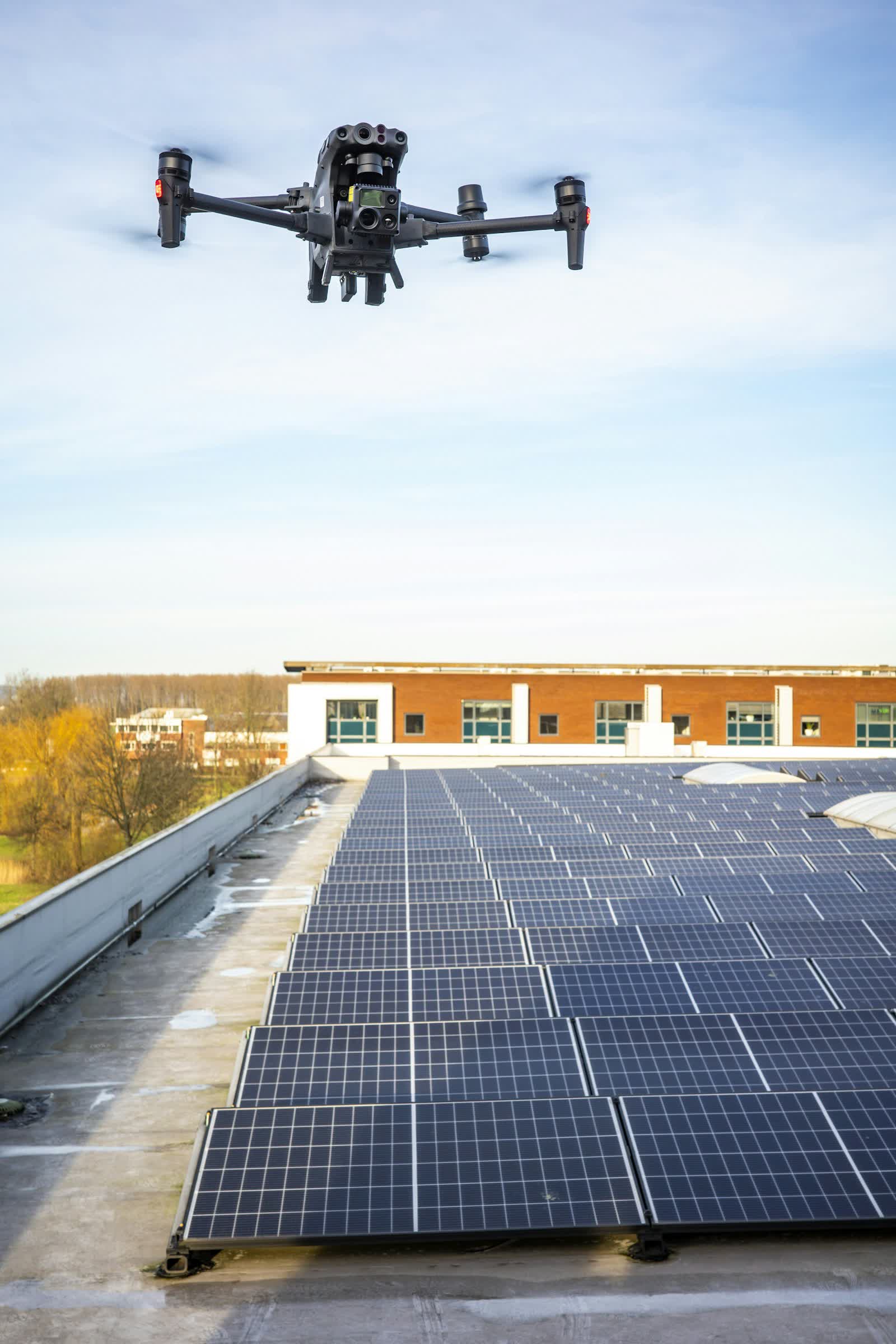
That geometry explains why on-foot inspection is laborious. An operator wanting to check transformer temperatures, the condition of HVAC units on container roofs, the cleanliness of air intake grilles and the absence of hot spots on busbars has to open doors, climb structures, and will in any case never see the top of the containers from ground level. An aerial pass resolves the geometry of the problem : container roofs, the tops of conversion units and the whole platform are covered in a single flight, with a thermal image of every item taken from the same angle and under the same conditions.
The productivity gain is not a contractor's hunch. A study by A. K. Vidal de Oliveira, M. Aghaei and R. Rüther, published in 2020 in Solar Energy, compared drone-borne aerial infrared thermography with conventional inspection methods on megawatt-scale photovoltaic plants and documented the cost and speed advantage of the aerial approach for detecting thermal faults across large footprints (see the study). The reasoning transfers directly to a BESS, which is often built on the same platform as a solar farm : same footprint constraints, same need to compare identical items against each other, same interest in reducing time spent inside an electrical zone. Our guide to drone thermography of a solar farm under the IEC 62446-3 standard details the method on the panel side ; storage is its natural extension.
Thermal runaway: why you want to look from a distance
The specific hazard of a BESS has a name : thermal runaway. A lithium-ion cell whose temperature or voltage leaves its operating window can enter a chain of self-sustaining exothermic reactions : heat generated exceeds heat removed, temperature accelerates, the electrolyte decomposes and releases flammable gases, and the cell vents. The reference review by X. Feng, M. Ouyang, X. Liu, L. Lu, Y. Xia and X. He, published in 2018 in Energy Storage Materials, catalogues the abuse conditions that lead there — mechanical, electrical, thermal — and identifies internal short circuit as the common denominator of nearly every scenario (see the study). The point that matters for an operator : the phenomenon does not stay confined to the originating cell if neighbouring modules receive enough energy to cross their own threshold — that is propagation, and it is what turns a point defect into a site-wide loss.
France has one documented and instructive case. The accident recorded as ARIA 60556 in the national industrial accident database occurred on 6 April 2023 at Aghione, Haute-Corse : a BESS container housed inside a 150 m² timber building, holding 636 lithium-ion batteries for a total capacity of 4 MW, on a solar farm of 12,000 panels. Fire broke out around 3.30 pm ; the automatic argon/nitrogen suppression system triggered ; shortly after the doors were opened, a thermal event occurred. The toll : an attack pair lightly injured and hospitalised, three firefighters hospitalised for smoke inhalation, evacuation of dwellings and a waste facility within a 500 m radius, shelter-in-place for a housing estate 6 km away, roads closed. Cooling continued for ten days, and the full operation ran for two weeks.
That account contains, implicitly, the safety case for remote inspection. The most dangerous phase of a BESS incident is not the visible flame but the approach : opening a container door whose internal atmosphere may hold a flammable gas mixture, walking towards an envelope of unknown real temperature, standing in line with a vent. At Aghione, firefighters did in fact monitor temperature regularly with a thermal camera throughout the cooling phase. A thermal drone takes exactly the same reading, getting as close as needed without any operator crossing the safety perimeter. The underlying mechanism — damaged lithium battery, propagation in a combustible environment — is the same one described in our guide to thermal monitoring of waste sorting centres and lithium battery fires ; what differs on a BESS is the energy density stored per square metre.
On the French technical doctrine side, the most useful document remains the public Ineris report "Risk control measures for batteries in containerised applications", published on 6 July 2023. It inventories the risk control devices deployed inside battery containers and analyses their limits in the light of real accident records — suppression system failing to trigger, absence of a vent, among others. It carries no binding regulatory force, but it provides a solid technical basis for discussion between an operator, its insurer and the classified-installations inspectorate.
What aerial thermography documents on a BESS — and what it cannot see
Start with the limitation, because it governs everything else. A thermal camera reads surface radiation, converted into an apparent temperature through an emissivity assumption and an atmospheric correction. On a BESS container, that surface is painted steel sheet, insulated and air-conditioned, separated from the cells by the rack structure and a layer of conditioned air. A cell beginning to drift deep inside a module produces, for a long time, no usable signature on the outer skin. The review by D. Han, J. Wang, C. Yin and Y. Zhao, published in 2025 in Advanced Sensor Research, surveys early-warning techniques for thermal runaway in battery energy storage systems and lays out the hierarchy clearly : internal signals — voltage drift, impedance change, gas emission before smoke appears — come well ahead of any temperature rise measurable at the surface (see the study). In other words : early detection happens inside the container, not above it.
What the drone does document, by contrast, is entirely real and rarely covered any other way. The HVAC unit of each container, first : it is the component keeping cells inside their temperature window, it sits on the roof or the end wall, and its faults read very well in infrared — fouled condenser, stopped fan, abnormal gap between air inlet and outlet. The power conversion systems and transformers next : these are conventional electrical assets, on which thermography does what it always does, spotting a loose connection, a phase imbalance, a blocked radiator. The delivery substation and busbars last, read by the same rules as any substation — a subject covered in detail in our guide to drone inspection of medium and high-voltage substations.
The real methodological value of a BESS site is repetition. A container park is made of identical units, exposed to the same sun, charged and discharged on the same schedule, cooled by identical HVAC models. That homogeneity makes the park its own reference : you are not chasing an absolute temperature — a delicate exercise outdoors, between sunshine, wind and variable emissivity — but a gap between twins. A container consistently three degrees warmer than its neighbours across three successive campaigns is telling you something ; the same container three degrees warmer once, at midday in August, tells you nothing. That is why an isolated campaign is worth far less than a series : the useful deliverable is a comparison table per unit, with the capture conditions and the history.
On the hardware side, gaps of a few degrees demand a decent radiometric sensor : enough resolution for each item to occupy enough pixels, a low NETD to resolve fine differences, and above all the ability to record radiometric images that can be re-analysed afterwards rather than mere colourised pictures. Our guide to the professional drone thermal camera — resolution, NETD, radiometry explains how to read a spec sheet without being dazzled by it, and our guide to what a drone thermography report is worth describes what a serious report must contain to hold up.
Separation, fire service access, water points: the geometric part of the file
Alongside thermography there is a second drone use on a BESS, less spectacular and often more profitable : the geometry of the site. A high-resolution orthophoto and a 3D model make it possible to measure what exists only as a drawing in the operating file : the actual distance between two container rows, the gap between a container and the fence or a neighbouring building, the clear width of access roads, the turning radius available at the end of a row, the real position of isolation devices and access points. It is a gap check between as-built drawings and the ground, and it regularly turns up surprises : a cabinet added after the fact in a circulation corridor, a temporary pallet stack against a wall, an earth bund that has shifted.
Why does this matter? Because separation between units is the primary means of limiting the propagation of thermal runaway from one container to the next. The most widely used international references — the North American NFPA 855 standard for the installation of stationary energy storage systems, backed by the UL 9540A test method that evaluates thermal runaway fire propagation — rest explicitly on that logic : a default minimum distance, reducible only where the manufacturer demonstrates through large-scale testing that fire does not spread to the adjacent unit. These texts are not mandatory in France, and that should be said plainly ; but they shape the design of virtually every container on the market, and the distances they impose appear in the installation instructions the operator has to comply with. Checking that they still hold, two years after commissioning, is ordinary operational common sense.
The same survey feeds the emergency response side. A 3D model of the site supports an intervention plan : appliance access routes, staging points, isolation devices, vent positions, zones where thermal radiation prohibits standing. That is exactly the subject of our guide to the 3D site model for fire intervention plans. The water resource question runs in parallel : survey and accessibility of firefighting water points, covered by our guide to drone survey of firefighting water points. On a BESS, the water demand of prolonged cooling — ten days at Aghione — is no textbook hypothesis : it is a sizing question to discuss with the fire service, and an up-to-date map beats an archived drawing.
The French ICPE framework: rubric 2925, its limits, and what is coming
An operator searching for "the ICPE rubric for BESS" quickly discovers it does not yet exist under that name. As France's classified-installations nomenclature currently stands, a lithium-ion battery park falls under rubric 2925, "electrical accumulator charging facilities". It has two paragraphs. Paragraph 1 covers charging that produces hydrogen — lead-acid chemistry, typically — with a declaration threshold at 50 kW of maximum usable direct current power. Paragraph 2 covers charging that does not — lithium-ion — with a declaration threshold at 600 kW of maximum usable current power, excluding public electric vehicle charging infrastructure. The rubric was last amended by decree no. 2019-1096 of 28 October 2019, and the general requirements of the declaration regime sit in the order of 29 May 2000.
Reading those texts is enough to see why the industry considers them ill-suited. First, the threshold is expressed as charging power rather than stored capacity : the nomenclature says nothing about the megawatt-hours present on site, even though it is precisely the available energy that determines the severity of a thermal runaway and the duration of cooling. Second, the order of 29 May 2000 was written for charging rooms — a space where forklift batteries are recharged — not for outdoor containers connected to the transmission grid. Third, rubric 2925 sits in the declaration regime, the lightest of the three, which leaves a wide margin for whatever the prefect chooses to impose case by case ; local prefectural orders have accordingly set BESS-specific requirements ahead of any national framework.
A dedicated battery rubric is in preparation at France's risk prevention directorate. Work started in 2024, several consultation rounds were held in 2025, and a further consultation on the ministerial general-requirement orders is announced for September 2026 ; working documents refer to it as rubric 2926 and discuss thresholds expressed in tonnes of batteries, with declaration, declaration-with-periodic-check and registration regimes. None of this is published to date, and it would be imprudent to quote thresholds the final text may change. What is certain is the direction of travel : the BESS regime will tighten and become more specific, and an operator who documents the state of their site today, with dated deliverables, is better prepared than one waiting for the decree.
One related change is worth flagging, because it touches the grid connection substation. Decree no. 2026-146 of 2 March 2026, amending the environmental assessment regime and the criteria for referral to the national public debate commission, removed from the third column of the thirty-second heading of the table annexed to article R. 122-2 of the environment code the reference to transformer substations whose maximum transformation voltage is 63 kilovolts or above, excluding operations that do not increase the substation's land footprint. In practice : case-by-case examination is no longer triggered on that ground alone for applications filed from 1 May 2026. This removes an administrative step for storage projects that come with a transformer substation ; it changes nothing about their ICPE classification or their safety requirements. The catch-all "safety net" clause also remains applicable. For a specific project, confirmation comes from the regional environment authority, not from a guide.
Construction, handover, due diligence, post-incident: the drone's four other moments
Periodic thermography is the most visible use, but a BESS calls on a drone at four other points in its life. The first is construction. A storage park is built fast — earthworks, platform, foundations, container placement, cabling, substation — and the sticking points are rarely where you expect them. A monthly pass producing a dated orthophoto and an overall view gives the project owner a factual basis for site meetings and payment applications ; the method is identical to the one described in our guide to drone monitoring of ground-mounted solar farm construction, since BESS units are very often built on the same sites. For the upstream industrial side — cell plants, gigafactory construction — our guide to drones in the Hauts-de-France Battery Valley covers the other end of the supply chain.
The second moment is handover. This is when the baseline is established : as-built orthophoto, measured real positions, a first complete thermal campaign under steady-state operation. That first campaign is not meant to find a fault — it is meant to become the reference against which every later campaign is compared. An operator without a baseline compares readings against nothing : they observe temperatures, not drift.
The third moment is sale. Storage asset portfolios change hands just as solar farms do, and the buyer needs to objectify what they are acquiring : apparent condition of containers and envelopes, geometric compliance of the layout with the manufacturer's instructions, thermal condition of the conversion equipment, any incident history. Our guide to technical due diligence of a solar or wind farm by drone describes the approach ; on a BESS it is paired with a documentary review of the ICPE file and the electrical verification reports.
The fourth moment is the aftermath of an incident, and it is the most delicate. After a container fire the area stays dangerous for a long time : re-ignition, residual gases, weakened structures, partially degraded batteries that must be cooled before any movement. This is exactly the configuration where a thermal flight replaces a human approach : mapping residual temperatures container by container, tracking the decay day after day, documenting the condition of neighbouring units for the loss adjuster and the classified-installations inspectorate. At Aghione this phase lasted ten days. The principle is the one already applied in our guide to drone survey of a fire-damaged building : record without exposing anyone, with time-stamped, georeferenced images that will stand up in the file.
What the drone does not replace: BMS, electrical verification, accredited body
An honest guide has to include this section, because the opposite promise circulates. A drone replaces nothing that is mandatory or that runs continuously ; it adds a layer of observation where there was none.
It does not replace the battery management system. The BMS continuously monitors voltage, current, per-module temperature and state of charge ; it is the only thing that sees inside, and the only thing that can trip a disconnection. Nor does it replace the container's fire and gas detection, its emergency ventilation, its pressure relief vents or its suppression system. On those devices, the Ineris report on containerised applications is a useful reminder that their real-world performance in an accident is not always what was expected : all the more reason to maintain and test them, not to substitute a quarterly overflight for them.
It does not replace statutory electrical verification. The electrical installations of a workplace fall under articles R. 4226-14 to R. 4226-16 of the French labour code and the order of 26 December 2011, which sets the methods, scope and frequency of verifications : a one-year interval from the initial verification, which the employer may extend to two years under conditions, with the report delivered within five weeks at most where an accredited body performs the check. Aerial thermography can feed that verification, guide it, document its follow-up : it never substitutes for it, and a drone report is not a verification report.
Neither does it replace product and system conformity. The safety of a grid-connected storage system is designed at system level, along the lines of the IEC 62933-5-2 standard on safety requirements for grid-integrated electrochemical storage systems, and tested through thermal runaway propagation tests of the UL 9540A type. That is manufacturer and inspection-body work, not drone operator work. Finally, it does not replace internal rack inspection, contact thermography under covers on connections unreachable from outside, or torque checking of terminations.
The right way to present the drone in a periodic inspection plan and in the operating file is therefore modest and precise : a documented thermal and visual patrol, at a defined frequency, producing a dated deliverable comparable from one campaign to the next, feeding maintenance decisions. It sits alongside human patrols, BMS monitoring and statutory verifications — never in their place. That is also how an insurer or an inspector will read it.
Method, deliverables and 2026 prices (excl. VAT)
A serious campaign begins before the flight. You need to know the operating regime at the time of capture — an idle park tells you nothing, a park under sustained charge or discharge tells you a great deal — and therefore to agree the slot with the operator rather than accept whatever the market schedule dictates. Conditions must be recorded : ambient temperature, wind, sunshine, time of day. The layout drawing with each container's identifier is essential, without which the report is unusable. And you need the operator's written authorisation, a site escort, and coordination with the network operator where the connection substation is involved.
The flight itself combines two passes : a thermal pass at constant height and constant angle, container by container, with radiometric recording ; and a high-resolution visible pass documenting the condition of envelopes, grilles, cable trays and fencing. The useful deliverable is a report identifying every unit, each with its thermal image, matching visible image, measured deviation from the park median, and a priority ranking of anomalies. Where geometry is at stake, an orthophoto and 3D model with a table of measured distances are added.
Ranges observed in 2026 (excl. VAT) :
- Thermal patrol of a site up to 20 containers (container skin, HVAC units, power conversion systems, transformers, per-unit commented report) : €800 to €1,800.
- Extended or multi-block site (beyond 20 containers, delivery substation included) : €1,800 to €3,500.
- Geometry option (orthophoto + 3D model, table of inter-unit distances, access roads and manoeuvring areas, up to 5 ha) : +€900 to €2,000.
- Baseline campaign at handover (thermal and geometric baseline, structured deliverable for the operating file) : €2,500 to €4,500 depending on park size.
- Construction monitoring : €500 to €1,100 per monthly pass, tapering beyond six passes.
- Periodic contract (2 to 4 campaigns a year, automatic comparison against history) : 15–25% discount per site from the third site in a portfolio.
- Post-incident response (thermal mapping of residual temperatures, repeated passes supporting the operator or loss adjuster) : €700 to €1,500 per half-day, with a surcharge for emergency mobilisation.
Set against the cost of a storage container, a power transformer or a prolonged outage of an asset earning ancillary services revenue, these amounts stay marginal : it is the insurance and traceability value of the deliverable that justifies the spend, as much as the detection itself. Request a quote stating the site's power and capacity, the container count, whether a high-voltage delivery substation is present, the frequency required and the report's intended use (maintenance, insurance, ICPE file, due diligence).
Frequently asked questions
Is a battery storage site a classified installation in France, and under which rubric?
As the nomenclature stands, a lithium-ion BESS falls under rubric 2925, "electrical accumulator charging facilities", and more precisely under its second paragraph, covering charging that does not produce hydrogen : the declaration regime is triggered when the maximum usable charging current power exceeds 600 kW. Two important caveats. First, that threshold is expressed as charging power, not stored capacity : the nomenclature does not reason in MWh, which many practitioners consider ill-suited to outdoor containers. Second, a project may fall under other rubrics depending on its configuration (transformers, gensets, ancillary storage), and the prefect has latitude to impose requirements by order. The only reliable answer for a given project comes from the competent regional environment authority (DREAL) and a regulatory consultancy, not from a generic article.
Can a thermal drone detect thermal runaway before a fire starts?
No, and no serious contractor will claim otherwise. An onboard thermal camera reads a surface temperature : on a BESS container, it reads the skin of an insulated, air-conditioned steel envelope, separated from the cells by several centimetres of structure and a layer of conditioned air. Incipient runaway in a module first shows up in internal quantities — voltage, impedance, gas venting — visible only to the battery management system and the container's gas detection. What an aerial thermal pass usefully spots is something else : an HVAC unit stopped or in fault, a container whose thermal signature diverges from its twins, a transformer or power conversion unit running abnormally hot, a degraded medium-voltage connection. These are drift signals, not a fire alarm.
Under what conditions can a drone be flown over a battery park?
A BESS site is fenced private property : written authorisation from the operator is the first document required, together with a site escort and a reminder of electrical safety rules. The flight itself follows ordinary drone law: usually in the Open category, with the separation distances applicable to uninvolved people, and a flight plan that accounts for substations and overhead lines. Two points deserve particular care. The frequent proximity of a grid connection substation or high-voltage lines requires coordination with the network operator and compliance with electrical safety clearances, including for take-off and landing. And the location — often rural, but sometimes under restricted airspace — must be checked against the restriction map before committing to the mission. Our guide to drone inspection of medium and high-voltage substations covers these precautions.
Put it into practice
- Drone aerial thermal imaging: rates and cities covered from €500
- Aerial thermal imaging in Saint-Maur-des-Fossés Île-de-France
- Aerial thermal imaging in Calais Hauts-de-France
- Aerial thermal imaging in Chambéry Auvergne-Rhône-Alpes