A professional drone pilot for this mission Request a free quote
C-DRONE GUIDE · 28 JULY 2026
Livestock buildings: drone inspection and thermography, price
Cattle sheds, poultry houses, pig units, sheepfolds: French livestock buildings form a huge, often ageing stock, largely covered with fibre-cement sheets — fragile, frequently asbestos-bearing — that nobody can walk on safely. Their roofs stack up functions: weatherproofing, natural light through rooflights, ridge ventilation and, increasingly, photovoltaic production. A defect costs twice — in building degradation and in degraded indoor climate, with direct consequences for the animals. The drone inspects these roofs without ladders or cherry pickers, without entering the buildings and without disturbing the herds. Here are the use cases, from roof checks to thermography, and prices observed in 2026.
Published on 28 July 2026, updated on 22 September 2026 — regulations in force as of September 2026.
Roofs you cannot walk on
Fibre-cement sheeting is the emblematic material of livestock buildings — and the most treacherous: it does not bear a person's weight, ages into micro-cracks invisible from below, and its failure is a recurring cause of serious farm accidents. As a result, these roofs are in practice never closely inspected. The drone fixes that in a few minutes per building: cracked or porous sheets, clouded or broken rooflights, loosened ridge caps, tired flashings around ventilation stacks, overgrown gutters — every defect photographed and located on a roof plan.
On older roofs, the asbestos question is almost systematic: aerial imagery prepares the survey and the removal costing under the conditions detailed in our asbestos roof survey guide. And after a windstorm or hail, the aerial record documents damage for the insurer without delay — the approach of our agricultural damage assessment guide, applied to buildings.
Thermography: ventilation, condensation, indoor climate
The indoor climate of a livestock building — temperature, humidity, air renewal — conditions animal health and unit performance. Seen from above with a thermal camera, the roof tells that climate's story: cold ridges betraying blocked ventilation, condensation zones flagging an insulation defect or thermal bridge, heat leaks located at junctions. Infrared thermography applied to buildings is an established discipline, whose reference review by Angeliki Kylili, Paris Fokaides and co-authors, published in 2014 in Applied Energy, codified diagnostic uses and measurement conditions (see the study).
The thermal pass happens without entering the building — a key point in health-alert periods, when biosecurity restricts visits: no contact with the herds, no movement between farms. For monitoring the animals themselves at pasture, see our herd counting and monitoring guide.
Farm photovoltaics: checking what produces
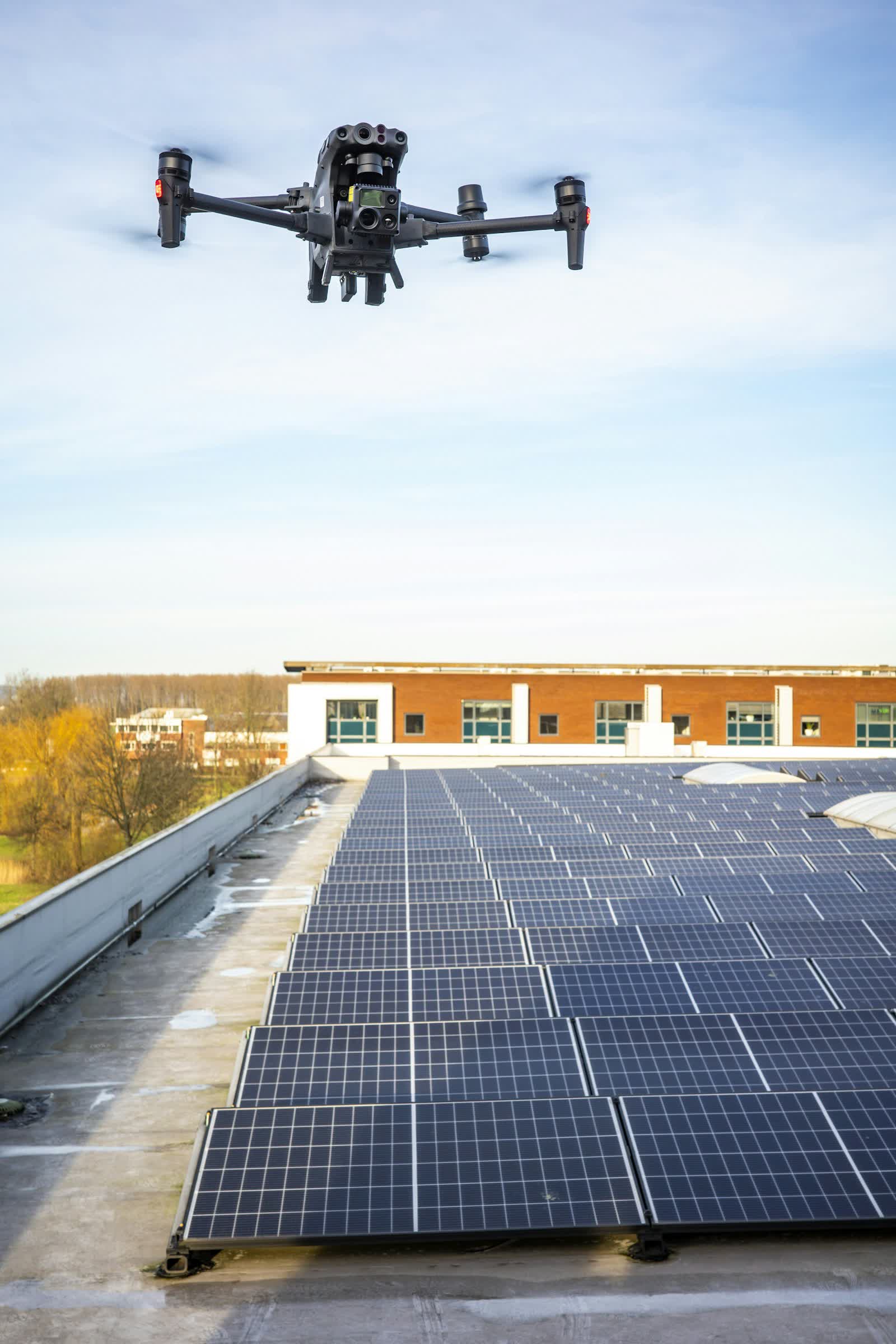
The photovoltaic barn has become a farming standard: thousands of holdings carry rooftop plants, often financed over twenty years by electricity sales. And a plant is only properly checked by aerial thermography: faulty cells and strings, hot spots at connectors, soiling eating into production — the protocols are those of our annual solar panel thermal inspection guide, and drone cleaning can follow on. For the farmer, coupling this check with the inspection of the adjoining roof in a single mission is the obvious economy.
Before a new project — new barn or overlay on existing roofs — the photogrammetric flight delivers exact roof areas, slopes and orientations and any shading (silos, trees, neighbouring buildings): the technical prerequisite described in our roof survey before solar panels guide, here with the fibre-cement structural question in the background.
Flying over a farm: simple, with a few reflexes
In rural areas the flight usually falls under the open category, far from restricted zones — the pilot still checks the aeronautical chart (rural hospital helipads, low-altitude military zones, agricultural airstrips). Livestock-specific reflexes concern the animals: no low pass over an outdoor herd without the farmer's agreement, take-off away from open buildings, quiet slots preferred (milking, feeding). Experience shows that inspection-height flights over roofs trigger no notable reaction from housed herds.
Around silos and storage facilities, the inspection extends naturally: stacks and capacities fall under the methods of our chimney and silo inspection guide, and thermal stock monitoring also applies to heat-sensitive fodder.
Prices observed in 2026
Ranges observed in 2026 (excl. VAT):
- Roof inspection of one livestock building (detailed photos, defect plan): €350 to €700, then €150 to €300 per additional building on the same site.
- Thermography option (ventilation, condensation, insulation): +€300 to €600 in suitable conditions.
- Rooftop photovoltaic plant check: €400 to €900 depending on capacity, often coupled with the roof inspection.
- Post-storm or hail record (fast mobilisation, dated report): €400 to €800 per site.
Machinery rings, producer groups and cooperatives pool usefully: a round of several neighbouring farms in one day cuts the per-site price by 20 to 40%. Request a quote stating the number of buildings, roof type and whether photovoltaics are fitted.
Put it into practice
- Drone aerial thermal imaging: rates and cities covered from €500
- Aerial thermal imaging in Bourges Centre-Val de Loire
- Aerial thermal imaging in Fréjus Provence-Alpes-Côte d'Azur
- Aerial thermal imaging in Saint-Quentin Hauts-de-France